Orthoceras
- 133
- 55
When shining a flashlight at particular LCD displays, an interesting interference pattern appears, consisting of parallel or concentric lines. It closely resembles Quetelet rings seen on dusty mirrors and glass panes. Quetelet rings are formed when light from a dust particle interferes with the light from its mirror image.
For example, when shining a flashlight at a digital whiteboard (brand Prowise), such a pattern appears. When moving the flashlight in circles around your eye or the camera lens, the pattern will rotate, without any preferred direction. If you move the flashlight laterally towards your eye or the camera lens, the distance between the interference maxima increases, as illustrated in this video (link). The digital whiteboard was clean, no dust on the glass, so the necessary condition for Quetelet rings seems to be missing.
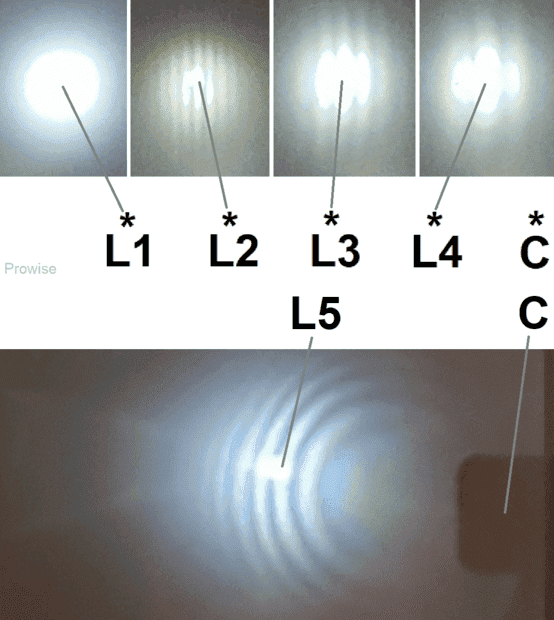
C is the position of the mirror image of the camera lens, Ln is the position of the mirror image of the flashlight. Top - camera and lamp equally remote from the screen: interference pattern consists of straight lines. Bottom - camera closer to monitor than lamp: interference pattern consists of concentric circles.I saw the same interference pattern on two laptops, Asus Vivobook Flip 14 and Lenovo Chromebook Ideapad Flex 5. Here too, any dust had been wiped off the screen, so that Quetelet rings were not to be expected.
In summary, two questions are:
1) is it right to call the interference pattern that appears on these LCD displays Quetelet rings?
2) how does this pattern arise at these screens? Which 'particles' have replaced the conventional dust particles? Google wasn't very helpful.
For example, when shining a flashlight at a digital whiteboard (brand Prowise), such a pattern appears. When moving the flashlight in circles around your eye or the camera lens, the pattern will rotate, without any preferred direction. If you move the flashlight laterally towards your eye or the camera lens, the distance between the interference maxima increases, as illustrated in this video (link). The digital whiteboard was clean, no dust on the glass, so the necessary condition for Quetelet rings seems to be missing.
C is the position of the mirror image of the camera lens, Ln is the position of the mirror image of the flashlight. Top - camera and lamp equally remote from the screen: interference pattern consists of straight lines. Bottom - camera closer to monitor than lamp: interference pattern consists of concentric circles.I saw the same interference pattern on two laptops, Asus Vivobook Flip 14 and Lenovo Chromebook Ideapad Flex 5. Here too, any dust had been wiped off the screen, so that Quetelet rings were not to be expected.
In summary, two questions are:
1) is it right to call the interference pattern that appears on these LCD displays Quetelet rings?
2) how does this pattern arise at these screens? Which 'particles' have replaced the conventional dust particles? Google wasn't very helpful.
Last edited: