Undergrad Quick brainteaser - Unknown objects and liquid volume/height

  • Thread starter Thread starter rwooduk
  • Start date Start date
  • Tags Tags
    Liquid
Click For Summary
The discussion revolves around a brainteaser involving three sealed boxes containing unknown objects, where participants can pour water in to measure liquid height changes. Key points include confusion over the definition of "sealed boxes" and whether water can enter a beaker inside the box. Participants discuss how to interpret the water level changes to identify the objects based on their volume and shape, noting that the behavior of the water level can indicate the size and type of object present. There are also considerations about floating objects affecting the measurement, with suggestions on how to quantify the observations. Ultimately, the exercise is seen as a fun demonstration for first-year students, despite challenges in quantifying the results.
rwooduk
Messages
757
Reaction score
59
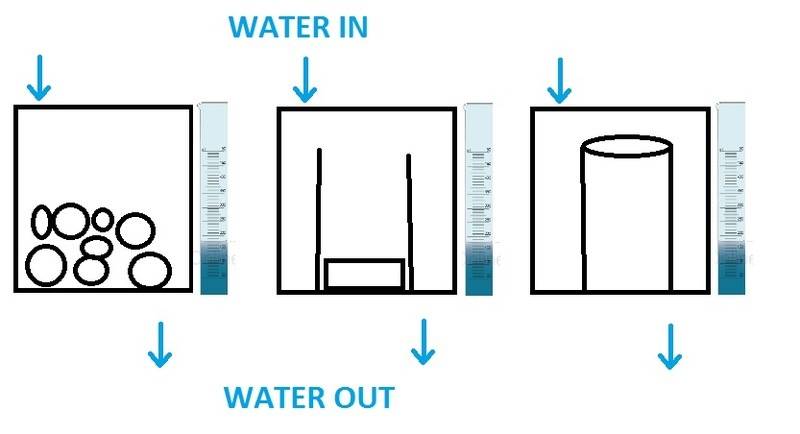
Hi, here's a quick brain teaser, if we have 3 objects in sealed boxes, we know what the objects could be: a solid metal cylinder, a metal sphere, mixed shape beads, a beaker with a metal object in it, a pyramid.

We can pour water into the boxes and measure the relative liquid height between boxes.

joQrMDA.jpg


So how would you determine which object was in each box?

Has anyone done this experiment before?
 
Last edited:
Physics news on Phys.org
rwooduk said:
if we have 3 objects in sealed boxes, we know what the objects could be: a solid metal cylinder, a metal sphere, mixed shape beads, a beaker with a metal object in it, a pyramid.
Hi rwooduk:
I am having some troubles with the brainteasers.
I am having a bit of counting trouble. I count 3 objects in the list, not 3.
I am having a bit of visualization trouble. When the water is poured into the box with the beaker, does the water get into the beaker?
I am having trouble with the sequence of events. Does water come out the bottom as soon as water goes into the top? If not, what is the delay? Is one to consider the changes with respect to time among the various water heights?​

Over all, I don't think I understand the problem statement well enough to know how to think about a solution.

Regards,
Buzz
 
me too have the trouble to understand.
 
What is the meaning of "sealed boxes" if you can pour water in them?
Can you give a ling to the original text of the problem?
 
Apologies for the late reply.

Buzz Bloom said:
Hi rwooduk:
I am having some troubles with the brainteasers.
I am having a bit of counting trouble. I count 3 objects in the list, not 3.
I am having a bit of visualization trouble. When the water is poured into the box with the beaker, does the water get into the beaker?
I am having trouble with the sequence of events. Does water come out the bottom as soon as water goes into the top? If not, what is the delay? Is one to consider the changes with respect to time among the various water heights?​

Over all, I don't think I understand the problem statement

Regards,
Buzz

1. the objects could be any shape, but there is a list of possibilities, the ones given were just a few examples
2. the water goes either outside or inside the beaker, the beaker could be anywhere in the box, under the water inlet or not
3. the tap at the bottom of the box is closed, and the volume of liquid measured changes as you fill the boxes. the water can be emptied at any point by opening the tap at the bottom.
4. Yes, I believe that is the theory, to watch the water level and how it behaves, for example if it rises quickly there is a large object in the box. If it rises slowly, there is a small object, if it doesn't rise at all until a certain point then it is going into a beaker first etc etc

I just wondered if there is a way to quantify this? i.e. knowing the equations for volume of the objects

Other than that I will have to simply have the students watch how the volume level of the water rises.

nasu said:
What is the meaning of "sealed boxes" if you can pour water in them?
Can you give a ling to the original text of the problem?

You can't see inside the boxes, they are metal and just have a water inlet and outlet taps.
Afraid I don't have one, I've been asked to demonstrate this thing and it seems pointless as nothing can be quantified! It's only for first year students, probably just for a bit of fun, but in my first year physics experiments we were doing errors, analysing lasers, magnetic fields etcetc everything was quantified and analysed.

Thanks for the replies.
 
  • Like
Likes Buzz Bloom
rwooduk said:
I just wondered if there is a way to quantify this?
You can compute the volume unoccupied by the objects for horizontal slices, which tells you how fast the water level rises at the height of each slice.

But there are tricky cases: The entire beaker interior belongs to the slice at the top of the beaker: Big slow down in level rise at this point, easy to spot.

I'm assuming the objects don't float.
 
A.T. said:
You can compute the volume unoccupied by the objects for horizontal slices, which tells you how fast the water level rises at the height of each slice.

But there are tricky cases: The entire beaker interior belongs to the slice at the top of the beaker: Big slow down in level rise at this point, easy to spot.

I'm assuming the objects don't float.

Good idea! Thanks for that.

Unfortunately there are some different sized hollow balls that do float.
 
rwooduk said:
Good idea! Thanks for that.

Unfortunately there are some different sized hollow balls that do float.
While all the objects inside float, the level rises at a constant rate that is equal to the fill rate. The offset between the filled in water volume, and what the level says is determined by the weight of the floating objects.

However there are transition phases at the begin (nor floating yet) and the end (ceiling contact). If you have too many objects, they might not float freely for long.
 
  • Like
Likes rwooduk
A.T. said:
While all the objects inside float, the level rises at a constant rate that is equal to the fill rate. The offset between the filled in water volume, and what the level says is determined by the weight of the floating objects.

However there are transition phases at the begin (nor floating yet) and the end (ceiling contact). If you have too many objects, they might not float freely for long.

Great, that really helps! Thanks again.
 

Similar threads

Replies
1
Views
52K
Replies
5
Views
3K
  • · Replies 1 ·
Replies
1
Views
3K
  • · Replies 3 ·
Replies
3
Views
9K
Replies
4
Views
6K
Replies
3
Views
2K
Replies
4
Views
2K
  • · Replies 6 ·
Replies
6
Views
6K
  • · Replies 2 ·
Replies
2
Views
3K