Quick question about resultant forces of tugboats

  • Thread starter Thread starter TomRiddle
  • Start date Start date
  • Tags Tags
    Forces Resultant
Join the discussion
Ask a follow-up here, or get your own question answered by working scientists, mathematicians and engineers — people, not an autocomplete.
Real named experts · corrections over time · the nuance an AI answer skips
3 replies · 3K views
TomRiddle
Messages
2
Reaction score
0
Member advised to use the homework template for posts in the homework sections of PF.
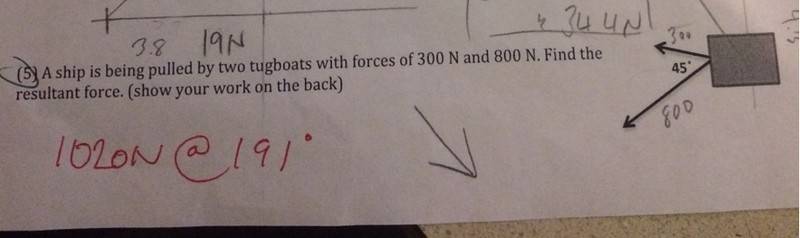
A ship is being pulled by tugboats with forces of 300 N and 800 N. The angle between the forces is 45 degrees.

My question is how can we find the angle between the force vectors and the x-axis? Would it just be 45/2 =22.5 degrees or would it be different because the forces have different magnitudes?
physics.jpg
 
on Phys.org
The two forces are 45deg to each other? No "x-axis" has been defined so you need to work out if you are free to pick any axis system you like.
The answer seems to suggest not... therefore: not enough information.
 
I would assume the x-axis to be the direction the tugboat is moving in. Or at least perpendicular to the left side of the rectangle representing the tugboat. Are you saying this problem is unsolvable?

I tried defining the x-axis as bisecting the 45 degree angle:
300cos157.5 + 800cos202.5 = -1016.27
300sin157.5 + 800sin202.5 = -191.34
arctan(191.34/1016.27) = 10.66 (rounding to 11 this does give me the 191 degree angle, matching the given answer)

But, the magnitude = sqrt(1016.27^2 + 191.34^2) = 1034.13 which is different from the provided answer
 
TomRiddle said:
I would assume the x-axis to be the direction the tugboat is moving in. Or at least perpendicular to the left side of the rectangle representing the tugboat.
How would you justify these assumptions?
Note: you are not told which direction the tugboat is moving in when the forces are applied - from the forces you can figure out which direction the acceleration is in, but only with respect to one of the forces. You are only told the direction of the forces wrt each other, not to anything else - like you are not told their direction wrt the front of the block representing the ship they are towing.

Are you saying this problem is unsolvable?
You have to define a coordinate system - you should be able to do that without using the provided answer.
The first step in your working has to state this definition ... ie. I would be inclined to add the vectors head-to-tail (sketch) and use the cosine and sine rules, being careful to label everything.

I tried defining the x-axis as bisecting the 45 degree angle:
300cos157.5 + 800cos202.5 = -1016.27
300sin157.5 + 800sin202.5 = -191.34
arctan(191.34/1016.27) = 10.66 (rounding to 11 this does give me the 191 degree angle, matching the given answer)
... yeah, it looks like the x-axis for the model answer is defined to be in the opposite direction to the initial orientation of the ship (assuming the tug boats are pulling from the bow) ie the +x direction is from bow to stern along the ship axis. But there is no reason to do this except maybe the convention that x is "to the right on the page". That is nonsense... but useful to remember if you have this same person set an exam in future.

But, the magnitude = sqrt(1016.27^2 + 191.34^2) = 1034.13 which is different from the provided answer
Try the head-to-tail approach w cosine rule, or define the x-axis as "pointing along the 800N force", to check your magnitude.