Ranking velocities of particles in uniform magnetic field

Click For Summary

Homework Help Overview

The discussion revolves around ranking the velocities of five equal-mass particles (A–E) entering a uniform magnetic field. The problem involves understanding the effects of the magnetic field on charged particles and their trajectories.

Discussion Character

  • Exploratory, Assumption checking

Approaches and Questions Raised

  • Participants discuss the relationship between the radius of the particles' trajectories and their velocities, questioning how the neutral particle (D) fits into the ranking. They explore the implications of assuming equal charge among the particles and the impact of charge on velocity.

Discussion Status

The conversation reflects uncertainty regarding the ranking of particles A, B, C, and E, with some participants suggesting that the problem cannot be definitively solved due to lack of information about the charges. Multiple interpretations of the problem are being explored.

Contextual Notes

Participants note that the problem lacks specific information about the charges of the particles, which is critical for determining their velocities accurately.

Linus Pauling
Messages
187
Reaction score
0
1. Five equal-mass particles (A–E) enter a region of uniform magnetic field directed into the page. They follow the trajectories illustrated in the figure.
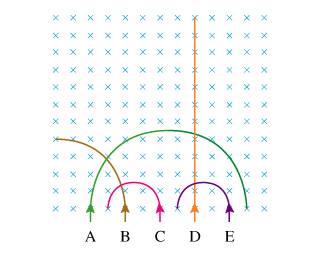
1011734.jpg


Rank from largest to smallest velocity


2. qvBsin(theta) = ma
qvB = ma = m(v^2/r)
v = qBr/m


3. Based on their radii, it should be A > B > C=E

But what about D? It is neutral, so has no radius because it doesn't go in a circle, but clearly has a velocity despite r = 0. Is the answer indeterminate, then?
 
Physics news on Phys.org
I think you're meant to assume that all particles have the same charge; otherwise, the problem would be unsolvable. So assuming they have the same charge, D appears to go straight because it's barely affected by the magnetic field. What does that tell you about its velocity?
 
The answer actually was that it couldn't be determined.

Now I am asked to rank the speeds largest to smallest of A, B, C, and E. I thought it was clearly A > B > C=E, but it is not and it tells me this:

The radius of the trajectory of a particle depends on more than just its speed. Be sure not to make assumptions about the relative magnitudes of the charges.

WTF?
 
Linus Pauling said:
v = qBr/m

The velocity depends on the charge, and you are not given any information about the charges. Therefore the problem is not solvable.
 
nvmm
 
Last edited:

Similar threads

  • · Replies 3 ·
Replies
3
Views
1K
  • · Replies 2 ·
Replies
2
Views
2K
  • · Replies 1 ·
Replies
1
Views
8K
Replies
3
Views
2K
Replies
11
Views
3K
  • · Replies 6 ·
Replies
6
Views
2K
  • · Replies 2 ·
Replies
2
Views
729
Replies
2
Views
3K
  • · Replies 31 ·
2
Replies
31
Views
2K
Replies
3
Views
2K