Ratio of total refelected intensity compared to incident intensity

Click For Summary
SUMMARY

The discussion focuses on calculating the ratio of total reflected intensity to incident intensity in a system involving multiple reflections. The formula derived is $$\frac{I_{total \: Reflection}}{I_{Incident}}=\frac{(n_2-n_1)^2}{(n_2+n_1)^2}(1+\frac{(4n_1n_2)^2}{(n_2+n_1)^2})*100$$, leading to a calculated value of approximately 7.84%. However, it is clarified that this value does not account for infinite reflections, which must be included for an accurate result. The correct approach involves recognizing the geometric series formed by the reflections, ultimately confirming that the total reflected intensity is approximately 7.7% of the incident intensity.

PREREQUISITES
  • Understanding of optical reflection and transmission coefficients
  • Familiarity with geometric series and their summation
  • Knowledge of Snell's Law and refractive indices
  • Basic proficiency in algebraic manipulation of equations
NEXT STEPS
  • Study the derivation of the reflection and transmission coefficients in optics
  • Learn how to sum geometric series and apply them in physical contexts
  • Explore the implications of multiple reflections in optical systems
  • Investigate the effects of varying refractive indices on reflection and transmission
USEFUL FOR

Students and professionals in optics, physicists analyzing light behavior at interfaces, and engineers designing optical systems who require a deep understanding of reflection and transmission phenomena.

Taylor_1989
Messages
400
Reaction score
14
Homework Statement
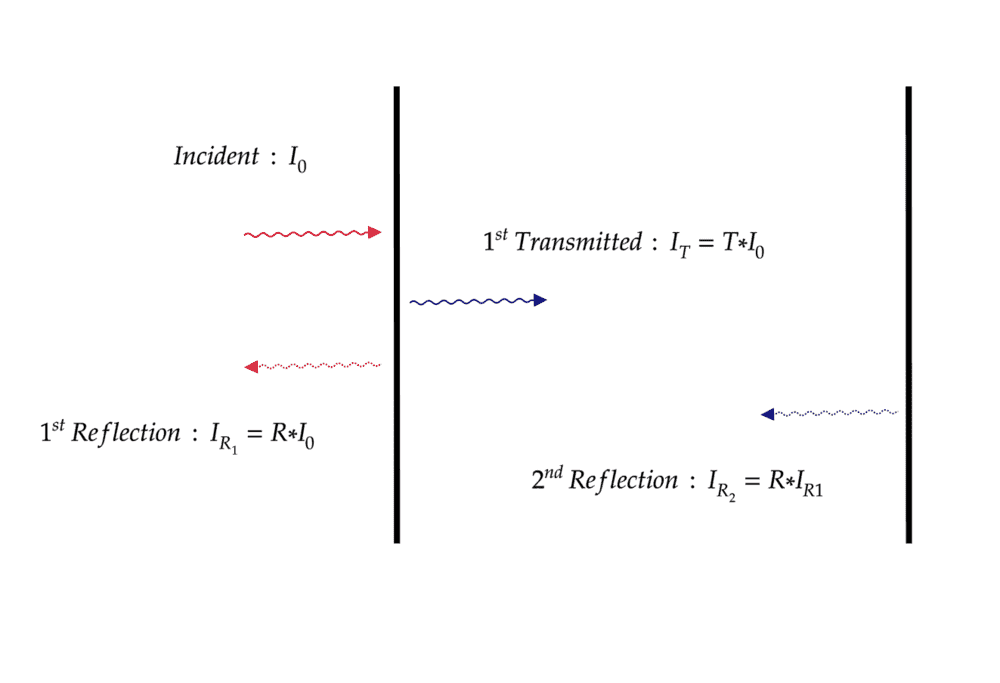
A plane electromagnetic wave is traveling in a vacuum in the positive Z direction and is normally incident on a planar glass of refractive index 1.50 and finite thickness. For normal incidence at a dielectric interface, the reflection and transmission coefficients of intensity are:

##R=\frac{(n_2-n_1)^2}{(n_2+n_1)^2}##

##T=\frac{(4n_1n_2)^2}{(n_2+n_1)^2}##

When the wave enters the glass plate it reflects from both the front and back surfaces of the interface. Considering these two contributions only, show that the total reflected intensity is approximately 7.7% of the incident intensity.
Relevant Equations
Contained within the question
Diagram
246763

Calculations as follows
$$\frac{I_{total \: Reflection}}{I_{Incident}}=\frac{I_{R_1}+I_{R_2}}{I_0}*100=\frac{R*I_0+(R*T)*I_0}{I_0}$$

Subbing in the relevant equations given in the question

$$\frac{I_{total \: Reflection}}{I_{Incident}}=\frac{(n_2-n_1)^2}{(n_2+n_1)^2}(1+\frac{(4n_1n_2)^2}{(n_2+n_1)^2})*100$$

Now by subbing in the numerical values into my above eqaution I get a percentage of ##7.84 \%## and the question states that it should be ##\approx 7.7%## thus I am not sure my working are correct but can't really understand why as there no other reflection that I can account for, I did think maybe it ment a reflection off the first mirror again but adding that into the above calculations I get ##8\%## which it larger than my original. Have I missed something in my calculation?
 
Physics news on Phys.org
Take a look at your expression for T. R+T=1 always
 
The transmission coefficient should be ##T=\dfrac{4n_1n_2}{(n_2+n_1)^2}##. There is no square term in the numerator, but that's not a problem here. With the correct ##T## I also got 7.8% which is approximately 7.7% of the incident intensity as the problem suggests. I see no problem with your answer other than fixing the typo.
 
kuruman said:
I see no problem with your answer other than fixing the typo.
This is not a complete and correct answer. The 2nd Reflection light is scattered at the original interface giving rise transmitted and 3rd reflection light and so on ad infinitum.
The good news is that the infinite sum you generate from this is easy to recognize and that leads to the easy solution
 
hutchphd said:
This is not a complete and correct answer. The 2nd Reflection light is scattered at the original interface giving rise transmitted and 3rd reflection light and so on ad infinitum.
The good news is that the infinite sum you generate from this is easy to recognize and that leads to the easy solution
Sure, you get a geometric series to add. However, the statement of the problem as posted says
Taylor_1989 said:
Considering these two contributions only, show that the total reflected intensity is approximately 7.7% of the incident intensity.
 
oops sorry. The full problem is much more fun!
 
hutchphd said:
oops sorry. The full problem is much more fun!
Yes.

Correction on Edit
In the reflected region,
1. the first reflection has intensity ##R##
2. the transmitted ray has intensity ##T##, upon reflection off the back surface it has intensity ##RT## and upon transmission through the front surface, it has intensity ##RT^2##.
I retract my confirmation in post #3.I made a mistake and my recalculated answer is not 7.84% with these considerations. I think that "approximately" in the statement of the problem does not mean "close to 7.7%" but "close to the answer that one gets when one considers all reflections off the back interface and not just one."
 
Last edited:
kuruman said:
Yes.

Correction on Edit
In the reflected region,
1. the first reflection has intensity ##R##
2. the transmitted ray has intensity ##T##, upon reflection off the back surface it has intensity ##RT## and upon transmission through the front surface, it has intensity ##RT^2##.
I retract my confirmation in post #3.I made a mistake and my recalculated answer is not 7.84% with these considerations. I think that "approximately" in the statement of the problem does not mean "close to 7.7%" but "close to the answer that one gets when one considers all reflections off the back interface and not just one."

Sorry but I am having a issue understanding, for your recalculation for total refection did you have the sum

$$R+RT+RT^2$$

Or did you form a geometric series which was mentioned in post #4.
 
Taylor_1989 said:
Sorry but I am having a issue understanding, for your recalculation for total refection did you have the sum

$$R+RT+RT^2$$

Or did you form a geometric series which was mentioned in post #4.
I had the sum ##R+RT^2##. My initial attempt did not correctly take into account the transmission through the front surface of the secondary reflections. Note that the secondary reflections must all have the same ##T^2## factor because they are all transmitted through the front boundary twice; they differ in the number of internal reflections which increases by two from one to the next starting with the first secondary reflection. Can you figure out the series?

On edit
It would be instructive to add the infinite series for the reflected and the transmitted part, add the two and see if the sum is 1. I did it and it is.
 
Last edited:
  • Like
Likes   Reactions: Taylor_1989

Similar threads

Replies
1
Views
2K
  • · Replies 1 ·
Replies
1
Views
1K
  • · Replies 1 ·
Replies
1
Views
962
Replies
2
Views
2K
  • · Replies 7 ·
Replies
7
Views
3K
  • · Replies 1 ·
Replies
1
Views
1K
Replies
8
Views
14K
  • · Replies 13 ·
Replies
13
Views
3K
  • · Replies 7 ·
Replies
7
Views
2K
  • · Replies 5 ·
Replies
5
Views
3K