Real Numbers & Sequences of Rationals .... Garling, Corollary 3.2.7 ....

Click For Summary
SUMMARY

This discussion focuses on understanding the proof of Corollary 3.2.7 from D. J. H. Garling's "A Course in Mathematical Analysis: Volume I: Foundations and Elementary Real Analysis." The corollary establishes that for any real number x, there exists a strictly increasing sequence of rational numbers (denoted as r_n) that converges to x, and a strictly decreasing sequence (s_n) that also converges to x. Participants clarify the recursive construction of these sequences, specifically the expressions max(x - 1/n, r_{n-1}) < r_n < x and x < s_n < min(x + 1/n, s_{n-1}), demonstrating the induction process involved in their proofs.

PREREQUISITES
  • Understanding of real analysis concepts, particularly sequences and limits.
  • Familiarity with induction proofs in mathematical analysis.
  • Knowledge of rational numbers and their properties in relation to real numbers.
  • Basic comprehension of the squeeze theorem in calculus.
NEXT STEPS
  • Study the details of induction proofs in mathematical analysis.
  • Explore the properties of convergent sequences in real analysis.
  • Learn about the squeeze theorem and its applications in proofs.
  • Review the construction and properties of rational numbers in relation to real numbers.
USEFUL FOR

Mathematics students, educators, and anyone interested in deepening their understanding of real analysis, particularly those studying sequences and convergence in the context of rational and real numbers.

Math Amateur
Gold Member
MHB
Messages
3,920
Reaction score
48
TL;DR
For any given real number x, there exists a strictly increasing sequence of rationals that converges to x as a limit ... same for a strictly decreasing sequence of rationals ...
I am reading D. J. H. Garling's book: "A Course in Mathematical Analysis: Volume I: Foundations and Elementary Real Analysis ... ...

I am focused on Chapter 3: Convergent Sequences ... ...

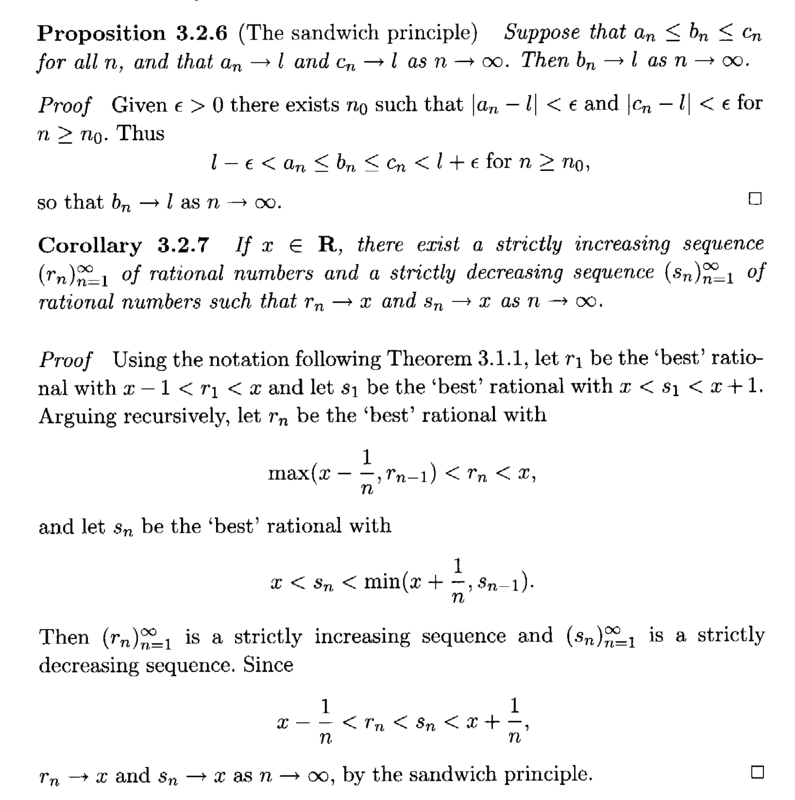
I need some help to fully understand the proof of Corollary 3.2.7 ...Garling's statement and proof of Corollary 3.2.7 (together with Proposition 3.2.6 which is mentioned in Corollary 3.2.7 ... ) reads as follows:
Garling - Corollary  3.2.7 ... and Proposition 3.2.6  ... .png


My questions related to the above Corollary are as follows:
Question 1

In the above proof of Corollary 3.2.7 we read the following:

" ... ... Arguing recursively, let ##r_n## be the 'best' rational with##\text{max} ( x - \frac{1}{n} , r_{ n - 1 } ) \lt r_n \lt x## ... ... "Can someone please explain (preferably in some detail) what is going on here ... how do we arrive at the expression

##\text{max} ( x - \frac{1}{n} , r_{ n - 1 } ) \lt r_n \lt x## ... ... ?Question 2

In the above proof of Corollary 3.2.7 we read the following:

" ... ... let ##s_n## be the 'best' rational with

##x \lt s_n \lt \text{min} ( x + \frac{1}{n}, s_{ n - 1 } )## ... ... "Can someone please explain (preferably in some detail) what is going on here ... how do we arrive at the expression

##x \lt s_n \lt \text{min} ( x + \frac{1}{n}, s_{ n - 1 } )## ... ... ?
Help will be appreciated ...

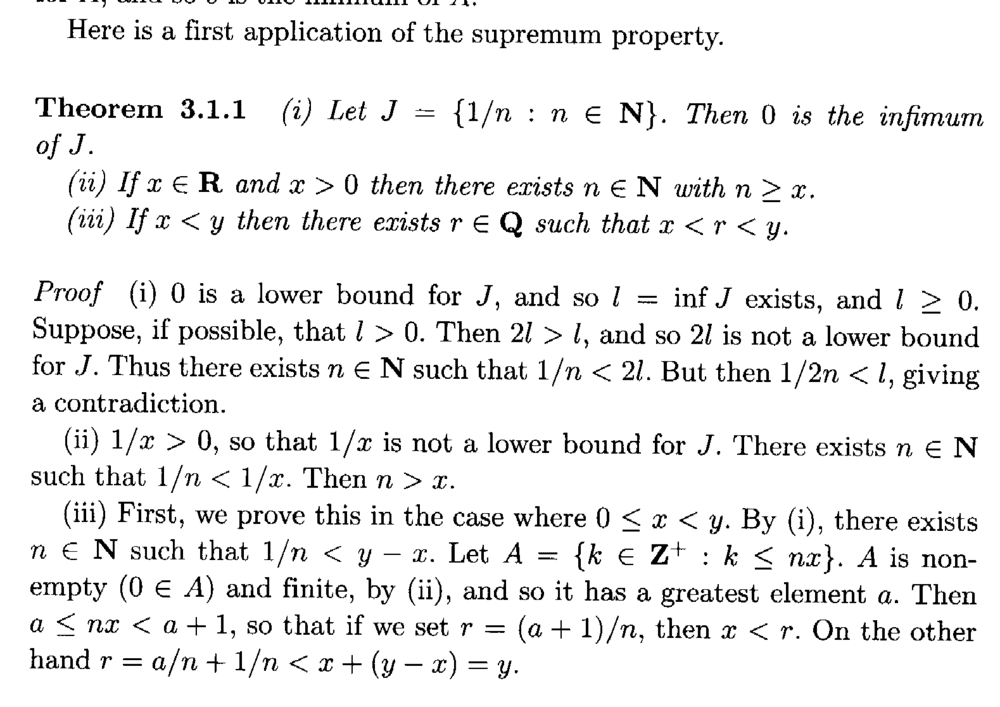
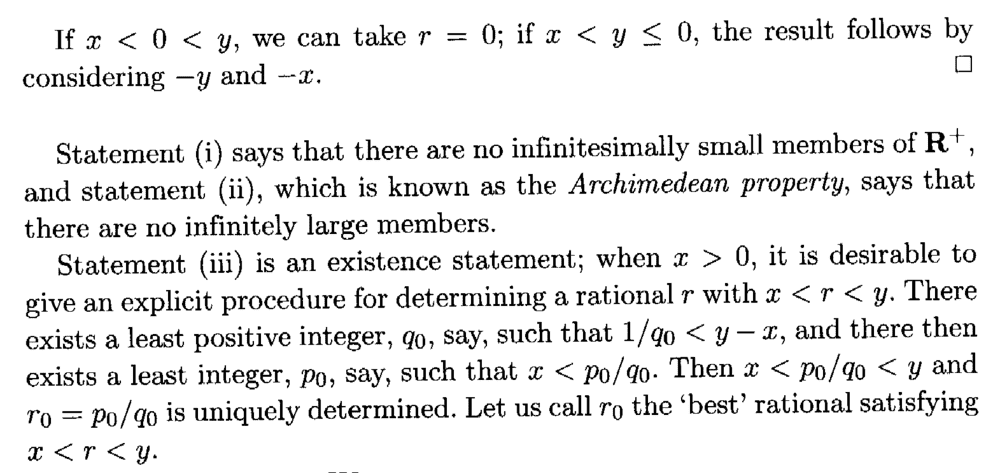
Peter==========================================================================================The post above mentions Theorem 3.1.1 and alludes to the remarks made after the proof of Theorem 3.1.1 ... so I am providing text of the theorem and the relevant remarks ... as follows:
Garling - 1 - Theorem 3.1.1 ...  ... PART 1 ... .png

Garling - 2 - Theorem 3.1.1 ...  ... PART 2 ... .png
Hope that helps ...

Peter
 
Physics news on Phys.org
This proof uses induction to construct sequences ##(s_n)_n, (r_n)_n##. To see what is really happening, just write out what happens when we jump from ##1## to ##2##. The following steps ##2\to 3, 3 \to 4, \dots## are just what the induction step makes formal.

So, we have ##x-1 < r_1 < x##. Then we have ##\max(x-1/1,r_1) < x## (because both ##r_1< x## and ##x-1/1 < x##, thus you can pick a 'best rational' ##r_2## with ##\max(x-1/2,r_1) < r_2 < x##.

Now, repeat this construction.

In my opinion, the induction could have been a lot clearer if the author has just added the sentence

Suppose ##r_1, \dots, r_{n-1}## are already constructed. And then proceed with the induction step.

Please let know if this answers your questions.
 
Hmmm ... will spend some time doing what you say ... but basically still struggling ...

Peter
 
Can you write out how the proof constructs ##r_3## given ##r_2##, as constructed in my post?
 
  • Like
Likes   Reactions: Math Amateur
Math Amateur said:
Summary: For any given real number x, there exists a strictly increasing sequence of rationals that converges to x as a limit ... same for a strictly decreasing sequence of rationals ...

I am reading D. J. H. Garling's book: "A Course in Mathematical Analysis: Volume I: Foundations and Elementary Real Analysis ... ...

I am focused on Chapter 3: Convergent Sequences ... ...

I need some help to fully understand the proof of Corollary 3.2.7 ...Garling's statement and proof of Corollary 3.2.7 (together with Proposition 3.2.6 which is mentioned in Corollary 3.2.7 ... ) reads as follows:View attachment 244240

My questions related to the above Corollary are as follows:
Question 1

In the above proof of Corollary 3.2.7 we read the following:

" ... ... Arguing recursively, let ##r_n## be the 'best' rational with##\text{max} ( x - \frac{1}{n} , r_{ n - 1 } ) \lt r_n \lt x## ... ... "Can someone please explain (preferably in some detail) what is going on here ... how do we arrive at the expression

##\text{max} ( x - \frac{1}{n} , r_{ n - 1 } ) \lt r_n \lt x## ... ... ?Question 2

In the above proof of Corollary 3.2.7 we read the following:

" ... ... let ##s_n## be the 'best' rational with

##x \lt s_n \lt \text{min} ( x + \frac{1}{n}, s_{ n - 1 } )## ... ... "Can someone please explain (preferably in some detail) what is going on here ... how do we arrive at the expression

##x \lt s_n \lt \text{min} ( x + \frac{1}{n}, s_{ n - 1 } )## ... ... ?
Help will be appreciated ...

Peter==========================================================================================The post above mentions Theorem 3.1.1 and alludes to the remarks made after the proof of Theorem 3.1.1 ... so I am providing text of the theorem and the relevant remarks ... as follows:
View attachment 244242
View attachment 244243Hope that helps ...

Peter
Math_QED said:
Can you write out how the proof constructs ##r_3## given ##r_2##, as constructed in my post?
Thanks Math_QED ... appreciate your help ...

I will try to show Garling's recursion process for n = 1, 2 and 3 ...For ##n = 1## we have ... ...

Let ##r_1## be the 'best' rational with ##x - 1 \lt r_1 \lt x##
For ##n = 2## we have ... ...

##x - \frac{1}{n} = x - \frac{1}{2} \lt x## ... ... and ... ... ##r_{ n - 1 } = r_1 \lt x## ... ...

and so ... ##\text{max} ( x - \frac{1}{2} , r_1 ) \lt x##

Therefore we can pick/construct a 'best' rational ##r_2## ...

... such that ... ##\text{max} ( x - \frac{1}{2} , r_1 ) \lt r_2 \lt x## ... ... ... ... ... NOTE: ##r_1 \lt r_2##
For ##n = 3## we have ... ...

##x - \frac{1}{n} = x - \frac{1}{3} \lt x## ... ... and ... ... ##r_{ n - 1 } = r_2 \lt x## ... ...

and so ... ##\text{max} ( x - \frac{1}{3} , r_2 ) \lt x##

Therefore we can pick/construct a 'best' rational ##r_3## ...

... such that ... ##\text{max} ( x - \frac{1}{3} , r_2 ) \lt r_3 \lt x## ... ... ... ... ... NOTE: ##r_1 \lt r_2 \lt r_3##
The above analysis indicates that ##(r_n)_{ n = 1}^\infty## is strictly increasing and bounded above by ##x## ...

... indeed ##\text{sup} \{ r_n \ : \ n \in \mathbb{N} \} = x## ...

... so ##r_n \longrightarrow x## as ##n \longrightarrow \infty## ...By a similar argument involving the infimum, ##s_n \longrightarrow x## as ##n \longrightarrow \infty## ...Is the above correct?

Peter
 
Math Amateur said:
Thanks Math_QED ... appreciate your help ...

I will try to show Garling's recursion process for n = 1, 2 and 3 ...For ##n = 1## we have ... ...

Let ##r_1## be the 'best' rational with ##x - 1 \lt r_1 \lt x##
For ##n = 2## we have ... ...

##x - \frac{1}{n} = x - \frac{1}{2} \lt x## ... ... and ... ... ##r_{ n - 1 } = r_1 \lt x## ... ...

and so ... ##\text{max} ( x - \frac{1}{2} , r_1 ) \lt x##

Therefore we can pick/construct a 'best' rational ##r_2## ...

... such that ... ##\text{max} ( x - \frac{1}{2} , r_1 ) \lt r_2 \lt x## ... ... ... ... ... NOTE: ##r_1 \lt r_2##
For ##n = 3## we have ... ...

##x - \frac{1}{n} = x - \frac{1}{3} \lt x## ... ... and ... ... ##r_{ n - 1 } = r_2 \lt x## ... ...

and so ... ##\text{max} ( x - \frac{1}{3} , r_2 ) \lt x##

Therefore we can pick/construct a 'best' rational ##r_3## ...

... such that ... ##\text{max} ( x - \frac{1}{3} , r_2 ) \lt r_3 \lt x## ... ... ... ... ... NOTE: ##r_1 \lt r_2 \lt r_3##
The above analysis indicates that ##(r_n)_{ n = 1}^\infty## is strictly increasing and bounded above by ##x## ...

... indeed ##\text{sup} \{ r_n \ : \ n \in \mathbb{N} \} = x## ...

... so ##r_n \longrightarrow x## as ##n \longrightarrow \infty## ...By a similar argument involving the infimum, ##s_n \longrightarrow x## as ##n \longrightarrow \infty## ...Is the above correct?

Peter

Yes, well done! I see that you understand well what's happening now.

This is key if you don't understand what in induction process does. Write it out for the first couple of steps! It becomes often very obvious what is happening.
 
  • Like
Likes   Reactions: Math Amateur
Math Amateur said:
Summary: For any given real number x, there exists a strictly increasing sequence of rationals that converges to x as a limit ... same for a strictly decreasing sequence of rationals ...

I am reading D. J. H. Garling's book: "A Course in Mathematical Analysis: Volume I: Foundations and Elementary Real Analysis ... ...

I am focused on Chapter 3: Convergent Sequences ... ...

I need some help to fully understand the proof of Corollary 3.2.7 ...Garling's statement and proof of Corollary 3.2.7 (together with Proposition 3.2.6 which is mentioned in Corollary 3.2.7 ... ) reads as follows:View attachment 244240

My questions related to the above Corollary are as follows:
Question 1

In the above proof of Corollary 3.2.7 we read the following:

" ... ... Arguing recursively, let ##r_n## be the 'best' rational with##\text{max} ( x - \frac{1}{n} , r_{ n - 1 } ) \lt r_n \lt x## ... ... "Can someone please explain (preferably in some detail) what is going on here ... how do we arrive at the expression

##\text{max} ( x - \frac{1}{n} , r_{ n - 1 } ) \lt r_n \lt x## ... ... ?Question 2

In the above proof of Corollary 3.2.7 we read the following:

" ... ... let ##s_n## be the 'best' rational with

##x \lt s_n \lt \text{min} ( x + \frac{1}{n}, s_{ n - 1 } )## ... ... "Can someone please explain (preferably in some detail) what is going on here ... how do we arrive at the expression

##x \lt s_n \lt \text{min} ( x + \frac{1}{n}, s_{ n - 1 } )## ... ... ?
Help will be appreciated ...

Peter==========================================================================================The post above mentions Theorem 3.1.1 and alludes to the remarks made after the proof of Theorem 3.1.1 ... so I am providing text of the theorem and the relevant remarks ... as follows:
View attachment 244242
View attachment 244243Hope that helps ...

Peter
Math_QED said:
Yes, well done! I see that you understand well what's happening now.

This is key if you don't understand what in induction process does. Write it out for the first couple of steps! It becomes often very obvious what is happening.
Thanks again Math_QED

Peter
 
Math Amateur said:
Thanks Math_QED ... appreciate your help ...

I will try to show Garling's recursion process for n = 1, 2 and 3 ...For ##n = 1## we have ... ...

Let ##r_1## be the 'best' rational with ##x - 1 \lt r_1 \lt x##
For ##n = 2## we have ... ...

##x - \frac{1}{n} = x - \frac{1}{2} \lt x## ... ... and ... ... ##r_{ n - 1 } = r_1 \lt x## ... ...

and so ... ##\text{max} ( x - \frac{1}{2} , r_1 ) \lt x##

Therefore we can pick/construct a 'best' rational ##r_2## ...

... such that ... ##\text{max} ( x - \frac{1}{2} , r_1 ) \lt r_2 \lt x## ... ... ... ... ... NOTE: ##r_1 \lt r_2##
For ##n = 3## we have ... ...

##x - \frac{1}{n} = x - \frac{1}{3} \lt x## ... ... and ... ... ##r_{ n - 1 } = r_2 \lt x## ... ...

and so ... ##\text{max} ( x - \frac{1}{3} , r_2 ) \lt x##

Therefore we can pick/construct a 'best' rational ##r_3## ...

... such that ... ##\text{max} ( x - \frac{1}{3} , r_2 ) \lt r_3 \lt x## ... ... ... ... ... NOTE: ##r_1 \lt r_2 \lt r_3##
The above analysis indicates that ##(r_n)_{ n = 1}^\infty## is strictly increasing and bounded above by ##x## ...

... indeed ##\text{sup} \{ r_n \ : \ n \in \mathbb{N} \} = x## ...

... so ##r_n \longrightarrow x## as ##n \longrightarrow \infty## ...By a similar argument involving the infimum, ##s_n \longrightarrow x## as ##n \longrightarrow \infty## ...Is the above correct?

Peter

Well, maybe one more remark: the convergence of the two sequences follows from the squeeze theorem (as in the proof of author), but what you wrote is correct as well.
 
  • Like
Likes   Reactions: Math Amateur

Similar threads

Replies
2
Views
2K
  • · Replies 6 ·
Replies
6
Views
2K
  • · Replies 4 ·
Replies
4
Views
2K
  • · Replies 2 ·
Replies
2
Views
1K
Replies
2
Views
1K
  • · Replies 2 ·
Replies
2
Views
2K
  • · Replies 2 ·
Replies
2
Views
2K
  • · Replies 3 ·
Replies
3
Views
3K
  • · Replies 5 ·
Replies
5
Views
2K
  • · Replies 4 ·
Replies
4
Views
2K