Real World Physics and my Wheels

Click For Summary

Discussion Overview

The discussion revolves around the physics of wheel spacers in the context of a 1939 Chevy HotRod build. Participants explore the implications of different wheel offsets on the forces experienced by lug studs and suspension components, considering both theoretical and practical aspects of vehicle dynamics.

Discussion Character

  • Exploratory
  • Technical explanation
  • Debate/contested

Main Points Raised

  • One participant questions whether there is a difference in force on lug studs between a -47mm offset and 0 or +10mm offsets, noting that all forces remain in the same location regardless of the offset.
  • Another participant asserts that using wheel spacers increases the risk of fatigue in components due to greater leverage and torque applied to suspension parts.
  • A different viewpoint emphasizes that while the net force on the vehicle remains unchanged, the component forces contributing to that net force are greater with spacers, leading to increased wear on suspension components.
  • Some participants argue that the centerline of the wheel remains unchanged across different offsets, raising questions about the overall effect on the system.
  • One participant acknowledges a misunderstanding of the scenario and concedes to the previous argument regarding the implications of wheel spacers.

Areas of Agreement / Disagreement

Participants express differing views on the effects of wheel spacers, with some emphasizing increased stress on components and others questioning the significance of offset changes. The discussion remains unresolved, with no consensus reached on the implications of using spacers.

Contextual Notes

Participants highlight the importance of considering the specific use case of the vehicle, noting that a hot-rod may experience different wear patterns compared to a daily driver. There is also mention of potential limitations in understanding the full impact of the changes without further empirical data.

cDuck28Z
Messages
2
Reaction score
0
Good evening,

First Post here on PhysicsForums! I'm building myself a 1939 Chevy HotRod and have encountered a slight problem with my build. I'm trying to find a wheel that will fit my project, but the problem is that they don't make it! There are numerous forums online with people both for and against wheel spacers, but I want to know the physics behind these little devices. The concept is simple: add a spacer between your wheel hub and the mounting surface of your wheel.

I'm trying to figure out if there is actually any difference in force on my lug studs (green) between having a -47mm offset or a 0 or +10mm offset. On one hand, I look at it an think 'Of course there's going to be more force, the wheel is so much further away from the hub'. On the other hand however, all of the forces of the vehicle, both while at rest and while driving, are located in the exact same location in all three scenarios. So would there actually be a difference?!

Please note, my diagram is off just a bit with regards to the lug studs. The holes are offset (see example image below) so there is more than enough metal to transfer the force of the vehicle.

PS. My hotrod will weigh an estimated 1400kg with aprox 850kg over the front wheels. Aprox 1.37m track (center point to center point of front tires) and 2.84m wheelbase.
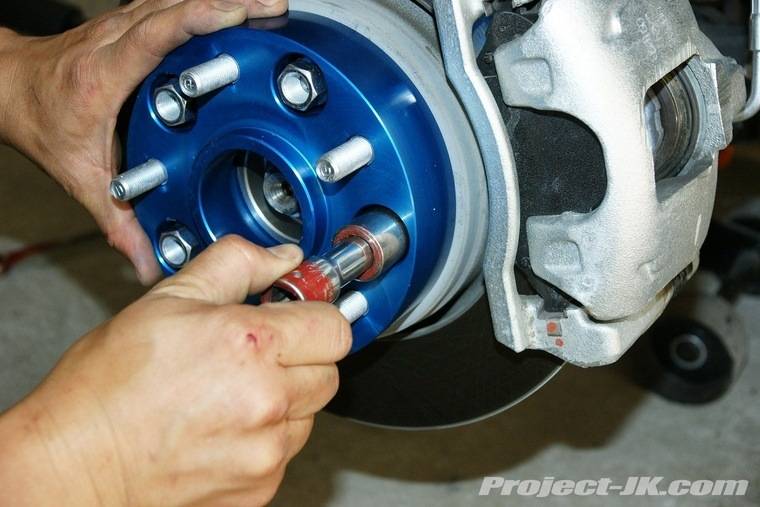
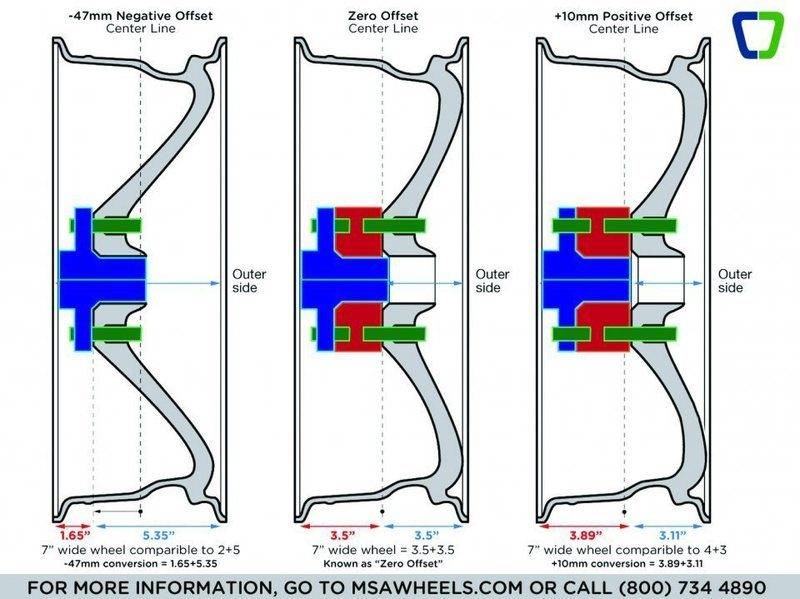
Wheel Spacer Example.jpg
Wheel Spacer Diagram.jpg
 
Physics news on Phys.org
There is s difference, it means the components are more prone to fatigue.
Generally you need to keep a closer eye on them than normal.
 
By spacing the wheel out you are creating more leverage against the suspension components, and therefore, applying more torque to them. suspension components apply a proportionally greater torque holding the wheel down against the ground, so the net force on the car remains the same, but the component forces that add up to that net force are greater, thus, the wear on the components is greater.

I doubt this will be of much concern on a hot-rod that is likely to be a fair weather weekend cruiser. You can tolerate a little sloppier engineering on a car that sees 1000 miles a year then a daily driver that sees 10,000 miles a year.
 
mrspeedybob said:
By spacing the wheel out you are creating more leverage against the suspension components, and therefore, applying more torque to them.

The centerline wheel is in the exact same position in every scenario. No part of the system is moving at all. The only change is that the offset that would be comprised of the negative offset of the wheel is replaced with a spacer filling the void and adapting the wheel to the positive offset creating a net 0 change in position. So how would this effect the entire system as a whole?
 
Last edited:
cDuck28Z said:
The centerline wheel is in the exact same position in every scenario. No part of the system is moving at all. The only change is that the offset that would be comprised of the negative offset of the wheel is replaced with a spacer filling the void and adapting the wheel to the positive offset creating a net 0 change in position. So how would this effect the entire system as a whole?

Ok, I mis-understood the scenario. In that case, you are right.
 

Similar threads

  • · Replies 21 ·
Replies
21
Views
3K
  • · Replies 8 ·
Replies
8
Views
6K
  • · Replies 25 ·
Replies
25
Views
42K
  • · Replies 6 ·
Replies
6
Views
32K
Replies
31
Views
3K
  • · Replies 5 ·
Replies
5
Views
3K
  • · Replies 4 ·
Replies
4
Views
5K
  • · Replies 7 ·
Replies
7
Views
3K
  • · Replies 1 ·
Replies
1
Views
4K
  • · Replies 2 ·
Replies
2
Views
12K