Real world problem, with KE problem

  • Context: Undergrad 
  • Thread starter Thread starter WhiteHawk
  • Start date Start date
  • Tags Tags
    Car accident Real world
Click For Summary

Discussion Overview

The discussion revolves around a real-world problem involving a car collision with a boulder, focusing on the kinetic energy and momentum involved in the impact. Participants explore the scenario to understand the velocities and forces at play, as well as the implications of the accident.

Discussion Character

  • Exploratory
  • Technical explanation
  • Debate/contested
  • Mathematical reasoning

Main Points Raised

  • One participant estimates the velocity of Object A (the car) at impact to be around 124 mph but expresses uncertainty about this figure, suggesting potential oversight in their calculations.
  • Another participant questions the assumption that the boulder has the same mass as the car, suggesting it may be lighter based on its description.
  • A comparison is made to a cue ball striking a stationary ball on a pool table, with a note that the conservation of momentum could be applicable to the collision scenario.
  • Further elaboration on the boulder's size and weight is provided, with an estimate of 1.5-2 tons, and a description of the energy transfer during the collision, including the distances moved by both objects.
  • One participant expresses skepticism about the feasibility of any calculations providing accurate results, questioning the purpose of the inquiry and whether it relates to negligence.

Areas of Agreement / Disagreement

Participants do not reach a consensus on the mass of the boulder or the accuracy of the initial velocity estimate. There are competing views regarding the applicability of conservation of momentum and the realism of the calculations based on the described scenario.

Contextual Notes

There are limitations in the assumptions made regarding the masses of the objects and the conditions of the collision. The discussion reflects uncertainties in the calculations and the physical properties of the objects involved.

WhiteHawk
Messages
10
Reaction score
0
What forum should I post this in, my friend died in a horrible car accident, some of us just want more answers I guess...

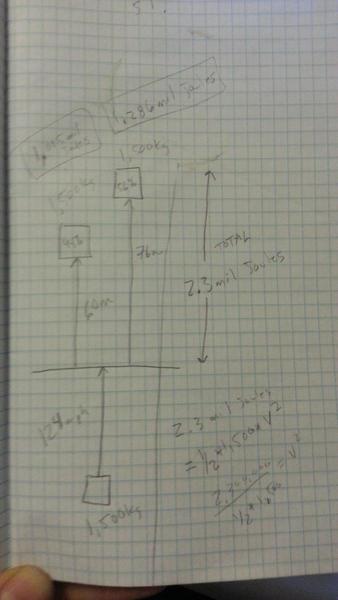
Object A is in straight line motion
Object B is static

Object A impacts Object B

Object A moves straight forward 60 m and rests
Object B moves straight forward 76 m and rests

Object A has a mass of 1,500 kg
Object B has a mass of 1,500 kg

What was the velocity of Object A when it impacted Object B?

To account for some rolling resistances, Object A was a car that rolled and tore up large patches of sod, Object B was a rectangular boulder that rolled ~20 times. I guesstimated 124 mph (see below), but I can't believe it (I feel like I missed a bunch of things or didn't draw the problem right).
vqFfUJs.jpg
 
Physics news on Phys.org
Are you sure the boulder is the same weight as the car. from your description it seems it is lighter.

On a pool table, when the cue ball strikes a stationary ball, the cue ball stops and the stationary ball continues with the same velocity unless the cue ball has some additional spin. In your case, after the collision both objects are moving forward.

I think you can solve it via conservation of momentum.
 
Last edited:
jedishrfu said:
Are you sure the boulder is the same weight as the car. from your description it seems it is lighter.

On a pool table, when the cue ball strikes a stationary ball, the cue ball stops and the stationary ball continues with the same velocity unless the cue ball has some additional spin. In your case, after the collision both objects are moving forward.

The boulder is about the volume of a fluffy lazy boy chair (minus the back). My landscape friend estimated that weighed 1.5-2 tons. Imagine literally, a car running directly into this boulder, transferring enough energy to launch the rock 62 meters (I just measured my stride, 737 mm x 84 strides), and keep enough energy to move / drag / roll the car 45 meters. I don't even know why I am doing this, I guess this is what a nerd does when his friend dies.
 
WhiteHawk said:
The boulder is about the volume of a fluffy lazy boy chair (minus the back). My landscape friend estimated that weighed 1.5-2 tons. Imagine literally, a car running directly into this boulder, transferring enough energy to launch the rock 62 meters (I just measured my stride, 737 mm x 84 strides), and keep enough energy to move / drag / roll the car 45 meters. I don't even know why I am doing this, I guess this is what a nerd does when his friend dies.

What answer do you hope to get from this? I'm thinking that any calculation will be far off from reality. Are you trying to determine speed? is there some negligence involved?
 

Similar threads

  • · Replies 1 ·
Replies
1
Views
1K
  • · Replies 1 ·
Replies
1
Views
2K
  • · Replies 8 ·
Replies
8
Views
3K
  • · Replies 7 ·
Replies
7
Views
2K
  • · Replies 3 ·
Replies
3
Views
6K
  • · Replies 2 ·
Replies
2
Views
2K
  • · Replies 1 ·
Replies
1
Views
2K
  • · Replies 5 ·
Replies
5
Views
3K
  • · Replies 15 ·
Replies
15
Views
5K
  • · Replies 1 ·
Replies
1
Views
1K