Discussion Overview
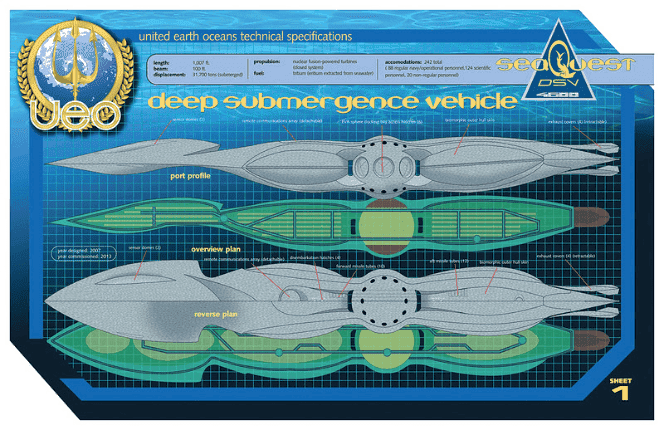
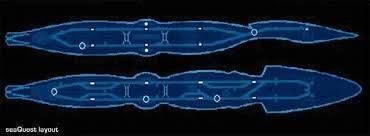
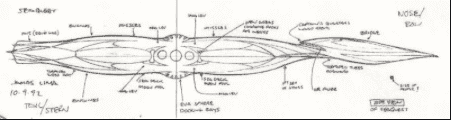
The discussion revolves around the realism of the Seaquest DSV submarine design in comparison to actual submarine designs. Participants explore various aspects of the design, including structural integrity, hydrodynamics, and aesthetic considerations, while questioning how these elements align with real-world engineering principles.
Discussion Character
- Exploratory
- Technical explanation
- Debate/contested
Main Points Raised
- Some participants express concerns that the presence of windows in the Seaquest DSV design could represent structural weaknesses, suggesting that flat surfaces would require significant internal reinforcement.
- Others argue that deviations from traditional shapes, such as spheres or cylinders, could increase drag due to turbulent flow, with specific mention of the design's central bulb as a potential issue.
- There is a discussion about the implications of the submarine's shape on drag and lift, with some questioning the assertion that the design is sleek.
- Some participants note that real-life submersibles, including those that descend into extreme depths, do utilize windows, indicating that this feature may not be as problematic as suggested.
- A participant mentions that deep ocean vehicles often have a spherical pressure hull surrounded by an outer hull designed for better hydrodynamic performance.
- There is a viewpoint that the Seaquest DSV should be regarded more as a piece of art rather than a practical submarine design.
Areas of Agreement / Disagreement
Participants exhibit a mix of agreement and disagreement regarding the design's realism. While some acknowledge the artistic nature of the Seaquest DSV, others contest its practicality based on engineering principles, leading to multiple competing views on the subject.
Contextual Notes
Participants highlight various assumptions about hydrodynamics and structural integrity without reaching a consensus on the implications of these factors for the Seaquest DSV design.

 So, there is a logical reason as to why real-life submarines are designed as cigar-like or teardrop-shape tubes, eh?