Really Simple PSPICE simulation, need somebody to double check me

  • Thread starter Thread starter audifanatic51
  • Start date Start date
  • Tags Tags
    Pspice Simulation
Click For Summary
The discussion focuses on simulating the I-V characteristics of a D1N4002 diode for an electronics lab prelab. The user encounters an issue where the simulation results appear linear instead of showing the expected exponential increase after the turn-on voltage. Suggestions include adjusting the DC sweep from 0 to 0.8 volts in smaller increments of 0.01 volts to better capture the diode's behavior. This adjustment is recommended because the current becomes excessively high above 1 volt, causing the characteristic curve to be obscured. Properly configuring the simulation parameters is essential for accurate results.
audifanatic51
Messages
10
Reaction score
0
Hi,

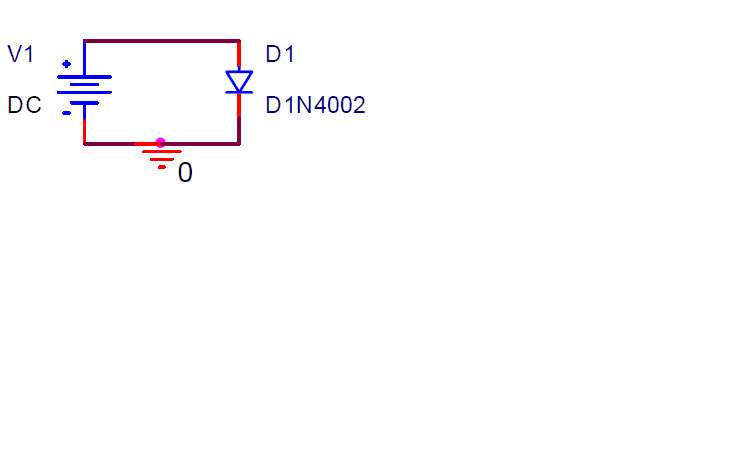
I am working on a prelab for my electronics laboratory course. It's really simple (or at least should be. Basically he wants us to simulate the I-V characteristics of a D1N4002 diode. There is no resistor in the circuit we are to simulate (basically we're shorting it if you consider the resistance of the diode negligible). The circuit is below:
29uvgjo.png


My problem is that whenever I simulate it, I get something that looks rather linear rather than exponentially increasing after the turn-on voltage like it should. I am doing a DC sweep from 0 to 5V with .1 increment and linear scale. No clue what I'm doing wrong here. Thanks
 
Engineering news on Phys.org
Try sweeping from 0 to 0.8 volts and in steps of 0.01 volts.

The program will try to fit the data onto the graph and because the current gets enormous above 1 volt, the curve of the diode characteristic, as it turns on, gets lost.
 
Thread 'I thought it was only Amazon that sold unsafe junk'
I grabbed an under cabinet LED light today at a big box store. Nothing special. 18 inches in length and made to plug several lights together. Here is a pic of the power cord: The drawing on the box led me to believe that it would accept a standard IEC cord which surprised me. But it's a variation of it. I didn't try it, but I would assume you could plug a standard IEC cord into this and have a double male cord AKA suicide cord. And to boot, it's likely going to reverse the hot and...

Similar threads

  • · Replies 4 ·
Replies
4
Views
2K
  • · Replies 9 ·
Replies
9
Views
17K
  • · Replies 6 ·
Replies
6
Views
2K
  • · Replies 3 ·
Replies
3
Views
2K
  • · Replies 18 ·
Replies
18
Views
4K
  • · Replies 25 ·
Replies
25
Views
8K
  • · Replies 3 ·
Replies
3
Views
2K
  • · Replies 7 ·
Replies
7
Views
2K
  • · Replies 4 ·
Replies
4
Views
4K
  • · Replies 1 ·
Replies
1
Views
4K