Really simple, system in equilibrium (weight and tension in light string)

Join the discussion
Registration is free. Ask a follow-up in this thread, or start your own.
3 replies · 7K views
furor celtica
Messages
69
Reaction score
0
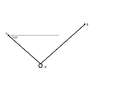
A small smooth ring R of mass 0.1 kg is threaded on a light string. The ends of the string are fastened to two fixed points A and B. The ring hangs in equilibrium with the part AR of the string inclined at 40° to the horizontal, as shown in the diagram. Show that the part RB of the string is also inclined at 40° to the horizontal and find the tension in the string.

I have no difficulties with the second question, namely finding the tension in the string, but although it seems obvious to me that RB should be inclined at 40° to the horizontal, I’m at a loss to prove why in the most coherent way possible. I would be grateful for an outline on how to prove this concisely and effectively. Cheers
 

Attachments

  • diagram.png
    diagram.png
    1.4 KB · Views: 150
Physics news on Phys.org
The tension in the string (or more precisely the magnitude $T$ of the tensional force) has to be the same all the way along the string. So the forces on the ring are as follows:
a force of magnitude $T$ in the direction RA,
a force of magnitude $T$ in the direction RB,
the weight of the ring, in a vertical direction.
Now resolve those forces horizontally.
 
furorceltica said:
A small smooth ring R of mass 0.1 kg is threaded on a light string. The ends of the string are fastened to two fixed points A and B. The ring hangs in equilibrium with the part AR of the string inclined at 40° to the horizontal, as shown in the diagram. Show that the part RB of the string is also inclined at 40° to the horizontal and find the tension in the string.

I have no difficulties with the second question, namely finding the tension in the string, but although it seems obvious to me that RB should be inclined at 40° to the horizontal, I’m at a loss to prove why in the most coherent way possible. I would be grateful for an outline on how to prove this concisely and effectively. Cheers

If rhe two parts of the string were at different angles their horizontal components would not be equql qnd we would not have equlibrium.
 
Specifically, the horizontal component of the force on the left is Tcos(40) (T is the tension in the cable) to the left. The horizontal component of the force on the right is [tex]Tcos(\theta)[/tex] to the right. Since the object does not move left or right those two components must be the same: [tex]Tcos(40)= Tcos(\theta)[/tex]. Dividing both sides by T, [tex]cos(40)= cos(\theta)[/tex] and since [tex]\theta[/tex] is clearly les than 90 degrees, [tex]\theta= 40[/tex].

Now the vertical component of force on the left is Tsin(40) upwad and the vertical component of force on the right is [tex]Tsin(\theta)[/tex], also upward. Since the object does not move up or down, those two must add to the weight, mg, which is g here.
Because [tex]\theta= 40[/itex], sin(\theta)+ Tsin(40)= 2Tsin(40)= -g[/tex] and you can solve that for T.