Received power for free space optics

Click For Summary
SUMMARY

The discussion focuses on calculating received power for Free Space Optics (FSO) using a specific equation involving system loss (Lsystem), transmitted power (PTx), and receiver parameters. The user calculated a received power of 10.72 dBm, which contradicts the principle that received power must be lower than transmitted power. The error arises from the beam not illuminating the entire receiver area, specifically when the divergence angle (θ) is less than the receiver diameter (d2R), which falls outside the formula's applicability range. The conversation highlights the need for clarity in applying the Friis transmission equation to FSO scenarios.

PREREQUISITES
  • Understanding of Free Space Optics (FSO) principles
  • Familiarity with the Friis transmission equation
  • Knowledge of optical parameters such as divergence angle (θ) and receiver diameter (d2R)
  • Basic concepts of system loss (Lsystem) in optical communications
NEXT STEPS
  • Research the applicability range of the Friis transmission equation in FSO contexts
  • Learn about optical beam propagation and its effects on receiver performance
  • Investigate methods to optimize receiver area illumination in FSO systems
  • Explore advanced topics in optical communication, including path loss and antenna gains
USEFUL FOR

Optical engineers, telecommunications professionals, and researchers involved in Free Space Optics and optical communication systems will benefit from this discussion.

Nur Ziadah
Messages
34
Reaction score
3
Hello everyone,

I have calculated the received power for free space optic (FSO) using the equation:

upload_2019-1-6_16-35-28.png

Lsystem (system loss) is set to 8dB. PTotal can be calculated as:

upload_2019-1-6_16-36-9.png

where Ntx (number of receiver) = 1 and PTx (transmitted power) =7.78 dBm. LGeo can be calculated as:

upload_2019-1-6_16-44-0.png

upload_2019-1-6_16-44-21.png

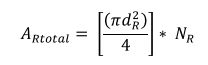
where d2R (receiver diameter) = 0.07, l=1, θ (divergence angle) =0.05 and Nr (number of receiver) =1.

The problem is, I got received power=10.72 dBm which is illogical value. As I know, the received power must be lower than transmitted power.
I hope that anyone may help me to understand this situation.
For your information, I refer this paper for the calculation: https://ieeexplore.ieee.org/document/6015903
Thank you.
 

Attachments

  • upload_2019-1-6_16-35-28.png
    upload_2019-1-6_16-35-28.png
    898 bytes · Views: 746
  • upload_2019-1-6_16-36-9.png
    upload_2019-1-6_16-36-9.png
    1 KB · Views: 767
  • upload_2019-1-6_16-36-56.png
    upload_2019-1-6_16-36-56.png
    1.3 KB · Views: 395
  • upload_2019-1-6_16-44-0.png
    upload_2019-1-6_16-44-0.png
    1.4 KB · Views: 571
  • upload_2019-1-6_16-44-21.png
    upload_2019-1-6_16-44-21.png
    1 KB · Views: 532
Science news on Phys.org
You have above the θl<d2R, which is outside of the formula applicability range.
Your beam is not illuminating the entire receiver area, therefore the error.
 
  • Like
Likes   Reactions: tech99
trurle said:
You have above the θl<d2R, which is outside of the formula applicability range.
Your beam is not illuminating the entire receiver area, therefore the error.
What is the applicable range?
 
Nur Ziadah said:
What is the applicable range?
Range (all values) of input variables producing a valid output.
 
You mean that θl must greater than d2R in order to produce a valid output?
 
  • Like
Likes   Reactions: tech99 and trurle
trurle said:
You have above the θl<d2R, which is outside of the formula applicability range.
Your beam is not illuminating the entire receiver area, therefore the error.
I am find that optical engineers seem to re-invent the wheel all the time; we have the simple Friis formula for microwave. This uses Ptx, Prx, antenna gains and path loss. The method used above seems very unclear to me. But I am impressed that you noticed that we do not have far field conditions.
 

Similar threads

  • · Replies 3 ·
Replies
3
Views
3K
Replies
4
Views
3K
  • · Replies 3 ·
Replies
3
Views
4K
  • · Replies 7 ·
Replies
7
Views
4K
  • · Replies 7 ·
Replies
7
Views
3K
  • · Replies 12 ·
Replies
12
Views
11K