SUMMARY
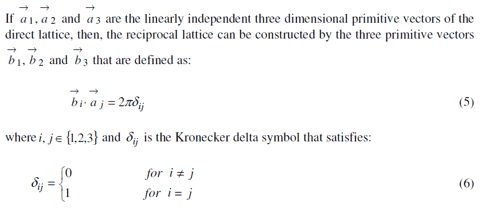
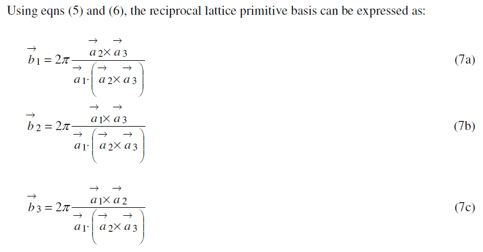
The discussion focuses on deriving the reciprocal lattice basis vectors \( b_i \) from the equations \( a_i \) using linear independence and orthogonality principles. Specifically, it highlights that the equations \( b_i \cdot a_j = 2\pi \delta_{ij} \) provide unique solutions for \( b_i \). The derivation process involves expressing \( b_1 \) as \( c_1 (a_2 \times a_3) \) and solving for the constant \( c_1 \) using the equation \( a_1 \cdot b_1 = 2\pi \). This method ensures that the derived vectors satisfy the necessary conditions for reciprocal lattice vectors.
PREREQUISITES
- Understanding of vector algebra and linear independence
- Familiarity with cross product operations in three-dimensional space
- Knowledge of reciprocal lattice concepts in crystallography
- Basic grasp of delta functions and their applications in physics
NEXT STEPS
- Study the derivation of reciprocal lattice vectors in more detail
- Learn about the properties of orthogonal vectors in vector spaces
- Explore applications of reciprocal lattices in solid-state physics
- Investigate the role of delta functions in quantum mechanics and crystallography
USEFUL FOR
Students and researchers in physics, particularly those focusing on crystallography, solid-state physics, and materials science, will benefit from this discussion. It is also valuable for anyone looking to deepen their understanding of reciprocal lattice concepts and their derivation.