Rectangle optimization - possible text error

Click For Summary
SUMMARY

The discussion centers on a potential error in a textbook regarding the optimization of a rectangle's perimeter and area. The original equation provided, $$ P(x) = x + \frac{440}{x}$$, should be corrected to $$ P(x) = 2x + \frac{440}{x}$$ to accurately reflect the relationship between length and width. Participants confirm that maximizing area for a given perimeter results in a square, emphasizing that a square is a specific type of rectangle. The correct dimensions for the maximum area are Length = Width = sqrt(220) cm.

PREREQUISITES
  • Understanding of calculus concepts, particularly optimization.
  • Familiarity with perimeter and area formulas for rectangles.
  • Basic knowledge of algebraic manipulation of equations.
  • Awareness of geometric definitions, specifically the properties of squares and rectangles.
NEXT STEPS
  • Review calculus optimization techniques for functions.
  • Study the properties of geometric shapes, focusing on rectangles and squares.
  • Learn about error detection in mathematical texts and how to approach authors for clarifications.
  • Explore advanced topics in mathematical modeling related to area and perimeter optimization.
USEFUL FOR

Students studying calculus, mathematics educators, and anyone involved in mathematical problem-solving or textbook review processes.

quicksilver123
Messages
173
Reaction score
0
Hi,
I may have discovered a textbook error but I'm no calc whiz. I need an assist to find out if the question unintentionally described a square instead of a rectangle.
I have attached the textbooks solution as well as my attempt at a solution.
The numbers check out, I just want to make sure before I submit a request for review to the author (my prof). Of course there's always the potential that he's just trying to be a tricky guy.
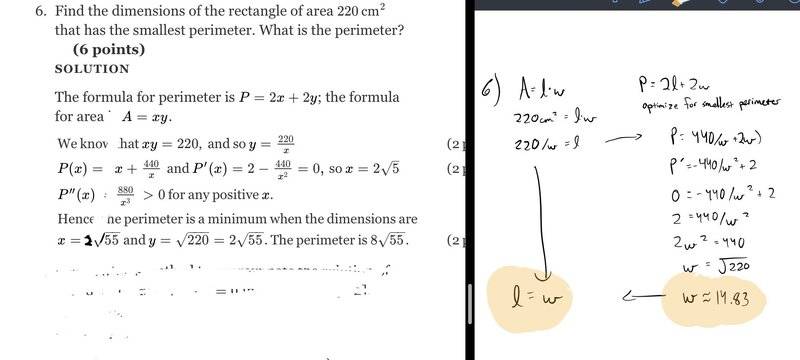
IMG_2067.jpg
 
Physics news on Phys.org
quicksilver123 said:
Hi,
I may have discovered a textbook error but I'm no calc whiz. I need an assist to find out if the question unintentionally described a square instead of a rectangle.
I have attached the textbooks solution as well as my attempt at a solution.
The numbers check out, I just want to make sure before I submit a request for review to the author (my prof). Of course there's always the potential that he's just trying to be a tricky guy.View attachment 207796

The book's equation
$$ P(x) = x + \frac{440}{x}$$
should be
$$ P(x) = 2x + \frac{440}{x}$$
 
A square IS a rectangle; a rectangle with all sides of equal length.
 
  • Like
Likes   Reactions: scottdave and quicksilver123
Anyone confirm that the answer I got is correct?
 
Yes there was a typo in the middle (x should have been 2x), but they apparently carried it through to get the correct answer. One thing to notice about this problem @quicksilver123 is that if you have a rectangle, and you want to maximize area for a given perimeter, the result will be a square. Or if you want to minimize perimeter for a given area, it essentially the same problem, and the result is a square.
 
quicksilver123 said:
Anyone confirm that the answer I got is correct?
Yes Length = Width = sqrt(220) cm. Always remember the units.
 
scottdave said:
there was a typo in the middle (x should have been 2x)
I don't think it was a typo. There is a band of erasure running near-vertically through several lines of text. It wipes out the portions in bold below:

for area is A=xy
We know that xy
P(x) = 2 x
P''(x) =
 

Similar threads

Replies
1
Views
2K
  • · Replies 1 ·
Replies
1
Views
4K
  • · Replies 2 ·
Replies
2
Views
2K
Replies
2
Views
3K
  • · Replies 65 ·
3
Replies
65
Views
8K
Replies
7
Views
8K
  • · Replies 8 ·
Replies
8
Views
2K
  • · Replies 15 ·
Replies
15
Views
4K
  • · Replies 2 ·
Replies
2
Views
3K
  • · Replies 9 ·
Replies
9
Views
2K