Rectified Current Through an Inductor

Click For Summary
SUMMARY

The discussion focuses on calculating the magnetomotive force (mmf) of an inductor in a circuit powered by a 24 VAC supply, rectified using a full-wave rectifier with four diodes. The key equations discussed include the peak voltage calculation (Vo = Vgrid * Sqrt(2) - 2 * Vpn) and the RMS average current through the inductor (Io = Vrms / Ro). The conversation highlights the importance of considering both the load resistance (Rload) and the inductor resistance (Rind = 47 Ohms) when determining the total output resistance (Ro). Additionally, the impact of inductance on the current waveform and the need for harmonic analysis is emphasized.

PREREQUISITES
  • Understanding of AC and DC circuit principles
  • Familiarity with full-wave rectification and diode operation
  • Knowledge of inductance and its effects on current
  • Ability to calculate RMS values and peak voltages
NEXT STEPS
  • Research "RMS calculations for non-sinusoidal waveforms"
  • Study "Inductor reactance and harmonic analysis"
  • Learn about "Diode forward voltage drop in rectifier circuits"
  • Explore "Magnetomotive force (mmf) calculations in inductors"
USEFUL FOR

Electrical engineers, students studying power electronics, and anyone involved in designing or analyzing circuits with inductors and rectifiers.

akaf244
Messages
2
Reaction score
0
TL;DR
rectified current through inductor
Hello, I need to find the magnetomotive force (mmf) of an inductor using NI (turns multiplied by amperes). The set up is pretty simple, AC power supply set at 24 VAC goes through a full wave rectifier (4 diodes) and into an inductor. If the inductor has a resistance of 47 Ohms, it looks like this (ignore Ls and Rs)...
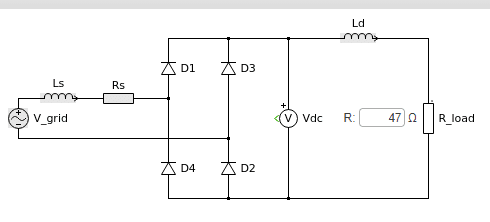
1566253695957.png


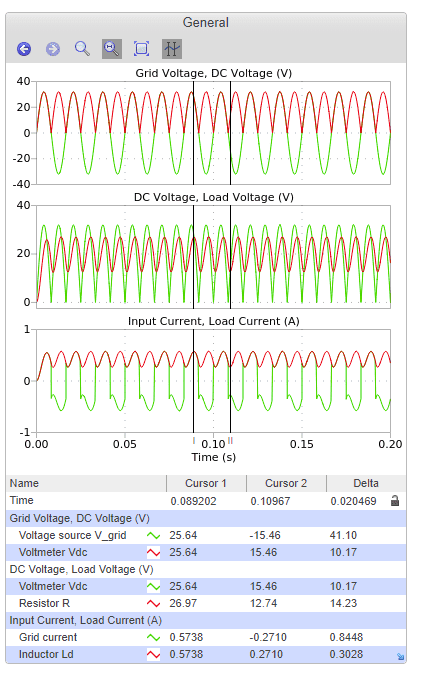
I have spent a few hours and a lot of different equations trying to figure out the current flowing through the inductor. I know it will look something like this...
1566253779948.png

but can anyone explain to me how they are graphing the current??

Thank you! (screenshots from: https://www.plexim.com/academy/power-electronics/diode-rect-ind-load )
 
Engineering news on Phys.org
Welcome to PF.
The Vgrid, 24 VAC, will have a peak voltage of Vgrid * Sqrt( 2 ).
Two bridge diodes need to conduct and will have a forward voltage of say, Vpn each.
The rectified output voltage will peak at; Vo = ( Vgrid * Sqrt( 2 )) - ( 2 * Vpn ).
The rectified waveform is close to a sine so the RMS value will be; Vrms = Vo / sqrt( 2 ).
The inductor will phase shift the DC current in proportion to the inductance.
The total output resistance will be; Ro = Rload + Rind.
The RMS average current through the inductor will be; Io = Vrms / Ro.
 
Hello, thank you for the response. How can I find Rload and Rind now? Shouldnt i be using Z? (Z=sqrt(R^2+(wL)^2)).Thank you.
 
Last edited:
Your question is unclear. Are you trying to find average RMS values or instantaneous values as a function of time?

If RMS, be aware that the sqrt(2) applies only for sinusoidal waveforms. This case in non-sinusoidal waveforms.
 
akaf244 said:
Hello, thank you for the response. How can I find Rload and Rind now?
You have specified resistance of the inductor as; Rind = 47 ohms.
You must identify the load resistance; maybe the box there with 47 ohms is for the load?

akaf244 said:
Shouldnt i be using Z? (Z=sqrt(R^2+(wL)^2)).Thank you.
The rectified waveform no longer has a fundamental sinewave, so in the frequency spectrum it has 2'nd and higher even harmonics of the original fundamental. The reactance of the inductor cannot be specified as a single value, it must be evaluated for each harmonic.

The current is not a single AC sinewave, it is a DC current with even harmonic ripple. The ripple is an inverse function of the inductance. You will need to consider Vind = L * di/dt. Consider the extremes; If the inductance was zero, the current would be resistive and follow the voltage without delay. If the inductance was infinite the current would be pure DC, with the average RMS value.

All components must be specified before real waveforms can be simulated. You have not specified those values because they were not provided by your reference.
 

Similar threads

  • · Replies 10 ·
Replies
10
Views
4K
Replies
23
Views
6K
  • · Replies 12 ·
Replies
12
Views
7K
  • · Replies 7 ·
Replies
7
Views
5K
Replies
12
Views
2K
  • · Replies 9 ·
Replies
9
Views
4K
Replies
1
Views
3K
  • · Replies 3 ·
Replies
3
Views
2K
  • · Replies 3 ·
Replies
3
Views
3K
  • · Replies 5 ·
Replies
5
Views
2K