Refraction Angle: Find the Answer to Your Question

  • Thread starter Thread starter StudentofPhysics
  • Start date Start date
  • Tags Tags
    Angle
Click For Summary
SUMMARY

The discussion focuses on calculating the angle of refraction for a ray of light passing from glass (n = 1.52) into liquid carbon disulfide (n = 1.63) at an incident angle of 46.0°. The correct approach involves using Snell's Law: n1 sin(θ1) = n2 sin(θ2). The initial calculation yielded an incorrect angle of 50.48°, which was clarified as the angle within the glass. The correct angle of refraction when transitioning to the liquid is determined to be 39.52° after subtracting from 90°.

PREREQUISITES
  • Understanding of Snell's Law in optics
  • Familiarity with refractive indices of materials
  • Basic trigonometry for angle calculations
  • Knowledge of light behavior at interfaces between different media
NEXT STEPS
  • Study Snell's Law applications in various materials
  • Learn about total internal reflection and its conditions
  • Explore advanced optics concepts such as lens design
  • Investigate the effects of wavelength on refraction
USEFUL FOR

Students in physics, optical engineers, and anyone interested in understanding light behavior at material interfaces will benefit from this discussion.

StudentofPhysics
Messages
65
Reaction score
0
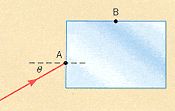
The drawing shows a rectangular block of glass (n = 1.52) surrounded by liquid carbon disulfide (n = 1.63). A ray of light is incident on the glass at point A with a = 46.0° angle of incidence. At what angle of refraction does the ray leave the glass at point B?
p26-20alt.gif


I know to use n1 sin 01 = n2 sin 02 (0 = theta)

i came up with 50.48 degrees, which was wrong. Then I figured since it was traveling back out of the block, maybe i should keep going and solve for that angle, which just cam out to be 46 degrees, also wrong.

What am I doing wrong?
 
Physics news on Phys.org
StudentofPhysics said:
i came up with 50.48 degrees, which was wrong. Then I figured since it was traveling back out of the block, maybe i should keep going and solve for that angle, which just cam out to be 46 degrees, also wrong.

50.48° is the angle at which the ray emerges in the block. It then continues its course and hits the surface block-liquid at the angle 90° - 50.48° = 39.52° (draw a little square-triangle to see it). Then you got to run another n1 sin 01 = n2 sin 02 to find the angle 02 at which the ray emerges in the liquid. But this time, of course, the index "1" refers to the glass and the index "2" refers to the liquid.
 
Thank you. I forget to subtract 50.48 from 90 before continuing on.
Got it now though.
 

Similar threads

  • · Replies 1 ·
Replies
1
Views
3K
  • · Replies 1 ·
Replies
1
Views
2K
  • · Replies 1 ·
Replies
1
Views
2K
  • · Replies 7 ·
Replies
7
Views
3K
  • · Replies 11 ·
Replies
11
Views
7K
  • · Replies 6 ·
Replies
6
Views
5K
  • · Replies 8 ·
Replies
8
Views
5K
  • · Replies 5 ·
Replies
5
Views
2K
  • · Replies 4 ·
Replies
4
Views
3K
  • · Replies 1 ·
Replies
1
Views
9K