Relative velocity during a race?

Click For Summary

Homework Help Overview

The discussion revolves around a physics problem involving relative velocity during a race between two individuals, Mia and Brandi, in an airport setting. The problem includes various components such as constant speeds, a moving sidewalk, and the distances covered by each participant during the race.

Discussion Character

  • Mixed

Approaches and Questions Raised

  • Participants explore the distances between Mia and Brandi at different points in the race, particularly when Mia reaches the turnaround point and when Brandi reaches hers. There are discussions about the numerical accuracy of the answers provided and suggestions to solve the problem algebraically rather than plugging in numbers too early.

Discussion Status

Some participants have provided feedback on the clarity of the original poster's work and have pointed out potential errors in calculations for parts B and C. There is ongoing exploration of how the distances change as the race progresses, with some participants questioning the assumptions made regarding the velocities and the time taken for each segment of the race.

Contextual Notes

Participants note that the problem specifies the velocities and distances involved, which are critical for solving the problem accurately. There is also mention of the challenge posed by the original poster's presentation of their work, which may hinder effective assistance.

Sagrebella
Messages
61
Reaction score
2
Hello,

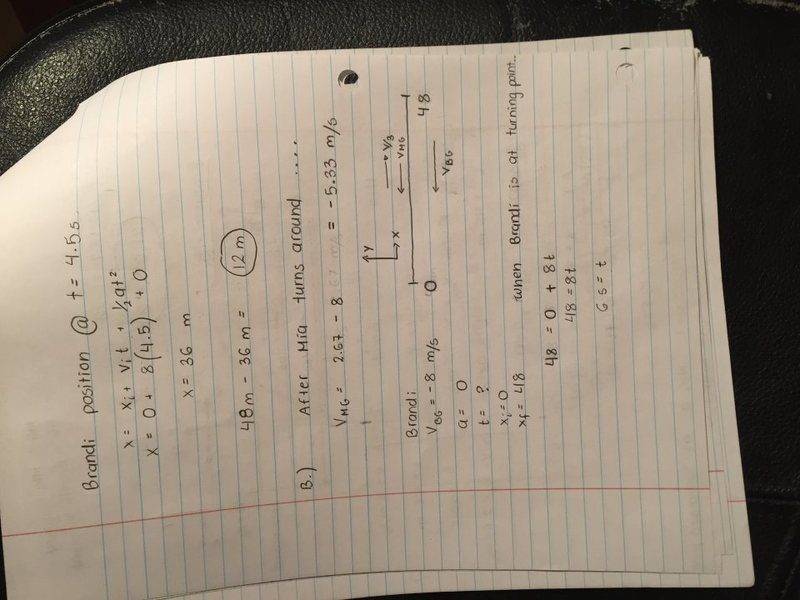
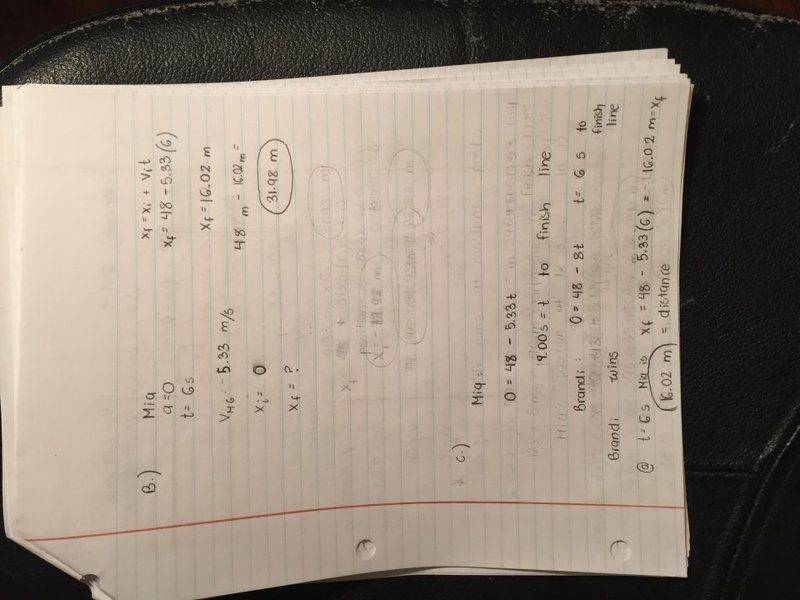
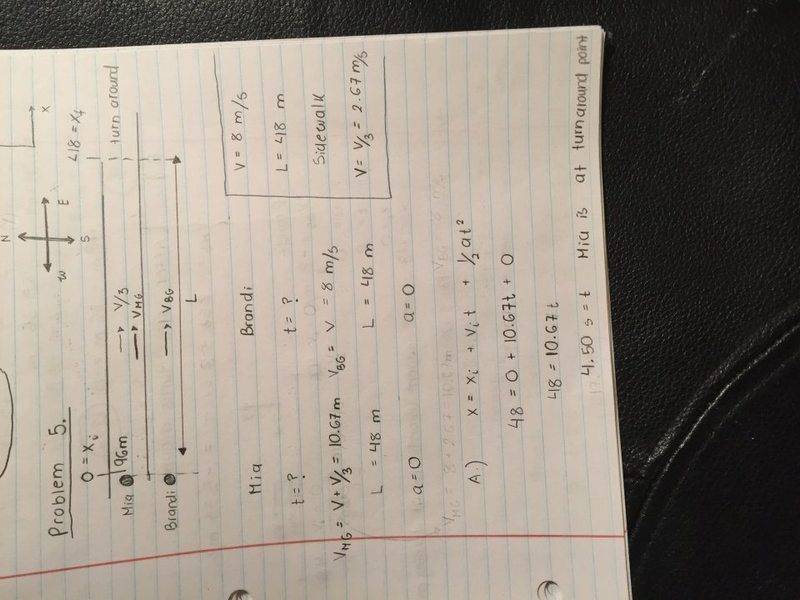
could someone please check my answer for this problem. All of my work and equations are clearly presented in the picture attached below. (If my answer is wrong, please give me pointers on how I could obtain the correct solution).

Thanks!

Problem 5:

On their way to play soccer in the World Cup, Mia and Brandi get stranded at O'Hare Airport in Chicago because of bad weather. Late at night, with nobody else around, they decide to have a race to see who is faster. They run down to a particular point, then turn around and return to their starting point. That race turns out to be a tie. They race again, this time with Mia running on a moving sidewalk. They start at the same time, run east at top speed a distance L through the airport terminal, and then turn around and run west back to the starting point. Brandi runs at a constant speed v, while Mia runs on a moving sidewalk that travels at a constant speed of v/3. Mia runs at a constant speed v relative to the moving sidewalk. Neglect the time it takes the women to turn around at the halfway point. Let's say that v = 8.00 m/s and L = 48.0 m.

(a) Mia reaches the turnaround point first, because she starts off running on the moving sidewalk in the direction the sidewalk is moving. What is the distance between the two women when Mia is at the turnaround point?

(b) After Mia turns around, she is running opposite to the direction the moving sidewalk is moving. What is the distance between the two women when Brandi is at the turnaround point?

(c) What is the distance between the two women when the winner of the race reaches the finish line?
IMG_3079.JPG
IMG_3080.JPG
IMG_3081.JPG
 
Physics news on Phys.org
Just as a suggestion, if you are going to ask people for help, it's a really bad idea to make it hard for them to GIVE you help. Why would you post your work sideways so it's necessary to get a neck cramp to look at it?
 
Sagrebella said:
Hello,

could someone please check my answer for this problem. All of my work and equations are clearly presented in the picture attached below. (If my answer is wrong, please give me pointers on how I could obtain the correct solution).

Thanks!

Problem 5:

On their way to play soccer in the World Cup, Mia and Brandi get stranded at O'Hare Airport in Chicago because of bad weather. Late at night, with nobody else around, they decide to have a race to see who is faster. They run down to a particular point, then turn around and return to their starting point. That race turns out to be a tie. They race again, this time with Mia running on a moving sidewalk. They start at the same time, run east at top speed a distance L through the airport terminal, and then turn around and run west back to the starting point. Brandi runs at a constant speed v, while Mia runs on a moving sidewalk that travels at a constant speed of v/3. Mia runs at a constant speed v relative to the moving sidewalk. Neglect the time it takes the women to turn around at the halfway point. Let's say that v = 8.00 m/s and L = 48.0 m.

(a) Mia reaches the turnaround point first, because she starts off running on the moving sidewalk in the direction the sidewalk is moving. What is the distance between the two women when Mia is at the turnaround point?

(b) After Mia turns around, she is running opposite to the direction the moving sidewalk is moving. What is the distance between the two women when Brandi is at the turnaround point?

(c) What is the distance between the two women when the winner of the race reaches the finish line?View attachment 113093 View attachment 113094 View attachment 113095
Part A looks fine. Part B and C are wrong numerically, unless I made a calculation error (Brandi does indeed win).

Also, your work is hard to follow. Not because it's sideways, but because you're complicating it by plugging numbers in too soon. Did the problem specify the velocity and distance by the way? You should be able to solve this algebraically pretty easily.

For part B, how much further does Mia run in the time it takes Brandi to reach the turn around point? Check your work.
 
phinds said:
Just as a suggestion, if you are going to ask people for help, it's a really bad idea to make it hard for them to GIVE you help. Why would you post your work sideways so it's necessary to get a neck cramp to look at it?

IMG_3079.jpg
IMG_3080.jpg
IMG_3081.jpg
 
phinds said:
Just as a suggestion, if you are going to ask people for help, it's a really bad idea to make it hard for them to GIVE you help. Why would you post your work sideways so it's necessary to get a neck cramp to look at it?

sorry about that, I posted my pictures again.
 
Student100 said:
Part A looks fine. Part B and C are wrong numerically, unless I made a calculation error (Brandi does indeed win).

Also, your work is hard to follow. Not because it's sideways, but because you're complicating it by plugging numbers in too soon. Did the problem specify the velocity and distance by the way? You should be able to solve this algebraically pretty easily.

For part B, how much further does Mia run in the time it takes Brandi to reach the turn around point? Check your work.

Hello; thanks for trying to help me even though my work was sideways! :smile: I uploaded the pictures again. Would you mind taking a look at it just one more time.
Yes, the problem does specify the velocity and distance. The length of one part of the race is 48 m, and the velocity v is 8 m/s. The moving sidewalk travels at v/3.

IMG_3079.jpg
IMG_3080.jpg
IMG_3081.jpg
 
B and C are still wrong, did you recheck?
 
Student100 said:
B and C are still wrong, did you recheck?

Yes, now I rechecked.
For B) I got 8 meters
but for C) I still got 16.02 meters
 
Sagrebella said:
Yes, now I rechecked.
For B) I got 8 meters
but for C) I still got 16.02 meters

B sounds good now. I can't remember what i got for C now, but that ain't it.

So what you have so far: Mia is at 40 meters from the finish line when Brandi is 48. How long does it take Brandi to cross the finish line? Then find the distance Mia can travel in that time.
 
  • #10
Student100 said:
B sounds good now. I can't remember what i got for C now, but that ain't it.

So what you have so far: Mia is at 40 meters from the finish line when Brandi is 48. How long does it take Brandi to cross the finish line? Then find the distance Mia can travel in that time.

Ok, so for part C I did this.

I found that it takes Brandi 6 seconds to reach the finish line.
In 6 seconds, Mia ends up at the position 8.02 meters.

xi=40
vi=-5.33 m/s
t= 6 seconds

xf = 40 - 5.33(6) = 8.02

so, the final distance between the winner and loser is 8.02 meters, right?

Hopefully that's right. This problem seems very simple but I keep struggling to get the right answer for some reason :P
 
  • #11
Sagrebella said:
Ok, so for part C I did this.

I found that it takes Brandi 6 seconds to reach the finish line.
In 6 seconds, Mia ends up at the position 8.02 meters.

xi=40
vi=-5.33 m/s
t= 6 seconds

xf = 40 - 5.33(6) = 8.02

so, the final distance between the winner and loser is 8.02 meters, right?

Hopefully that's right. This problem seems very simple but I keep struggling to get the right answer for some reason :P

Thats right (basically, don't round velocity and you should get 8 meters. )

Now can you reason how that would be, how does Mia gain 8 meters but lose 16 meters on the way back?
 
  • #12
While you're chewing on that, let me show you a way to minimize mistakes and make your work more general/easier to read.

Here's kind of how I would approach the problem:

First, let's figure out Brandi's times... We're assuming that both runners are starting initially from their maximum velocity, so that acceleration is a constant 0. We can also assume we begin our race from a point we'll define as zero. So to figure out here time to run to the turn around point is:

$$x = x_0 + v_0(t) + \frac{1}{2}at^2$$

Or after making substitutions for what we know/assume:

$$L = v_0(t)$$ $$t= \frac{L}{v_0}=T$$

Using symmetry, we know that the total time it takes her to run is just twice T.

For Brandi's motion we're going to do the same thing..

On her trip there her velocity is ##v_0+\frac{1}{3}v_0## or, ## \frac{4}{3}v_0##, that way we can conclude..

$$L = \frac{4}{3}v_0t$$ $$ t= \frac{3L}{4v_0}$$ or that ##\frac{3T}{4}##, so she's faster than Brandi at this point.

Next we'll look at her return trip, ##-v_0 +\frac{1}{3}v_0## or ##-\frac{2}{3}v_0##

So we get,

$$0 =L - \frac{2}{3}v_0t $$ $$t= \frac{3L}{2v_0}$$ ##\frac{3T}{2}## Summing her two times we find that it takes her ##\frac{9T}{4}## to complete the race. So we already know at this point she loses.

So part A we would find Mia's first time using ##t= \frac{3L}{4v_0}##, since we know she's quicker, then find the how far Brandi has ran in the same time using ##L = v_0(t)##

For part B we would find Brandi's time ##t= \frac{L}{v_0}##, subtract the time found in part A, and then use ##0 =L - \frac{2}{3}v_0t## to find how far Mia has gone back on her return trip and then find the distance between them.

For part C we would use Brandi's time from part B, since it takes her an equal amount of time to run back and then use ##0 =L - \frac{2}{3}v_0t## setting L to the length we found in part B.

Do you maybe see how it's more useful to do it this way, given any velocity or length we can solve this problem now, and it's easier to write/less error prone than plugging in numbers, in my opinion.
 
  • #13
Student100 said:
While you're chewing on that, let me show you a way to minimize mistakes and make your work more general/easier to read.

Here's kind of how I would approach the problem:

First, let's figure out Brandi's times... We're assuming that both runners are starting initially from their maximum velocity, so that acceleration is a constant 0. We can also assume we begin our race from a point we'll define as zero. So to figure out here time to run to the turn around point is:

$$x = x_0 + v_0(t) + \frac{1}{2}at^2$$

Or after making substitutions for what we know/assume:

$$L = v_0(t)$$ $$t= \frac{L}{v_0}=T$$

Using symmetry, we know that the total time it takes her to run is just twice T.

For Brandi's motion we're going to do the same thing..

On her trip there her velocity is ##v_0+\frac{1}{3}v_0## or, ## \frac{4}{3}v_0##, that way we can conclude..

$$L = \frac{4}{3}v_0t$$ $$ t= \frac{3L}{4v_0}$$ or that ##\frac{3T}{4}##, so she's faster than Brandi at this point.

Next we'll look at her return trip, ##-v_0 +\frac{1}{3}v_0## or ##-\frac{2}{3}v_0##

So we get,

$$0 =L - \frac{2}{3}v_0t $$ $$t= \frac{3L}{2v_0}$$ ##\frac{3T}{2}## Summing her two times we find that it takes her ##\frac{9T}{4}## to complete the race. So we already know at this point she loses.

So part A we would find Mia's first time using ##t= \frac{3L}{4v_0}##, since we know she's quicker, then find the how far Brandi has ran in the same time using ##L = v_0(t)##

For part B we would find Brandi's time ##t= \frac{L}{v_0}##, subtract the time found in part A, and then use ##0 =L - \frac{2}{3}v_0t## to find how far Mia has gone back on her return trip and then find the distance between them.

For part C we would use Brandi's time from part B, since it takes her an equal amount of time to run back and then use ##0 =L - \frac{2}{3}v_0t## setting L to the length we found in part B.

Do you maybe see how it's more useful to do it this way, given any velocity or length we can solve this problem now, and it's easier to write/less error prone than plugging in numbers, in my opinion.

Yes, thank you for your thorough explanation. Using variables instead of actual numbers is much cleaner and easier to follow. Also, your method gives a concrete explanation as to why Mia lost the race. It all had to do with the moving sidewalk either adding to her velocity, or slowing it down.

Do you mind taking a look at my other questions perhaps and seeing if my answers are wrong or correct? I appreciate the explanations and feel that your pointers could help me a lot on future homework problems and exams. Thanks again
 

Similar threads

  • · Replies 5 ·
Replies
5
Views
3K
Replies
1
Views
5K
  • · Replies 16 ·
Replies
16
Views
2K
  • · Replies 2 ·
Replies
2
Views
5K
  • · Replies 9 ·
Replies
9
Views
2K
  • · Replies 4 ·
Replies
4
Views
4K
  • · Replies 11 ·
Replies
11
Views
6K
  • · Replies 5 ·
Replies
5
Views
3K
Replies
31
Views
2K
  • · Replies 9 ·
Replies
9
Views
1K