What Is the Correct Way to Calculate Resistance in This Circuit?

  • Thread starter Thread starter Lord Dark
  • Start date Start date
  • Tags Tags
    Circuit
Click For Summary
SUMMARY

The correct method to calculate resistance in the discussed circuit involves understanding series and parallel configurations. For part (a), the teacher's answer of 12 ohms is derived from adding three 4-ohm resistors in series. In part (b), the equivalent resistance is calculated using the formula for parallel resistors, resulting in 6.667 ohms. The confusion arises from the arrangement of resistors and the application of voltage across specific terminals, which clarifies the calculations.

PREREQUISITES
  • Understanding of series and parallel resistor configurations
  • Familiarity with Ohm's Law
  • Ability to simplify complex circuits
  • Basic circuit diagram interpretation skills
NEXT STEPS
  • Study series and parallel resistor calculations in detail
  • Learn about circuit simplification techniques
  • Explore advanced circuit analysis methods, such as Thevenin's and Norton's theorems
  • Practice with circuit simulation tools like LTspice or Multisim
USEFUL FOR

Electrical engineering students, hobbyists working on circuit design, and anyone seeking to improve their understanding of resistance calculations in electrical circuits.

Lord Dark
Messages
120
Reaction score
0
Resistance in a circuit ,,

Homework Statement


Hi guys ,, I have the following picture
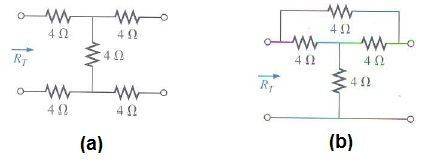
attachment.php?attachmentid=24434&stc=1&d=1268821144.jpg


The Attempt at a Solution


OK ,, I know it's easy but my answer's is not like my teacher's answer :

for (a) I get 6.12 ohm and for (b) I get 2.4 ohm

but my teacher's answer is :

a. Rt=4+4+4=12 ohm
b. Rt= (8//4)+4= 6.667 ohm

what I don't get for :

a. how can he just add them together ,, it's not like they are in series and 2 of them are in parallel .. and I don't know why adding only 3 resistors only ?? there are 5 ~.~ ,,

b.how come 8//4 and there is a resistor between 4 & 4 ,, so don't we have to take a parallel (4//4) then add with 4 then parallel them with the upper resistor ??

so can someone simplify circuits please -_- ,, (I usually use current direction to know whether they are in parallel or series)
 

Attachments

  • 123.jpg
    123.jpg
    6.8 KB · Views: 307
Last edited:
Physics news on Phys.org
Think about which wires in the circuit that would actually carry a current if you were to measure R_T by applying a voltage over the two left terminals. It may also help to redraw the diagram so you have the top-left terminal on the left and the bottom left terminal on the right.
 
aha ,, now I get it ,, so the arrow (Rt) in the diagram means where the voltage terminals are ,, I get it for (a) and (b) too ,, thanks very much filiplarsen ,, but question , if both circuits where closed my answers were right ??
 
If you by closed mean that the two terminals to the right are short-circuited, then I get
a) 4+(8//4)+4 = 10 2/3, and
b) 4//(4+(4//4)) = 4//6 = 2 2/5
So we have same result for b) but not a).
 
Lol,, got it :)

thanks very much m8
 

Similar threads

  • · Replies 3 ·
Replies
3
Views
829
  • · Replies 14 ·
Replies
14
Views
1K
  • · Replies 42 ·
2
Replies
42
Views
5K
  • · Replies 6 ·
Replies
6
Views
2K
Replies
6
Views
2K
Replies
5
Views
2K
  • · Replies 3 ·
Replies
3
Views
2K
  • · Replies 10 ·
Replies
10
Views
3K
Replies
9
Views
2K
Replies
9
Views
3K