Resonant cavity and circuit analysis

Click For Summary
SUMMARY

The discussion focuses on the relationship between resonant cavities and RCL circuit analysis, specifically how to model different modes of a resonant cavity as electrical circuits. The eigenvalue problem derived from Maxwell's field equations leads to various modes, such as TM02, which can be represented by ladder circuits. Each extremum of the electric field corresponds to a capacitor, while nodes correspond to inductors. The analysis concludes that the LC circuit approximation is narrowband, with specific configurations yielding different numbers of inductors and capacitors based on the mode.

PREREQUISITES
  • Understanding of Maxwell's field equations
  • Knowledge of resonant cavity modes (TM and TE modes)
  • Familiarity with RCL circuit theory
  • Basic principles of electromagnetism (E&M)
NEXT STEPS
  • Study the derivation of eigenvalue problems from Maxwell's equations
  • Learn how to model TM and TE modes in resonant cavities
  • Explore ladder circuit configurations for resonant circuits
  • Investigate narrowband circuit approximations and their applications
USEFUL FOR

Electrical engineers, physicists, and students involved in circuit design and electromagnetic theory will benefit from this discussion, particularly those focusing on resonant cavity applications and circuit modeling.

dRic2
Gold Member
Messages
887
Reaction score
225
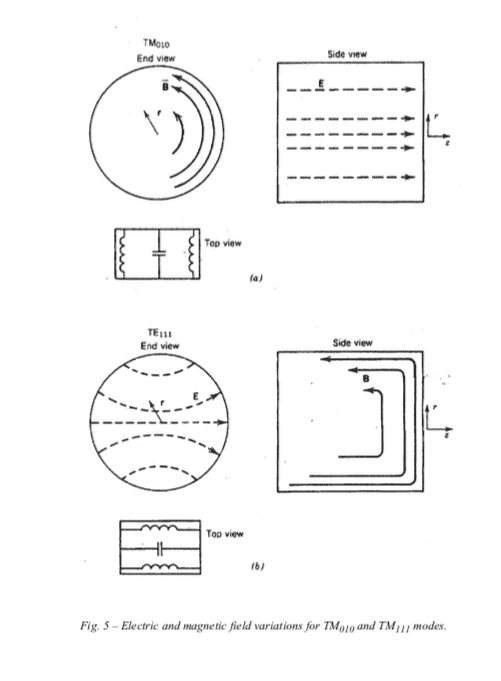
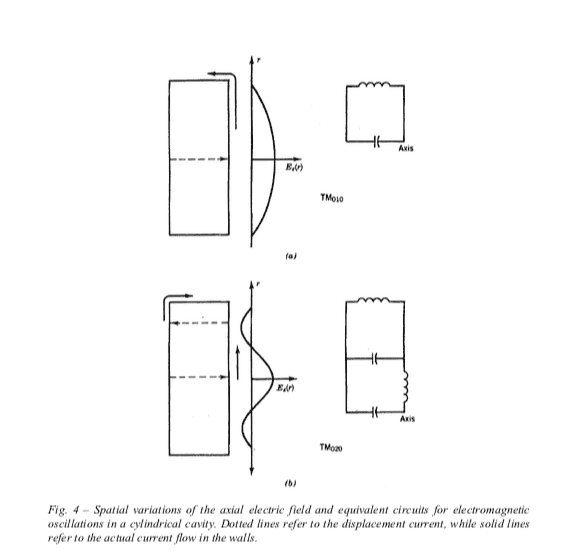
As I understand, if you solve the Maxwell's field equations for a resonant cavity, supposing a time dependence of the form ##e^{iwt}##, you get an eigenvalue problem and different modes as possible solutions. I'm reading some notes where the author states that each mode can be associated with a corresponding RCL circuit. Assuming ideal conducting walls you have no resistances (a part from a possible device to which the cavity is coupled), but I don't get how to draw the corresponding circuit for each TM or TE mode. To better explain myself I'll post some pictures:
Schermata 2020-05-06 alle 23.31.31.png
Schermata 2020-05-06 alle 23.31.35.png
 
Physics news on Phys.org
You should start with each extremum of E corresponding to capacitor, and node corresponding to inductor. You will get ladder circuit. Afterward, you need to treat each section of ladder as resonator in primary resonance, and calculate values of L and C. After calculation is complete for each section, produce the equivalent circuit for the frequency of interest. Some sections will reduce to single capacitors, while others - for single inductors.
For example, TM02 will have 11 elements (8 inductors and 3 capacitors) before reduction. Of course, such LC circuit approximation is intrinsically narrowband.
 
  • Like
Likes   Reactions: dRic2
Thanks a lot. But I am pretty weak in both E&M and circuit analysis...

trurle said:
You should start with each extremum of E corresponding to capacitor, and node corresponding to inductor.
Can you explain why this is so?
 
dRic2 said:
Can you explain why this is so?
Extremum of E corresponds to resonator area with large swings of voltage but low currents. This state is well approximated by capacitor. Opposite is correct for zero of electric field.
 
trurle said:
low currents
Why do you say that ? I suppose we are talking about induced currents, but I don't see it
 

Similar threads

  • · Replies 9 ·
Replies
9
Views
674
  • · Replies 11 ·
Replies
11
Views
854
  • · Replies 8 ·
Replies
8
Views
2K
  • · Replies 5 ·
Replies
5
Views
4K
  • · Replies 2 ·
Replies
2
Views
3K
  • · Replies 73 ·
3
Replies
73
Views
9K
  • · Replies 16 ·
Replies
16
Views
3K
  • · Replies 2 ·
Replies
2
Views
2K
  • · Replies 6 ·
Replies
6
Views
4K
  • · Replies 1 ·
Replies
1
Views
2K