SweatingBear
- 119
- 0
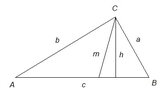
For a triangle with sides $$a$$, $$b$$, $$c$$ and angle $$C$$, where the angle $$C$$ subtends the side $$c$$, show that
$$c \geqslant (a+b) \sin \left( \frac C2 \right)$$
_______
Let us stipulate $$0^\circ < C < 180^\circ$$ and of course $$a,b,c > 0$$. Consequently, $$0^\circ < \frac C2 \leqslant 90^\circ \implies 0 < \sin^2 \left( \frac C2 \right) \leqslant 1$$ (we include $$90^\circ$$ for the angle $$\frac C2$$ in order to account for right triangles).
Law of cosines yield
$$c^2 = a^2 + b^2 - 2ab \cos ( C )$$
Using $$\cos (C) \equiv 1 - 2\sin^2 \left( \frac C2 \right)$$, we can write
$$c^2 = a^2 + b^2 - 2ab + 4ab\sin^2 \left( \frac C2 \right)$$
Now since $$0 < \sin^2 \left( \frac C2 \right) \leqslant 1$$, $$a^2 + b^2 - 2ab + 4ab\sin^2 \left( \frac C2 \right)$$ will either have to equal $$a^2 + b^2 - 2ab + 4ab$$ or be greater than it. Thus
$$c^2 \geqslant a^2 + b^2 - 2ab + 4ab = a^2 + 2ab + b^2 = (a+b)^2 $$
A similar argument can be made for $$(a+b)^2$$ versus $$(a+b)^2 \sin^2 \left( \frac C2 \right)$$: $$(a+b)^2$$ will either have to equal or be greater than the latter expression, due to the values $$\sin^2 \left( \frac C2 \right)$$ can assume. Therefore
$$c^2 \geqslant (a+b)^2 \geqslant (a+b)^2 \sin^2 \left( \frac C2 \right) $$
We can finally conclude
$$c \geqslant (a+b) \sin \left( \frac C2 \right)$$
Thoughts?
$$c \geqslant (a+b) \sin \left( \frac C2 \right)$$
_______
Let us stipulate $$0^\circ < C < 180^\circ$$ and of course $$a,b,c > 0$$. Consequently, $$0^\circ < \frac C2 \leqslant 90^\circ \implies 0 < \sin^2 \left( \frac C2 \right) \leqslant 1$$ (we include $$90^\circ$$ for the angle $$\frac C2$$ in order to account for right triangles).
Law of cosines yield
$$c^2 = a^2 + b^2 - 2ab \cos ( C )$$
Using $$\cos (C) \equiv 1 - 2\sin^2 \left( \frac C2 \right)$$, we can write
$$c^2 = a^2 + b^2 - 2ab + 4ab\sin^2 \left( \frac C2 \right)$$
Now since $$0 < \sin^2 \left( \frac C2 \right) \leqslant 1$$, $$a^2 + b^2 - 2ab + 4ab\sin^2 \left( \frac C2 \right)$$ will either have to equal $$a^2 + b^2 - 2ab + 4ab$$ or be greater than it. Thus
$$c^2 \geqslant a^2 + b^2 - 2ab + 4ab = a^2 + 2ab + b^2 = (a+b)^2 $$
A similar argument can be made for $$(a+b)^2$$ versus $$(a+b)^2 \sin^2 \left( \frac C2 \right)$$: $$(a+b)^2$$ will either have to equal or be greater than the latter expression, due to the values $$\sin^2 \left( \frac C2 \right)$$ can assume. Therefore
$$c^2 \geqslant (a+b)^2 \geqslant (a+b)^2 \sin^2 \left( \frac C2 \right) $$
We can finally conclude
$$c \geqslant (a+b) \sin \left( \frac C2 \right)$$
Thoughts?