Undergrad Is My Summary of the Work-Energy Theorem Accurate?

  • Thread starter Thread starter pkc111
  • Start date Start date
Click For Summary
SUMMARY

The discussion clarifies the work-energy theorem (W-E theorem) and its applicability to forces with non-zero components parallel to motion. It emphasizes that the W-E theorem is valid for any combination of forces, asserting that conservation of energy is not universally applicable, while the W-E theorem remains valid even when work is zero. The conversation highlights the importance of using vectors in mechanics to avoid confusion and illustrates the relationship between kinetic energy and work through mathematical derivations involving forces and potential energy.

PREREQUISITES
  • Understanding of the work-energy theorem in classical mechanics
  • Familiarity with vector calculus and its application in physics
  • Knowledge of kinetic energy and potential energy concepts
  • Basic proficiency in solving differential equations related to motion
NEXT STEPS
  • Study the derivation of the work-energy theorem using vector calculus
  • Explore the implications of conservative forces and potential energy in mechanics
  • Learn about the role of non-conservative forces in energy conservation
  • Investigate applications of the work-energy theorem in real-world physics problems
USEFUL FOR

Students and professionals in physics, particularly those focusing on classical mechanics, as well as educators seeking to deepen their understanding of the work-energy theorem and its applications.

pkc111
Messages
224
Reaction score
26
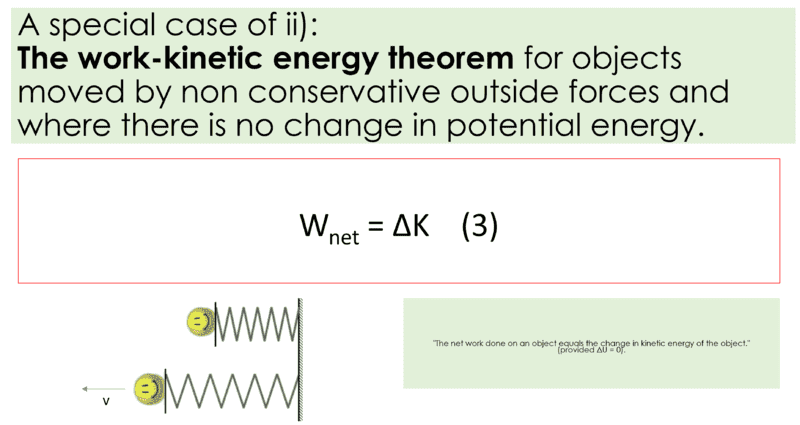
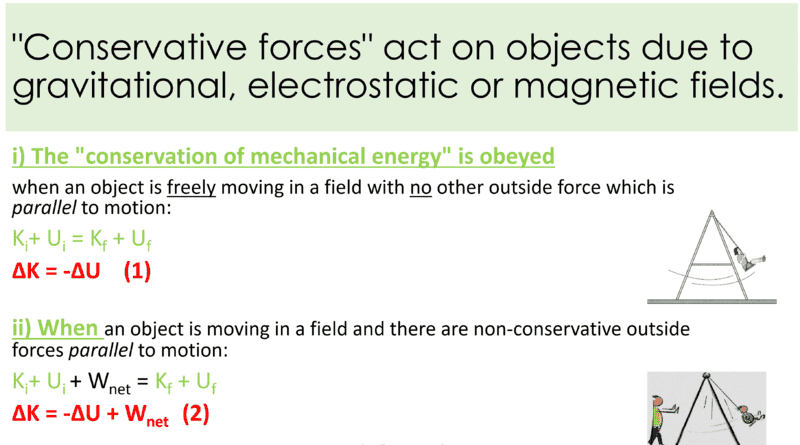
This is my latest attempt at trying to summarise but I feel there maybe a mistake in the wording. Any help would be appreciated.
Thanks.

1632383664022.png


1632383714920.png
 
Physics news on Phys.org
why do you think the forces need to be parallel to the velocity?
 
Every force has to have a non-zero component parallel to the motion to contribute to work in that direction
ie W=Fscostheta.
 
yeah, exactly - a force doesn't need to be parallel to the velocity to do work
 
  • Like
Likes vanhees71
Ok then does it sound better to replace "parallel" with "which have a component that is parallel"?
 
  • Like
Likes vanhees71
The work-energy theorem is valid for any combination of forces. It is the most general relationship and not a special case. Conservation of energy does not apply always but w-e theorem does.
 
  • Like
Likes vanhees71
pkc111 said:
Every force has to have a non-zero component parallel to the motion to contribute to work in that direction
ie W=Fscostheta.
The W-E theorem remains perfectly valid even when the work is zero. You could argue that is just as important a case as when the KE is changing.
 
The work-energy theorem holds for all forces, and one should always use vectors for derivations in mechanics not to get confused with directions of the involved quantities. As the most simple case we consider a single point particle moving under the influence of an arbitrary external force:
$$m \ddot{\vec{x}}=\vec{F}(t,\vec{x},\dot{\vec{x}}).$$
You get the work-energy theorem by assuming that ##\vec{x}(t)## is an arbitrary solution of this equation of motion. Then
$$m \dot{\vec{x}} \cdot \ddot{\vec{x}}=\dot{\vec{x}} \cdot \vec{F}[t,\vec{x}(t),\dot{\vec{x}}(t)].$$
The left-hand side is a total time derivative, because
$$m \dot{\vec{x}} \cdot \ddot{\vec{x}}=\mathrm{d_t}(m \dot{\vec{x}}^2/2)=\mathrm{d}_t T,$$
where ##T=m \dot{\vec{x}}^2/2## is the kinetic energy. Plugging this in the above equation and integrating over some time interval you get
$$T_2-T_1=\int_{t_1}^{t_2} \mathrm{d} t \dot{\vec{x}}(t) \cdot \vec{F}[t,\vec{x}(t),\dot{\vec{x}}(t)]=W_{12}.$$
The right-hand side is called work.

This law is not very helpful as it stands, because you need to know a solution of the equations of state. So it's just a nice observation to hold for any such solution, but it doesn't help much to find a solution.

This changes drastically for the special case that the force has a potential. Then the force shouldn't depend on time and velocity and there should be a scalar field ##V(\vec{x})## such that
$$\vec{F}(\vec{x})=-\vec{\nabla} V(\vec{x}).$$
Plugging this into the work-energy theorem you get
$$T_2-T_1=W_{12}=-\int_{t_1}^{t_2} \mathrm{d} t \mathrm{d}_t V[\vec{x}(t)]=-[V(\vec{x}(t_2))-V(\vec{x}(t_1))]$$
or
$$T_2+V(\vec{x}(t_2))=T_1+V(\vec{x}(t_1))=E.$$
This means that in this case for any trajectory the total energy ##E=T+V## is conserved, i.e., it doesn't change with time.

The important twist now is that ##W_{12}## does not depend on using the solution of the equation of motion to calculate the corresponding line integral, because if the force has a potential, then you can use any line connecting two points ##\vec{x}_1## and ##\vec{x}_2##. You always get
$$W_{12}=-[V(\vec{x}_2) -V(\vec{x}_1)],$$
i.e. you know without the solution of the equation of motion how energy conservation looks, and it can indeed help to find solutions of the equation of motion and that's why we call forces which have a scalar potential in the above given sense "conservative", i.e., you don't only have the work-energy theorem but the theorem of energy conservation, i.e.,
$$E=T+V=\text{const}##
along any solution of the equations of motion.
 

Similar threads

  • · Replies 4 ·
Replies
4
Views
2K
  • · Replies 11 ·
Replies
11
Views
2K
  • · Replies 77 ·
3
Replies
77
Views
5K
  • · Replies 21 ·
Replies
21
Views
3K
  • · Replies 13 ·
Replies
13
Views
838
Replies
7
Views
2K
  • · Replies 31 ·
2
Replies
31
Views
4K
  • · Replies 10 ·
Replies
10
Views
2K
Replies
4
Views
2K
  • · Replies 4 ·
Replies
4
Views
1K