Why Is My Rigid Body Equilibrium Equation Incorrect?

Click For Summary
SUMMARY

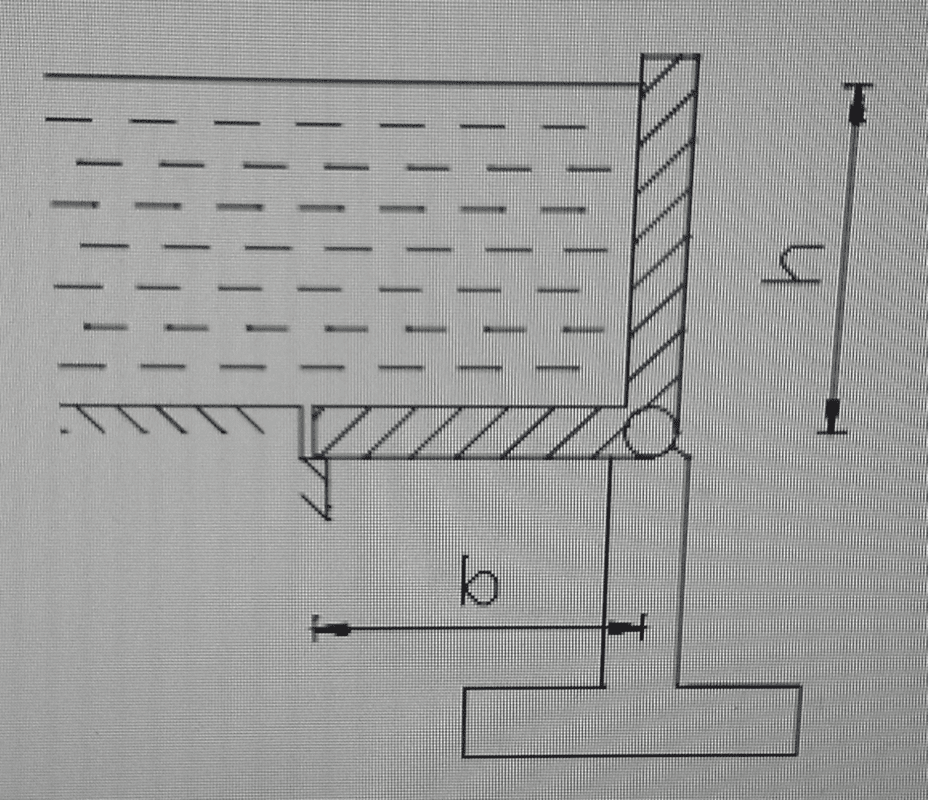
The discussion centers on the incorrect equilibrium equation for a rigid body involving a vertical wall subjected to water pressure. The participant derived the moment equation as bh*1/2b - 1/2hb*1/3b = 0, but the expected solution for height (h) is h = √3 * b. Key insights include the need to correctly identify the height of the wall (h) versus the base (b) and the relationship between average pressure, total force, and torque on the wall. The participant was advised to reconsider the triangle used for calculating the force on the vertical wall.

PREREQUISITES
  • Understanding of rigid body equilibrium principles
  • Familiarity with fluid mechanics, particularly hydrostatic pressure
  • Knowledge of torque calculations and moment arms
  • Basic geometry related to triangles and areas
NEXT STEPS
  • Study hydrostatic pressure distribution on vertical surfaces
  • Learn about calculating torque in fluid mechanics
  • Explore the derivation of moment equations for triangular loads
  • Review rigid body equilibrium conditions in engineering mechanics
USEFUL FOR

Engineers, physics students, and anyone involved in fluid mechanics or structural analysis will benefit from this discussion, particularly those working with rigid body equilibrium and hydrostatic forces.

dbag123
Messages
76
Reaction score
3
Homework Statement
Determine the lenght of h with respect to b so that the water flows.
Relevant Equations
sum of moments at the hinge
Hello
j.png


Ihave gotten as far as coming up with an equation for the sum of moments and it goes as follows: bh*1/2b-1/2hb*1/3b=0 the answer for h i get is wrong and i don't know if i am missing something. moment arm on the b is 1/2b and the moment arm on h is 1/3h because of the way water pressure works , meaning its a uniform load in the shape of triangle. bh is my way of writing the force as a point load acting on the levers. The answer to this problem is supposed to be h= √3 *b. Any help is appreciated.
 
Physics news on Phys.org
dbag123 said:
sum of moments and it goes as follows: bh*1/2b-1/2hb*1/3b=0
In your expression for the torque on the vertical wall, why does b enter in?
 
jbriggs444 said:
In your expression for the torque on the vertical wall, why does b enter in?
my thinking was that replacing the acting force with the area of water would be of help, but yeah its not helping
 
dbag123 said:
my thinking was that replacing the acting force with the area of water would be of help, but yeah its not helping
I do not think that you are catching on. The wall is h meters high, not b meters high.
 
jbriggs444 said:
I do not think that you are catching on. The wall is h meters high, not b meters high.
My thinking was that the resultant force acting on the vertical Wall would be 1/2hb(area of triangle) and the moment arm 1/3h from the hinge and the product of these 2 then the moment
 
dbag123 said:
My thinking was that the resultant force acting on the vertical Wall would be 1/2hb(area of triangle) and the moment arm 1/3h from the hinge and the product of these 2 then the moment

The average pressure on the wall is proportional to the height of the wall. The higher the wall, the higher the average pressure.

The total force on the wall is proportional to the height of the wall [times the average pressure]. The higher the wall, the higher the total force.

The total torque on the wall is proportional to the height of the wall [times the total force]. The higher the wall, the higher the total torque.

The length of the floor segment does not enter into the calculation of torque on the vertical wall. You can use a triangle to calculate the force on the vertical wall. Just not the particular triangle you have in mind.
 
jbriggs444 said:
The average pressure on the wall is proportional to the height of the wall. The higher the wall, the higher the average pressure.

The total force on the wall is proportional to the height of the wall [times the average pressure]. The higher the wall, the higher the total force.

The total torque on the wall is proportional to the height of the wall [times the total force]. The higher the wall, the higher the total torque.

The length of the floor segment does not enter into the calculation of torque on the vertical wall. You can use a triangle to calculate the force on the vertical wall. Just not the particular triangle you have in mind.

And that's why my moment equation does not work. Thank you.
 

Similar threads

  • · Replies 1 ·
Replies
1
Views
3K
  • · Replies 12 ·
Replies
12
Views
2K
  • · Replies 11 ·
Replies
11
Views
2K
  • · Replies 6 ·
Replies
6
Views
3K
  • · Replies 38 ·
2
Replies
38
Views
5K
  • · Replies 31 ·
2
Replies
31
Views
4K
  • · Replies 9 ·
Replies
9
Views
904
Replies
4
Views
2K
Replies
9
Views
4K
Replies
4
Views
4K