Rocket-Jet Hybrid, Rocket + Ramjet

Click For Summary
SUMMARY

The discussion centers on the concept of integrating a thrust augmentor with a ramjet engine to enhance efficiency. A thrust augmentor operates by mixing cold air with hot air, improving thrust without additional fuel consumption. Participants suggest that modifying the intake shape, as demonstrated in the SR-71 Blackbird, could optimize performance. Additionally, Reaction Engines' innovative designs, including micro-filament heat exchangers, are highlighted as cutting-edge advancements in jet-rocket technology.

PREREQUISITES
  • Understanding of thrust augmentors and their function in jet engines
  • Familiarity with ramjet engine mechanics
  • Knowledge of aerodynamic principles related to intake design
  • Awareness of advanced propulsion systems, such as those developed by Reaction Engines
NEXT STEPS
  • Research the design and function of thrust augmentors in jet engines
  • Explore the aerodynamic modifications used in the SR-71 Blackbird
  • Investigate Reaction Engines' micro-filament heat exchanger technology
  • Study the principles of jet pumping and its applications in hybrid propulsion systems
USEFUL FOR

Aerospace engineers, propulsion system designers, and enthusiasts interested in advanced jet and rocket engine technologies.

Julian Erickson
Messages
8
Reaction score
0
I read that a thrust augmentor can significantly increase the efficiency of a jet engine (http://www.pulse-jets.com/phpbb3/viewtopic.php?t=931). Now from my understanding, the thrust agumentor is sort of like a ramjet. Only, in this case, the cold air is being sucked in along with the hot air that's being forced into it from the previous stage (like a jet jump). The hot air heats the cold air instead of burning fuel like in a ramjet.

So...

Could a low-force rocket pump cold air into a ramjet to provide high force? I don't think I understand all this correctly. I would appreciate any help. Please point me to where I could read about this (someone has already built it I'm sure).
Here is my Frankenstein image in case my words are worthless:
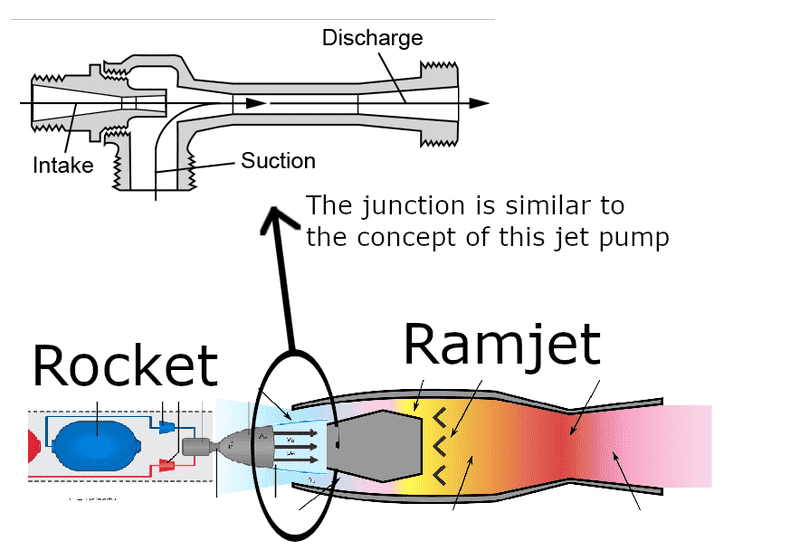
Rocket-_Ramjet.png
 

Attachments

  • Rocket-_Ramjet.png
    Rocket-_Ramjet.png
    34.7 KB · Views: 2,444
Last edited:
Science news on Phys.org
Julian Erickson said:
I read that ...
Read where? Do you have a link? You will get more and better answers if we have a better idea where you're starting from.
 
  • Like
Likes   Reactions: Julian Erickson
IMHO, you would get more benefit by altering the intake shape, as was done with the 'Blackbird'. Ramp, cone, spike or whatever.

You may need that rocket to kick-start the main jet, but I reckon the thrust augmenter belongs at the back, where it cannot compromise the intake's airflow. IIRC, a pulse-jet enthusiast in the Antipodes found a real-neat way to put a wide, tuned pipe over the exhaust, creating the equivalent of a high-bypass ratio jet engine. His research publishing was hampered some-what by the possible application to build inexpensive flying-bombs...

If you want a cutting-edge jet-rocket combo, with inter-cooling yet, check out Reaction Engines' fascinating work.
https://www.reactionengines.co.uk/
Disclosure: Some years ago, when I first read about their micro-filament heat exchanger, I asked them if they'd considered diagnosis via Fourier analysis of the 'Aeolian Harping'. Their reply was a BIG smiley...
 
Have a look at this video to see the same principle of jet pumping in action with a rocket motor.


You can also see the effect of entrainment from a rocket engine in this example.

Starts test firing at 8min into the video.


Perhaps it may be possible to redirect some of the exhaust from the jet back into the intake so as to bootstrap the flow too.
 

Similar threads

Replies
4
Views
2K
  • · Replies 3 ·
Replies
3
Views
3K
Replies
2
Views
3K
  • · Replies 9 ·
Replies
9
Views
2K
  • · Replies 2 ·
Replies
2
Views
3K
  • · Replies 3 ·
Replies
3
Views
3K
  • · Replies 6 ·
Replies
6
Views
2K
  • · Replies 2 ·
Replies
2
Views
3K
Replies
1
Views
4K
  • · Replies 7 ·
Replies
7
Views
6K