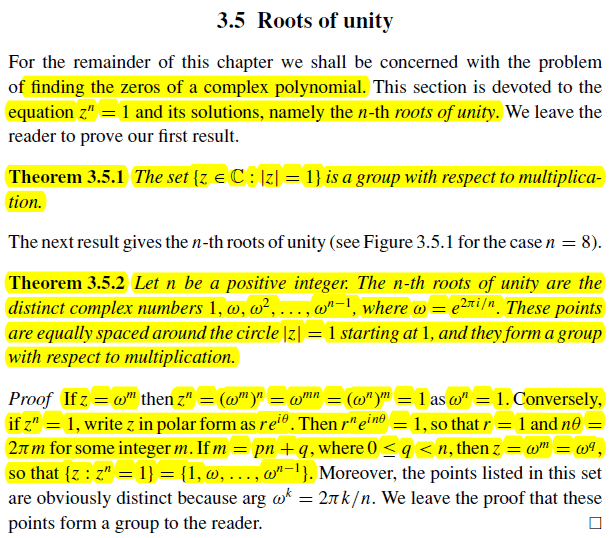
Roots of unity, Roots of complex equations of the form z^n = 1

Click For Summary
SUMMARY

The discussion centers on the properties of roots of unity, specifically the equation zn = 1, where |z| = 1. According to Theorem 3.5.2 from Alan F. Beardon’s "Abstract Algebra and Geometry," these complex numbers form a group under multiplication. Participants confirm that the inverse of each element is indeed its complex conjugate, and for n = 8, z = 1 is its own inverse. The discussion also clarifies that z = -1 is its own inverse, as its conjugate coincides with itself in rectangular form.

PREREQUISITES
  • Understanding of complex numbers and their properties
  • Familiarity with group theory concepts
  • Knowledge of complex conjugates and their geometric interpretation
  • Basic grasp of multiplication in the context of complex numbers
NEXT STEPS
  • Study the properties of complex conjugates in detail
  • Explore group theory applications in complex analysis
  • Learn about the geometric representation of roots of unity
  • Investigate the implications of even and odd n in zn = 1
USEFUL FOR

Mathematicians, students of abstract algebra, and anyone interested in the geometric properties of complex numbers and their applications in group theory.

PcumP_Ravenclaw
Messages
105
Reaction score
4
Dear all,

upload_2014-11-19_7-52-58.png


please see the page above, (Alan F, Beardon, Abstract Algebra and Geometry). On the page, Theorem 3.5.2 says that the set of Complex numbers from ## z^n = 1 ##, where ## |z| = 1 ## forms a group w.r.t multiplication. I want to know if...

The inverse of all elements are their complex conjugates?

inverse of the identity, z = 1∠0 is its own inverse??

is an inverse missing when n is even??
upload_2014-11-19_7-50-32.png

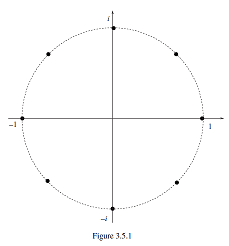
In the above diagram, n = 8. z = 1 is the inverse of itself. the three complex points above the real axis have inverses as the three complex points below the real axis. What about z = -1?? where is its inverse?? is it z = 1? why?
 
Physics news on Phys.org
well when you multiply two complex numbers their angles add and their lengths multiply, so does that answer your question about what happens when you multiply two complex conjugates of length one?
 
The inverse of z = -1, the point on the Leftmost side of the circle above is its own inverse. It's because in rectangular form its ## z = -1 +0i ## so its conjugate is ##z' = -1 - 0i## which lies on the same point as z.
 
I am studying the mathematical formalism behind non-commutative geometry approach to quantum gravity. I was reading about Hopf algebras and their Drinfeld twist with a specific example of the Moyal-Weyl twist defined as F=exp(-iλ/2θ^(μν)∂_μ⊗∂_ν) where λ is a constant parametar and θ antisymmetric constant tensor. {∂_μ} is the basis of the tangent vector space over the underlying spacetime Now, from my understanding the enveloping algebra which appears in the definition of the Hopf algebra...

Similar threads

Replies
48
Views
4K
  • · Replies 26 ·
Replies
26
Views
887
  • · Replies 4 ·
Replies
4
Views
2K
  • · Replies 3 ·
Replies
3
Views
2K
Replies
2
Views
2K
  • · Replies 1 ·
Replies
1
Views
2K
Replies
9
Views
3K
  • · Replies 11 ·
Replies
11
Views
3K
  • · Replies 17 ·
Replies
17
Views
6K
  • · Replies 2 ·
Replies
2
Views
2K