Rope tension problem: Mass hanging from a rope tied at an angle

  • Thread starter Thread starter litelboi
  • Start date Start date
  • Tags Tags
    College Physics
Click For Summary

Homework Help Overview

The discussion revolves around a physics problem involving the tension in ropes supporting a mass at an angle. Participants are exploring the relationships between the forces acting on the mass and the tensions in the ropes.

Discussion Character

  • Exploratory, Assumption checking, Problem interpretation

Approaches and Questions Raised

  • Participants suggest drawing free body diagrams and decomposing forces into components. There are discussions about the relationships between the tensions T1 and T2 and the weight of the object, with some questioning the validity of their assumptions regarding the directions and magnitudes of these tensions.

Discussion Status

There is ongoing exploration of the problem with various interpretations of the forces involved. Some participants have provided hints and guidance on how to approach the problem, while others express confusion about their calculations and the implications of their results.

Contextual Notes

Participants note the importance of significant figures in their calculations and the constraints of the problem, including the requirement to consider the angles involved in the tension forces. There is also mention of the need to ensure that the sum of the forces equals zero for the system to be in equilibrium.

litelboi
Messages
7
Reaction score
3
Homework Statement
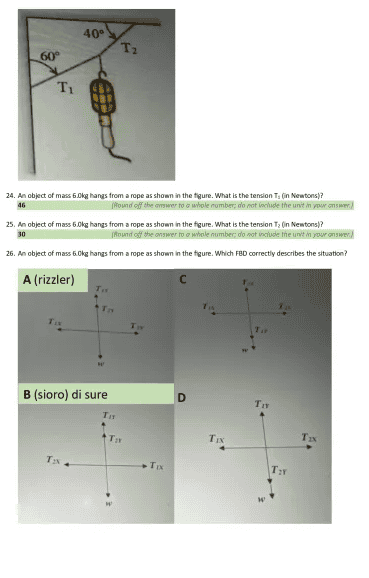
An object of a mass 6.0kg hangs from a rope as shown in the figure. What is the tension T1/T2?
Relevant Equations
Rope Tension Solutions
Please Help Me With This! I have tried so many different ways to answer it but I just cannot seem to find the right solution to get T1 and T2 for this.

Screenshot 2024-09-14 190301.png
 
Physics news on Phys.org
1. Draw a free body diagram of the point on the rope at which the vertical rope is attached.
2. Demand the sum of all the forces be zero at that point.

Please use LaTeX to post your work and to explain what you are doing. To learn how, click #LaTeX Guide", lower left above "Attach files." If we don't know what you did, we cannot help you do it right.
 
:welcome:

We can only help you with some hints. Whenever you have forces acting at various angles like this, your first thought should be to decompose the forces into horizontal and vertical components.
 
This is what I did in my latest attempt.

1726321331609.png
 
Check your equation for the sum of the vertical components.
 
##T_2## is less than the weight of the object. That's impossible, given that the second rope is attached below the object and can't be supporting its weight.
 
  • Like
Likes   Reactions: Lnewqban
Isn't it right that T1cos(60) + T2sin(40) = w?
 
Wait so you mean T1 must be greater than the weight and T2 is purely horizontal?
 
litelboi said:
Isn't it right that T1cos(60) + T2sin(40) = w?
Not if ##T_1## is positive.
 
  • #10
litelboi said:
Wait so you mean T1 must be greater than the weight and T2 is purely horizontal?
No. ##T_2## is supporting the object. ##T_1## is pulling it down. They are both pulling it sideways (in different directions). That's why a FBD for the object is a good idea.
 
  • #11
Ok so, T1 pulls it left and down, while T2 pulls it up and right?
 
  • Like
Likes   Reactions: PeroK
  • #12
I am sorry if I am so confused, i'm very weak at physics.
 
  • #13
I got a completely different answer when I changed sum of vertical components. T1 = 259.04 and T2 = 292.84. It feels so wrong.
 
  • #14
litelboi said:
I got a completely different answer when I changed sum of vertical components. T1 = 259.04 and T2 = 292.84. It feels so wrong.
It isn't wrong!
 
  • #15
litelboi said:
I got a completely different answer when I changed sum of vertical components. T1 = 259.04 and T2 = 292.84. It feels so wrong.
It's not easy in this case to estimate the answer. I really wasn't sure what to expect. When I saw ##T_2 \approx 300N## (note that you should always include units in your answer), I thought you might have made a mistake. But, I did the calculation and got the same answer.

Sometimes the numerical answer to a problem is a surprise.
 
  • #16
@litelboi, it's probably worth noting that you should make sure each answer has the appropriate number of significant figures. Or you can be penalised 1 mark in an exam!

The given data (m= 6.0kg, g = 9.8N/kg) have 2 significant figures. So your answers should be rounded to 2 significant figures, giving 260N and 290N.

You can usually get away with an extra significant figure, (answers of 259N and 293N). But you can’t justify 259.04N and 292.84N – you can’t get a precise result from imprecise data.
 
  • Informative
Likes   Reactions: PeroK
  • #17
I guess I would first look at it by drawing the four quadrants graph on graph paper. Then look at the angles that your triangle has on the graph to the lower right quadrant. Zero, Zero is at the very center of the graph. This might help you understand how the forces are working.
 
  • #18
litelboi said:
It feels so wrong.
Why? You can see which of the two tensions is larger by looking at the equation for the horizontal components. We have $$ T_2\cos40^{\circ}=T_1\cos30^{\circ}\implies T_1=\frac{\cos40^{\circ}}{\cos30^{\circ}}T_2.$$Since ##\cos40^{\circ}<\cos30^{\circ}##, it follows that ##T_1<T_2.##
 
  • #19
Steve4Physics said:
@litelboi, it's probably worth noting that you should make sure each answer has the appropriate number of significant figures. Or you can be penalised 1 mark in an exam!

The given data (m= 6.0kg, g = 9.8N/kg) have 2 significant figures. So your answers should be rounded to 2 significant figures, giving 260N and 290N.

You can usually get away with an extra significant figure, (answers of 259N and 293N). But you can’t justify 259.04N and 292.84N – you can’t get a precise result from imprecise data.
To avoid roundoff errors, one should also derive algebraic expressions for the tensions and substitute numbers at the very end.
 
  • #20
litelboi said:
I am sorry if I am so confused, i'm very weak at physics.
Welcome, @litelboi !

No reason to be sorry.
It is not that difficult once you learn how to produce free body diagrams (FBD).

If the object that hangs from a rope is in repose, all the external forces and moments acting on it cancel each other, resulting in zero net external force and moment.

Based on that, we imaginarily isolate that body from the rope and compute the forces that need to exist, in the same directions than the two rope branches (T1/T2), in order to perfectly counteract the weight of the body.

Please, see:
https://courses.lumenlearning.com/suny-osuniversityphysics/chapter/5-7-drawing-free-body-diagrams/

https://courses.lumenlearning.com/s...apter/6-1-solving-problems-with-newtons-laws/

CNX_UPhysics_06_01_StopLight.jpg
 
  • Informative
Likes   Reactions: PeroK
  • #21
litelboi said:
It feels so wrong
It often helps to consider a special case variant of the problem. (This is one of the many advantages of working purely algebraically as far as possible. Never plug in numbers until you need to!)

Here's how you might have gone:
##T_1\cos(\alpha)+T_2\sin(\beta)=W##
##T_1\sin(\alpha)=T_2\cos(\beta)##
##T_1=T_2\cos(\beta)/\sin(\alpha)##
##T_2(\cos(\beta)/\sin(\alpha))\cos(\alpha)+T_2\sin(\beta)=W##
##T_2=\frac{W\sin(\alpha)}{\cos(\beta)\cos(\alpha)+\sin(\beta)\sin(\alpha)}##
##=\frac{W\sin(\alpha)}{\cos(\beta-\alpha)}##
To check, what would happen if you change 40° to 30°, so that the two tensions are in a straight line? There would be no way for the string to remain straight when a weight is hung on it.
Substituting the angle values 60° and 30°, nothing special happens, showing the above answer is wrong.

After correcting the error in the first line, you arrive at
##T_2=\frac{W\sin(\alpha)}{\cos(\beta+\alpha)}##.
Now plugging in those angles gives ##T_2\rightarrow\infty##.

PeroK said:
note that you should always include units in your answer
The instructions in post #1 say not to …
Steve4Physics said:
your answers should be rounded to 2 significant figures
… and to round the answers to whole numbers.
 
  • Informative
Likes   Reactions: Steve4Physics

Similar threads

  • · Replies 5 ·
Replies
5
Views
3K
  • · Replies 7 ·
Replies
7
Views
3K
  • · Replies 2 ·
Replies
2
Views
2K
  • · Replies 38 ·
2
Replies
38
Views
5K
  • · Replies 22 ·
Replies
22
Views
1K
Replies
4
Views
1K
Replies
5
Views
2K
Replies
43
Views
5K
Replies
7
Views
2K
Replies
15
Views
3K