MHB Rose Petal - Circle - Area problem - Can someone check my work please?

Click For Summary
The discussion revolves around verifying the calculation of the area of blue glass in a stained-glass window featuring a rose design. The user correctly identified the intersection points of the rose and the circle to set the bounds for their integral, focusing on the area from 0 to pi/4. The total area of the blue glass is found by subtracting the area of the rose from the area of the circle. Another participant confirms the user's approach and provides a simpler method for calculating the areas involved. Overall, the calculations and methods presented are validated as correct.
Pindrought
Messages
15
Reaction score
0
I'd love it if someone could verify whether or not I did this problem correctly.

A stained-glass window is a disc of radius 2 (graph r=2) with a rose inside (graph of r=2sin(2theta) ). The rose is red glass, and the rest is blue glass. Find the total area of the blue glass.

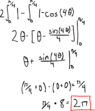
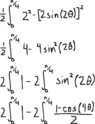
So I set 2=2sin(2theta) to find where they intersect and found that at theta = pi/4 there is an intersection, so I set my bounds to be from 0 to pi/4 to find an eighth section of the total area of the blue glass.

My integral looks like so
View attachment 2174

View attachment 2175

Did I do this right?

Thanks a lot for taking the time to read
 

Attachments

  • rose1.png
    rose1.png
    5.5 KB · Views: 106
  • rose2.png
    rose2.png
    6.5 KB · Views: 89
Physics news on Phys.org
Looks good to me, and you have the correct result. :D
 
Hello, Pindrought!

Your work is correct . . . Good job!I used a simpler approach.

The area of the circle is: \pi(2^2) \,=\,4\pi.
The area of the rose is: .8 \times \tfrac{1}{2}\int^{\frac{\pi}{4}}_0(2\sin2\theta)^2\,d\theta

And subtract the two areas.
 
Thread 'Problem with calculating projections of curl using rotation of contour'
Hello! I tried to calculate projections of curl using rotation of coordinate system but I encountered with following problem. Given: ##rot_xA=\frac{\partial A_z}{\partial y}-\frac{\partial A_y}{\partial z}=0## ##rot_yA=\frac{\partial A_x}{\partial z}-\frac{\partial A_z}{\partial x}=1## ##rot_zA=\frac{\partial A_y}{\partial x}-\frac{\partial A_x}{\partial y}=0## I rotated ##yz##-plane of this coordinate system by an angle ##45## degrees about ##x##-axis and used rotation matrix to...

Similar threads

  • · Replies 29 ·
Replies
29
Views
4K
  • · Replies 5 ·
Replies
5
Views
3K
  • · Replies 2 ·
Replies
2
Views
3K
  • · Replies 2 ·
Replies
2
Views
1K
  • · Replies 6 ·
Replies
6
Views
2K
  • · Replies 6 ·
Replies
6
Views
2K
Replies
1
Views
3K
Replies
4
Views
4K
  • · Replies 2 ·
Replies
2
Views
2K
  • · Replies 3 ·
Replies
3
Views
7K