Understanding the Continuity of Current in a Rotating Magnetic Field

Click For Summary
SUMMARY

The discussion centers on the analysis of rotor magnetic fields in electric motors, specifically addressing the continuity of current in a rotating magnetic field. The currents are defined as i_a = i_{max}, i_b = -\frac{i_{max}}{2}, and i_c = -\frac{i_{max}}{2}, resulting in a net magnetomotive force (mmf) of \frac{3F_{max}}{2}. The participants clarify that the magnetic field remains continuous between defined points (pt1 and pt2) due to the nature of sine wave currents, which ensures a smooth rotation of the magnetic field. In contrast, stepper motors exhibit a different behavior due to their discrete current steps, allowing the rotor to pause between poles.

PREREQUISITES
  • Understanding of rotor magnetic fields in electric motors
  • Familiarity with sine wave and step currents
  • Knowledge of magnetomotive force (mmf) calculations
  • Basic principles of motor operation, particularly in relation to magnetic flux
NEXT STEPS
  • Research the principles of rotating magnetic fields in AC motors
  • Study the differences between sine wave and stepper motor operation
  • Explore magnetomotive force (mmf) calculations in electric motor design
  • Learn about the implications of magnetic flux continuity in motor performance
USEFUL FOR

Electrical engineers, motor design specialists, and students studying electromagnetic theory will benefit from this discussion, particularly those focused on the dynamics of rotating magnetic fields in electric motors.

PhysicsTest
Messages
256
Reaction score
27
TL;DR
Does the magnetic field rotate continuously or discrete.
I am analyzing the rotor magnetic field, i feel i understand the basic concept but have few clarifications.
1603550647150.png


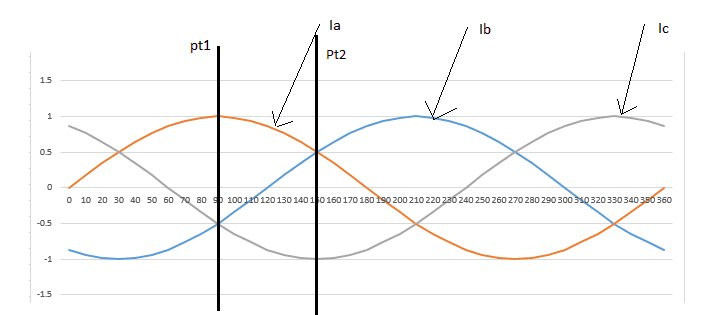
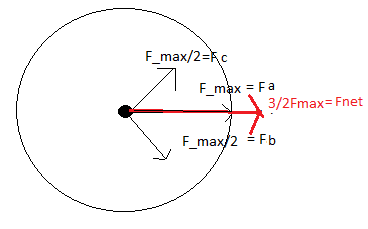
At pt1, the net mmf due to currents
##i_a = i_{max}; i_b = -\frac{i_{max}} 2 ; i_c = -\frac{i_{max}} 2## is ##\frac {3F_{max}} 2##
1603550483841.png

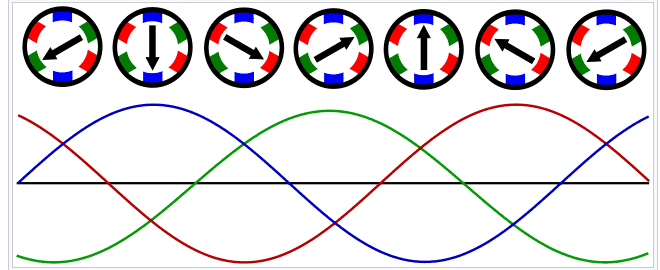
Similarly i can do for Pt2. But my confusion is the region between the points pt1 and pt2, do i need to calculate similar to above. This question i am asking because if i see this website https://en.wikipedia.org/wiki/Rotating_magnetic_field ( i came to know from here) if share a screen shot from the website. The black arrow cannot stop in between the stator windings is my guess. Am I correct? What is the advantage of the continuous current in between pt1 and pt2?
1603550949200.png
 
Engineering news on Phys.org
PhysicsTest said:
The black arrow cannot stop in between the stator windings is my guess. Am I correct?
If the currents are true sine waves then the magnetic field will be rotating reasonably smoothly.

As the current through two pole windings are momentarily equal as they pass, the two poles will have the same magnetic flux so the gap between will be magnetically invisible to the rotor as it passes.

If it was a stepper motor, fed with step currents rather than sine waves, then the field will step and the rotor would be able to be held between the poles.
 
Most likely this can only be answered by an "old timer". I am making measurements on an uA709 op amp (metal can). I would like to calculate the frequency rolloff curves (I can measure them). I assume the compensation is via the miller effect. To do the calculations I would need to know the gain of the transistors and the effective resistance seen at the compensation terminals, not including the values I put there. Anyone know those values?

Similar threads

  • · Replies 1 ·
Replies
1
Views
2K
  • · Replies 1 ·
Replies
1
Views
1K
  • · Replies 7 ·
Replies
7
Views
2K
  • · Replies 3 ·
Replies
3
Views
2K
  • · Replies 6 ·
Replies
6
Views
3K
  • · Replies 3 ·
Replies
3
Views
5K
  • · Replies 5 ·
Replies
5
Views
2K
Replies
24
Views
5K
  • · Replies 7 ·
Replies
7
Views
2K
  • · Replies 1 ·
Replies
1
Views
789