What is the Missing Factor in Clarke Transform?

  • Thread starter Thread starter PhysicsTest
  • Start date Start date
  • Tags Tags
    Transform
Click For Summary
SUMMARY

The discussion focuses on the Clarke Transform, specifically the conversion of three-phase currents \(I_a\), \(I_b\), and \(I_c\) into two-axis components \(I_{\alpha}\) and \(I_{\beta}\). The user identifies a missing factor of \(\frac{2}{3}\) in their derived equations compared to the standard equations. This factor is crucial for maintaining power invariance in the transformation, which ensures that the power in the original three-phase system is preserved in the two-axis representation. The user seeks clarification on the significance of this factor and its inclusion in the transformation.

PREREQUISITES
  • Understanding of three-phase electrical systems
  • Familiarity with the Clarke Transform and its mathematical representation
  • Knowledge of trigonometric functions and their application in electrical engineering
  • Basic concepts of power invariance in transformations
NEXT STEPS
  • Research the mathematical derivation of the Clarke Transform and its applications
  • Study the significance of power invariance in electrical transformations
  • Explore the relationship between three-phase systems and their two-axis representations
  • Learn about other transformations such as the Park Transform and their applications
USEFUL FOR

Electrical engineers, students studying power systems, and professionals working with three-phase electrical systems will benefit from this discussion.

PhysicsTest
Messages
260
Reaction score
27
TL;DR
The Clarke transform equation does not match with my calculations
The standard Clarke Transform is
##
i_{alpha} = i_a; -> 1
i_{beta} = \frac {(i_a + 2i_b)} {\sqrt3} ->2
##
1605953917984.png


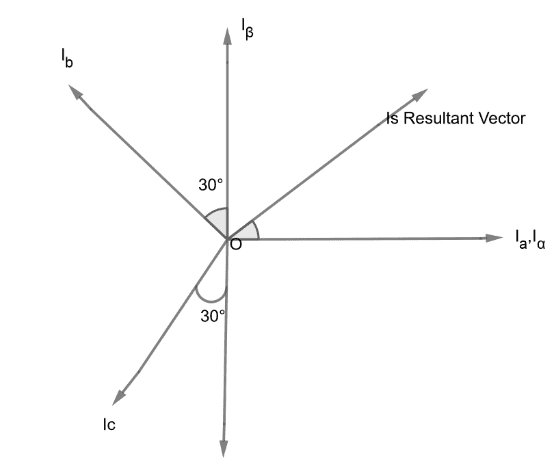
I am trying to derive it, but missing a factor. Basically converting the 3 phase currents ## I_a, I_b, I_c ## into the 2 axis ##I_{\alpha}, I_{\beta} ##
resolving along the x-axis
##I_{\alpha} = I_a - I_b \sin(30) - I_c\sin(30) = \frac {3I_a} 2; ## since ##I_a+I_b+I_c=0## -->3
resolving along y-axis
##
I_{\beta} = I_b\cos30 - I_c\cos30; = \frac{\sqrt3(I_a+ 2I_b)} 2 --> 4
##
Now the derived 3 and 4 if i compare with original equations 1, 2, there is a factor ##\frac 2 3## is missing. What is this factor? Why should i include it?
 
Engineering news on Phys.org
Clarke Transformation i found the explanation in the wiki, the Power invariant transformation. What does it mean?
 

Similar threads

  • · Replies 97 ·
4
Replies
97
Views
6K
Replies
7
Views
2K
Replies
4
Views
2K
  • · Replies 8 ·
Replies
8
Views
2K
  • · Replies 4 ·
Replies
4
Views
2K
Replies
4
Views
2K
  • · Replies 11 ·
Replies
11
Views
2K
  • · Replies 9 ·
Replies
9
Views
1K
  • · Replies 8 ·
Replies
8
Views
3K
  • · Replies 8 ·
Replies
8
Views
1K