Rotation from axis to axis in 4 dimensions

Click For Summary
The discussion focuses on the process of rotating vectors in four-dimensional space, specifically transitioning from the line defined by (-1,-1,-1,-1) to (1,1,1,1) to the x-axis defined by (-1,0,0,0) to (1,0,0,0). The user outlines their approach of performing sequential rotations around the z and y axes, calculating specific angles to account for previous rotations. They inquire about rotating around the xw plane and suggest using quaternions for easier manipulation of the rotation process. The conversation also touches on the necessity of maintaining orientation and the use of a modified Gram-Schmidt process to establish a right-handed basis for generating a rotation matrix applicable in any dimension. This method emphasizes the importance of proper transformations and basis changes in achieving the desired rotation.
Matt Benesi
Messages
134
Reaction score
7
I can easily visualize the 3 dimensional way to do so, and already have.

I'd like to rotate from the (-1,-1,-1,-1) -- (1,1,1,1) line to the x-axis (-1,0,0,0) -- (1,0,0,0).

To do so in 3 dimensions (-1,-1,-1) -- (1,1,1) line to the x-axis (-1,0,0) -- (1,0,0)

I rotated around the z axis (xy plane) by pi/2 - acos(sqrt(1/2))= pi/4

Next I rotated around the y-axis (zx plane) by pi/2 - acos (sqrt(2/3)) *** I had to use this angle because the x portion had already been rotated with the y portion

This got me to the x axis.

Should I just rotate around the xw plane?

I'm assuming the 3rd angle would be pi/2 - acos(sqrt(3/4)) because I will have to take into account the 2 previous x rotations.

The reason is I'm modifying a fractal's 4 dimensional formula:
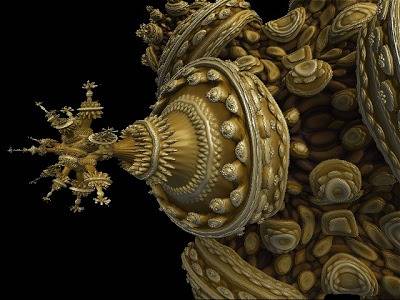
2nd%2520order%2520stalk.jpg


MODS- don't know if this is the correct forum?
 
Last edited:
Physics news on Phys.org
Are you familiar with quaternions? The 4d analogue to quaternions is very easy to work with, and all it requires is information about the plane of rotation (which is easy to get here, since you clearly explained what you want the original and final vectors to be). There would be no need to break the rotation down into a series of rotations in unit planes.
 
  • Like
Likes Matt Benesi
Hey Matt Benesi.

Basically for a rotation, you need to an axis rotate around and an angle to rotate around for.

If you look at points only you need to find a normal vector that is normal to the sub-space formed by linear combinations of the two vectors. So in point form you have (-1,-1,-1,-1) to (1, 0, 0, 0) as your start and final points, and you need a basis for this.

The basis can be found by the use of Gram-Schmidt in a modified way where you start with this two vectors and create a right-handed basis by finding for each new vector an n such that n . r = 0 where r is basically the sum of all your previous basis vectors with the rest normalized: you then choose free values for the components of n and make it satisfy that equation and then normalize that vector.

What will happen is if the orientation is kept right, you will generate a rotation matrix with determinant 1 and R^T = R^-1 that can be applied to the vector.

In terms of getting the actual transformation you will need to consider a change of basis in the matrix sense.

Basically you know that Ax = y and Bx = z where A is the basis for one system and B is for the other. But x = A^(-1)y which means BA^(-1)y = z and depending on which quantity you want, then you get y or z since both and A are invertible (and it's easy to calculate since any rotation matrix has its inverse as its tranpose).

If you keep the orientation right throughout the process, this should work for any dimension.
 
  • Like
Likes Matt Benesi
I am studying the mathematical formalism behind non-commutative geometry approach to quantum gravity. I was reading about Hopf algebras and their Drinfeld twist with a specific example of the Moyal-Weyl twist defined as F=exp(-iλ/2θ^(μν)∂_μ⊗∂_ν) where λ is a constant parametar and θ antisymmetric constant tensor. {∂_μ} is the basis of the tangent vector space over the underlying spacetime Now, from my understanding the enveloping algebra which appears in the definition of the Hopf algebra...

Similar threads

  • · Replies 2 ·
Replies
2
Views
2K
  • · Replies 1 ·
Replies
1
Views
3K
Replies
31
Views
3K
  • · Replies 16 ·
Replies
16
Views
2K
Replies
4
Views
2K
  • · Replies 7 ·
Replies
7
Views
2K
  • · Replies 26 ·
Replies
26
Views
845
  • · Replies 4 ·
Replies
4
Views
2K
  • · Replies 2 ·
Replies
2
Views
2K
  • · Replies 3 ·
Replies
3
Views
2K