SUMMARY
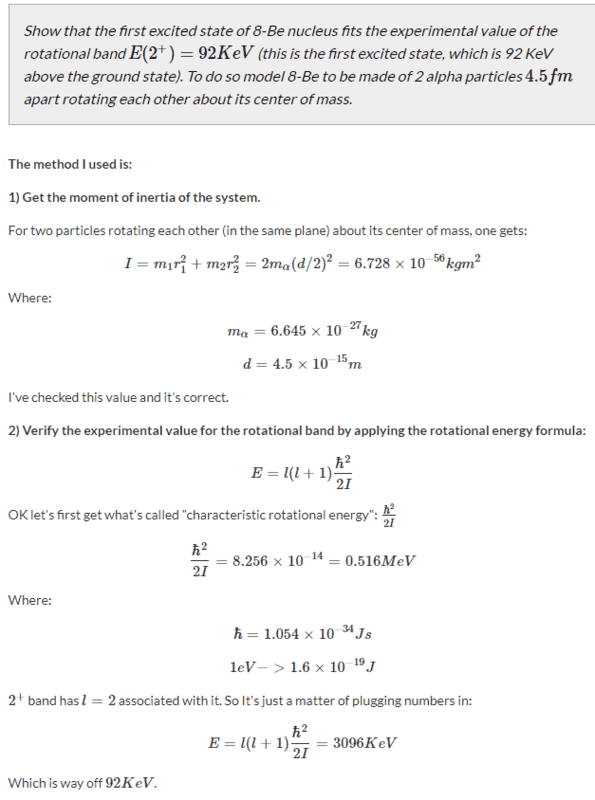
The discussion centers on the discrepancy in calculating the energy of the E(2+) state using the rotational energy formula. The expected result is 92 KeV, while the calculation yields 3096 KeV. A moderator points out that there is a flaw in the exercise, asserting that the original calculation is incorrect. This indicates a need for a deeper understanding of the rotational energy formula and its application in nuclear physics.
PREREQUISITES
- Understanding of rotational energy formulas in nuclear physics
- Familiarity with energy states in nuclear models
- Knowledge of KeV as a unit of energy measurement
- Basic principles of quantum mechanics
NEXT STEPS
- Review the derivation of the rotational energy formula in nuclear physics
- Study the concept of energy states in nuclear models
- Examine case studies involving E(2+) calculations
- Learn about common pitfalls in energy calculations in quantum mechanics
USEFUL FOR
Students and professionals in nuclear physics, physicists analyzing energy states, and educators teaching quantum mechanics concepts.