Motion of rotating rig, find the angle variation with control rod length

Click For Summary

Homework Help Overview

The discussion revolves around a problem involving a rotating arm controlled by a variable-length control rod. The goal is to express the angle of the rotating arm in relation to the length of the control rod, with specific lengths fixed and known.

Discussion Character

  • Exploratory, Assumption checking, Mathematical reasoning

Approaches and Questions Raised

  • Participants discuss the relationships between angles and lengths in the system, with some attempting to derive equations using trigonometric identities. There are inquiries about naming conventions for points and the implications of fixed angles and lengths.

Discussion Status

Participants are actively exploring various geometric relationships and equations related to the problem. Some have suggested working backwards from the angle to the variable length, while others are questioning the assumptions about angles in specific triangles. There is a recognition of the complexity involved in the equations being developed.

Contextual Notes

There is mention of the problem being part of university homework, and participants are encouraged to clarify their diagrams and naming conventions. The discussion also highlights the fixed nature of certain distances and angles, which may influence the approaches taken.

alexm
Messages
6
Reaction score
0
Homework Statement
Motion of rotating rig, find angle variation with control rod length
Relevant Equations
Trigonometry
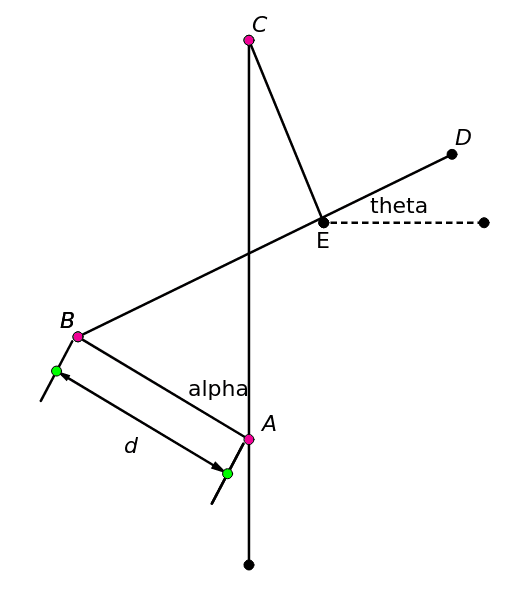
Summary:: We have a rotating arm, offset from the centre of rotation by a certain length, which is controlled by varying the length of a control rod. Need the angle of the rotating arm in terms of length of the rod.
mechanics_2.png


The blue line is a fixed column structure. CE and BD form the rotational arm, and AB is the control rod. The control rod and arm are free to rotate at the points shown (either end of the control rod, the join of the arm and the vertical column (AC)).

My question is, can anyone tell me the function that describes theta in terms of d (theta = f(d))? All lengths other than d are fixed and known. theta is the angle the rotational arm makes with the horizontal.

The pink joints show freedom of rotation.
Angle CED is fixed at 90 degrees.
Lengths LBE, LDE, LCE, LCA are also fixed.
When theta is 0, d = d0.
d = LAB and is variable.

[Moderator's note: Moved from a technical forum and thus no template.]
 
Last edited:

Physics news on Phys.org
Hello @alexm , :welcome: !
alexm said:
Summary:: We have a rotating arm, offset from the centre of rotation by a certain length, which is controlled by varying the length of a control rod. Need the angle of the rotating arm in terms of length of the rod.

All lengths other than d are fixed and known
Give them symbolic names. Add a ##d_0## for when ##\theta = 0## and do some trigonometry.
Is this professional, or is it homework ?
 
Hello @BvU

Thanks for your reply :smile:.

It's for university homework if that counts?

Yesterday I got as far as showing that sin2θ + cos2θ = 1 through my trig efforts, so any help would be much appreciated!
 
alexm said:
I got as far as showing that ##\sin^2\theta + \cos^2\theta = 1##
That is valid for all angles you can think of, so not very sensational... :wink:

We still need the list of names. Name the relevant points, too. Preferably with a drawing.
(note: the ##\Theta## in your picture are confusing. I suppose they mean"this is a pivot point"
 
Edited the original post, must've been trying to do so as it was moved between forums earlier.
 

Attachments

  • mechanics_2.png
    mechanics_2.png
    5.3 KB · Views: 279
Last edited:
Good. So A is a fixed pivot point. ##\angle## ACE = ##\theta##. So we can concentrate on ABEC with length ##d## as variable.
1583843807351.png

Working backwards from ##\theta## to ##d## is probably the easiest. Write down some equations: for triangle BAF you have three angles and two sides. Should be easy !
 
What lines are blue or green?
 
Lnewqban said:
What lines are blue or green?
Apologies they were in the first picture, will change the description.
 
From triangle CFE:
LEF = LCEtan(θ)
LCF = LCE / cos(θ)
considering lengths:
LBE = LBF + LEF
so:
LBF = LBE - LEF
LBF = LBE - LCEtan(θ)
also:
LAC = LAF + LCF
LAF = LAC - LCE / cos(θ)

Now if we say: β = ∠AFB, using the law of cosines gives:
d2 = LBF2 + LAF2 - 2LBFLAFcos(β)
Which is nearly there apart from knowing β, but I think β + θ = 90o, which would solve this. Is this the case? Or is there something I'm missing on the angles in triangle ABF?
 
Last edited:
  • #10
alexm said:
Is this the case?
For you to know:
Picture suggests BD ##\perp## CE
 
  • #11
BvU said:
For you to know:
Picture suggests BD ##\perp## CE
Yes that's right, which should mean that the cosine rule based answer is correct? Out of interest is there a more elegant solution I may have missed?
 
Last edited:
  • #12
Wouldn't know. With such mixed equations the result may be intrinsically tedious and complicated. To an extent that I personally would leave it to an equation solving algorithm. But perhaps someone else can enlighten us ?
 
  • #13
Since BC is a fixed distance, I would start by finding the angle BC makes to the vertical as a function of d.
 

Similar threads

  • · Replies 4 ·
Replies
4
Views
8K
  • · Replies 31 ·
2
Replies
31
Views
5K
Replies
1
Views
4K
  • · Replies 3 ·
Replies
3
Views
3K
  • · Replies 27 ·
Replies
27
Views
5K
  • · Replies 11 ·
Replies
11
Views
4K
  • · Replies 2 ·
Replies
2
Views
2K
Replies
4
Views
3K
  • · Replies 1 ·
Replies
1
Views
4K
  • · Replies 5 ·
Replies
5
Views
3K