Rotational motion and angular momentum

Click For Summary
SUMMARY

The discussion focuses on the calculations of rotational motion and angular momentum involving a system of a ball and putty. The moment of inertia is calculated as I = 0.253125 kg.m², leading to an angular velocity of ω = 0.148 rad/s. The kinetic energy before and after the collision is analyzed, revealing a ratio of Kfinal to Kinitial of approximately 0.013. Additionally, the conservation of energy principle is applied to determine the angle of rotation, concluding that the system must rotate more than 180°.

PREREQUISITES
  • Understanding of rotational dynamics and angular momentum
  • Familiarity with the conservation of energy principle
  • Knowledge of moment of inertia calculations
  • Basic proficiency in algebra and trigonometry
NEXT STEPS
  • Study the principles of conservation of angular momentum
  • Learn about the effects of initial conditions on pendulum motion
  • Explore advanced calculations of moment of inertia for complex shapes
  • Investigate the impact of friction and air resistance on pendulum dynamics
USEFUL FOR

Physics students, educators, and anyone interested in understanding the principles of rotational motion and energy conservation in mechanical systems.

hquang001
Messages
31
Reaction score
3
Homework Statement
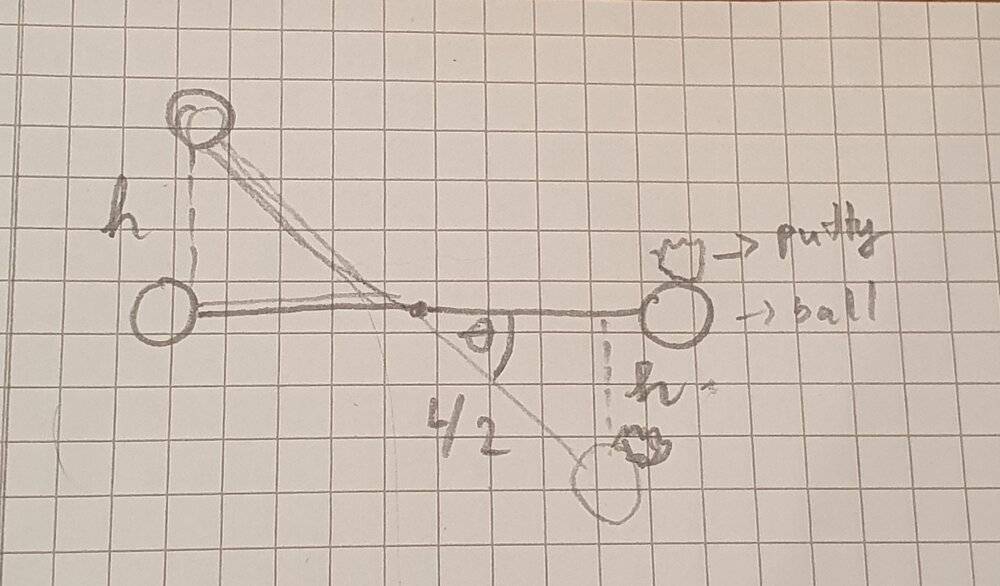
Two 2.00 kg balls are attached to the ends of a thin rod of length 50.0 cm and negligible mass. The rod is free to rotate in a vertical plane without friction about a horizontal axis through its center. With the rod initially horizontal, a 50.0 g wad of wet putty drops onto one of the balls, hitting it with a speed of 3.00 m/s and then sticking to it.
(a) What is the angular speed of the system just after the putty wad hits?
(b) What is the ratio of the kinetic energy of the system after the collision to that of the putty wad just before?
( c) Through what angle will the system rotate before it momentarily stops?
Relevant Equations
[tex] L_{initial} = L_{final} [/tex]
[tex] K_{initial} + PE_{initial} = K_{final} + PE_{final} [/tex]
mball = 2 kg, mputty = 0.05 kg, L = 0.5 m, v = 3m/s
a) Moment of inertia : I = (2mball + mputty ). ¼ L^2 = 0.253125 kg.m^2

Linitial = Lfinal => mputty. v. r = I.ω => ω = (4.mputty.v.r) / I = 0.148 rad/s

b) K initial = 1/2 m v^2 = 0.225 J
K final = 1/2 Iω^2 = 2.85.10^(-3) J => Kfinal / Kinitial = 0.013

c) Using conservation of energy :K initial +PE initial = K final + PE final
1/2 I.ω^2 + 0 = 0 + (mball + mputty).g.(-h) + mball.g.h
158053457_296620081898095_8345120285906046267_n.jpg

1/2 I.ω^2 = (2.05).g. (-sinΘ . L/2 ) + (2).g.(sinΘ . L/2)
=> 1/2 I.ω^2 = g.sinΘ . L/2 . (2 - 2.05) => Θ = -1.3°
I think the angle should be larger than 180 => 180° - (-1.3°) = 181°

I don't know if my answer for question c is correct or not
 
Last edited:
Physics news on Phys.org
It all looks right. It should definitely be 181.3°, of course.
 
  • Like
Likes   Reactions: Steve4Physics
Edit - typo's corrected.

If you release a simple pendulum (negligible friction/air resistance) what height does it reach on the other side, and why?

If you give the same pendulum a small downwards push at the moment of release, what can you say about the height it reaches on the other side, and why?

I get a very slightly different answer to you for part b). This could be caused by a small rounding error in your calculation. (Don't use rounded values in intermediate steps.) Your working isn't clear enough for me to check what you've done in detail but the method is OK.

As noted by @PeroK, you are asked through what angle the system rotates - not what angle it makes relative to its starting position.
 
  • Like
Likes   Reactions: PeroK
Steve4Physics said:
If you release a simple pendulum (negligible friction/air resistance) what height does it reach on the other side, and why?
I think it should reach the same height because there is no outside force. we can proof it by using conservation of energy
PE initial = PE final => mgh1 = mgh2 => h1 = h2
Steve4Physics said:
If you give the same pendulum a small downwards push at the moment of release, what can you say about the height it reaches on the other side, and why?
Does it reach greater height than original height ? I'm not sure about this
Steve4Physics said:
I get a very slightly different answer to you for part b). This could be caused by a small rounding error in your calculation. (Don't use rounded values in intermediate steps.) Your working isn't clear enough for me to check what you've done in detail but the method is OK.

- for part b). yes you're right. As i rounded the value of angular speed 0.148 to 0.15 rad/s so the answer is not quite correct. The final kinetic energy should be 2.77.10^(-3) J => the ratio is 0.0123
 
  • Like
Likes   Reactions: Steve4Physics
hquang001 said:
Does it [a pendulum] reach greater height than original height [if given an initial push] ? I'm not sure about this
If you are holding a pendulum (at an angle) and give it an initial push, it will reach a bigger height compared to merely releasing it. The extra gravitational potential energy equals the extra initial kinetic energy you gave it (conservation of energy).

Applying the same argument to the original problem, you should see that the rod must rotate more than 180º, not less.

And you've sorted out the rounding error. Yay!
 
  • Like
Likes   Reactions: hquang001
@hquang001 here's a way to avoid rounding errors.

Let ##r## be half the length of the rod, ##m## the mass of the putty, ##M## the mass of each ball, ##u## the initial speed of the putty and ##v## the speed of each ball immediately after the collision.
$$L_i = mur = (2M + m)vr = L_f $$ $$\therefore v = \mu u, \ \text{where} \ \mu = \frac{m}{2M+m}$$
For part a): $$\omega = \frac{v}{r} = \frac{\mu u}{ r}$$
For part b): $$\frac{KE_f}{KE_i} = \frac{(2M+m)v^2}{mu^2} = \frac{1}{\mu}\mu^2 = \mu$$
 
  • Like
Likes   Reactions: hquang001 and Steve4Physics

Similar threads

  • · Replies 17 ·
Replies
17
Views
959
Replies
10
Views
2K
Replies
5
Views
1K
  • · Replies 21 ·
Replies
21
Views
1K
  • · Replies 9 ·
Replies
9
Views
872
Replies
67
Views
4K
Replies
5
Views
1K
  • · Replies 11 ·
Replies
11
Views
3K
Replies
335
Views
16K
  • · Replies 11 ·
Replies
11
Views
2K