Satellite Orbital Transfers: How to Calculate Work Done by Rocket Motors

  • Thread starter Thread starter pureouchies4717
  • Start date Start date
  • Tags Tags
    Orbit Satellites
Click For Summary

Homework Help Overview

The discussion revolves around calculating the work done by rocket motors during satellite orbital transfers, specifically from a lower circular orbit to an elliptical orbit and then to a higher circular orbit. The problem involves understanding the mechanics of orbital transfers and energy changes associated with these maneuvers.

Discussion Character

  • Exploratory, Conceptual clarification, Mathematical reasoning, Problem interpretation

Approaches and Questions Raised

  • Participants discuss the need to calculate work done during orbital transfers, questioning how to divide the total work between different burns. Some explore the concept of mechanical energy conservation in orbits and the role of kinetic energy changes during transfers.

Discussion Status

Participants are actively engaging with the problem, with some offering insights into the energy calculations required for the transfers. There is recognition that a deeper analysis is needed to understand the work distribution between the two burns, but no consensus has been reached on specific methods or solutions.

Contextual Notes

Participants note that the problem involves calculating total mechanical energy in different orbits and the differences in energy that correspond to the work done by the rocket motors. There is an acknowledgment of the complexity involved in these calculations, particularly in relation to the elliptical transfer orbit.

pureouchies4717
Messages
98
Reaction score
0
hi everyone. I am having a little bit of trouble on this and was wondering if someone can help. i don't understand how to answer parts c and f

this is the picture:
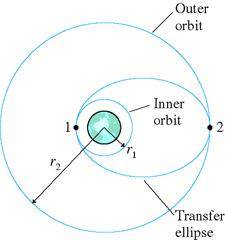
knight_Figure_12_76.jpg


a)Consider a 1000 kg communication satellite that needs to be boosted from an orbit 300 km above the Earth to a geosynchronous orbit 35,900 km above the earth. Find the velocity v_1 on the lower circular orbit.
answer: 7730m/s
b) Find the velocity v_1' at the low point on the elliptical orbit that spans the two circular orbits.
Answer: 1.02 x 10^4 m/s
c) How much work must the rocket motor do to transfer the satellite from the circular orbit to the elliptical orbit?
Answer: ?
d) Now find the velocity v_2' at the top of the elliptical orbit
Answer: 1600 m/s
e) Now find the velocity v_2 of the upper circular orbit.
Answer: 3070 m/s
f) How much work must the rocket motor do to transfer the satellite from the elliptical orbit to the upper circular orbit?
Answer: ?

g) Compute the total work done.
Answer: 2.51 x 10^10 J

i know that c and f equal 2.51 x 10^10 J when added up. However, i don't understand how to get the work done to get this ship to the elliptical orbit and then to the outer orbit

please help. thanks,
nick
 
Physics news on Phys.org
this is what my book says:

The work is the total work done in both burns. it takes a more extended analysis to see how the work has to be divided between the burns.

...real helpful haha

basically, i just know how to find the work done on geosynchronous orbits
 
Since the satellite is experiencing only a conservative force its total mechanical energy in each of the orbits will be constant. But to transfer it from one orbit to the other the rocket needs to do work to alter its total mechanical energy so that it will go into the new orbit (with a different total mechanical energy [itex]E[/itex]). Since the orbital transfers is happening at the points in the elliptical orbit where its motion is purely tangential only the kinetic energy of the satellite need to be changed by the rocket.
 
Last edited:
nick727kcin said:
this is what my book says:


...real helpful haha

basically, i just know how to find the work done on geosynchronous orbits

Calculate the total energy in the first cicrular orbit. Then calculate the total energy in the transfer (elliptical) orbit (If I recall correctly, it's [itex]{- G m M \over 2 a }[/itex] where a is the semimajor axis). The difference will be the work done by the rockets (the transfer orbit will obviously have a larger energy)

At the arrival, calculate the difference between the total energy of the transfer orbit and the larger circular orbit (the latter will have a larger energy). That's the work done by the rockets there.

Patrick
 

Similar threads

Replies
5
Views
3K
Replies
5
Views
3K
Replies
5
Views
3K
  • · Replies 6 ·
Replies
6
Views
3K
  • · Replies 2 ·
Replies
2
Views
3K
  • · Replies 3 ·
Replies
3
Views
2K
  • · Replies 6 ·
Replies
6
Views
2K
Replies
37
Views
4K
  • · Replies 12 ·
Replies
12
Views
8K
Replies
1
Views
1K