Undergrad Scale factor/redshift formula wrong at the end?

Click For Summary
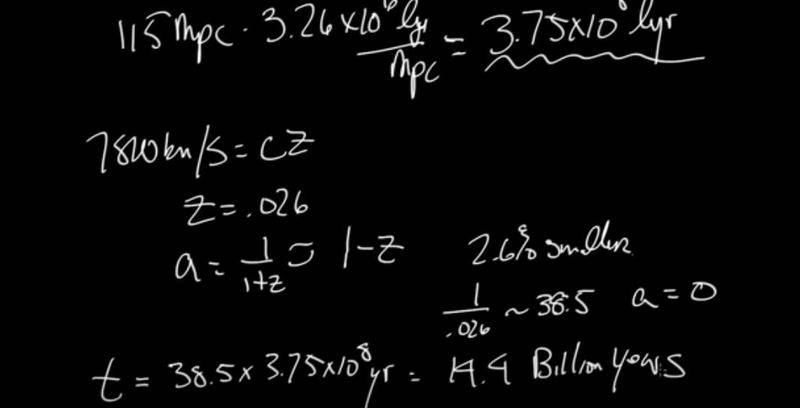
The discussion critiques a professor's use of the incorrect formula for scale factor and redshift, a(t) = 1/z, instead of the correct one, a(t) = 1/(1+z). This discrepancy leads to significantly different results in calculations related to the scale factor. Despite using an approximation that may seem non-rigorous, the professor arrives at a correct conclusion regarding the scale factor for z = 0.026 being 2.6% smaller. The method of extrapolating back to the Big Bang by determining how many times 0.026 fits into 1 raises questions about its relevance and clarity. The discussion emphasizes the need for accurate formulas in cosmological calculations.
Phys12
Messages
351
Reaction score
42
In this video:


Capture.jpg


The professor at the end (at about 7:28), used the formula for scale factor and redshift as a(t) = 1/z, instead of the actual one a(t) = 1/1+z. And when we apply both of them, they give very different results. So, how could the professor use the first formula, which we were never taught about previously and I'm inclined to think is incorrect?
 
Astronomy news on Phys.org
He's not saying that, but what he does do is confusing. He correctly computes that the scale factor for z = 0.026 is 2.6% smaller, then extrapolates that back to when the scale factor is zero, i.e., the Big Bang, by asking how many times 0.026 goes into 1.

Because he uses the approximation a ~ 1-z it's not obvious that this is rigorous, but the answer he gets is nonetheless correct.
 
DrSteve said:
He correctly computes that the scale factor for z = 0.026 is 2.6% smaller, then extrapolates that back to when the scale factor is zero, i.e., the Big Bang, by asking how many times 0.026 goes into 1.
Why would you want to find out how many times 0.026 goes into 1 to find out the scale factor?
 
UC Berkely, December 16, 2025 https://news.berkeley.edu/2025/12/16/whats-powering-these-mysterious-bright-blue-cosmic-flashes-astronomers-find-a-clue/ AT 2024wpp, a luminous fast blue optical transient, or LFBOT, is the bright blue spot at the upper right edge of its host galaxy, which is 1.1 billion light-years from Earth in (or near) a galaxy far, far away. Such objects are very bright (obiously) and very energetic. The article indicates that AT 2024wpp had a peak luminosity of 2-4 x...

Similar threads

  • · Replies 17 ·
Replies
17
Views
3K
  • · Replies 13 ·
Replies
13
Views
3K
  • · Replies 11 ·
Replies
11
Views
4K
  • · Replies 7 ·
Replies
7
Views
3K
Replies
2
Views
4K
  • · Replies 2 ·
Replies
2
Views
2K
  • · Replies 5 ·
Replies
5
Views
2K
  • · Replies 3 ·
Replies
3
Views
3K
  • · Replies 12 ·
Replies
12
Views
2K
  • · Replies 8 ·
Replies
8
Views
1K