Schwartz QFT book, equation 15.59

  • Context: Undergrad 
  • Thread starter Thread starter Pnin
  • Start date Start date
  • Tags Tags
    Book Qft
Join the discussion
Ask a follow-up here, or get your own question answered by working scientists, mathematicians and engineers — people, not an autocomplete.
Real named experts · corrections over time · the nuance an AI answer skips
4 replies · 2K views
Pnin
Messages
20
Reaction score
1
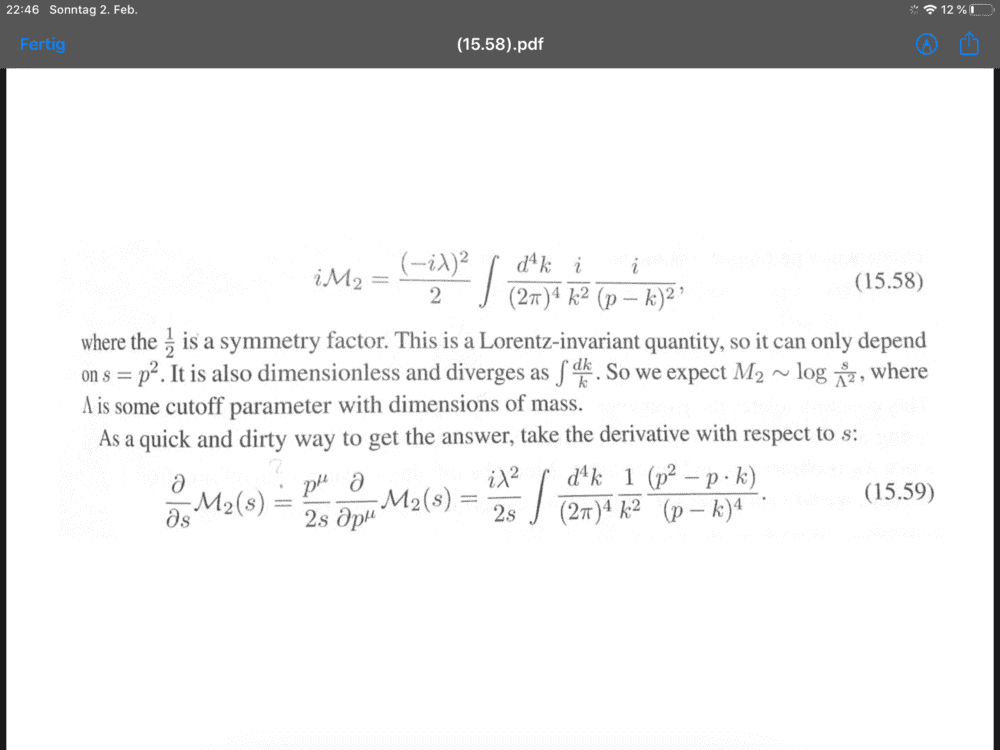
Can someone please explain what the author does here in 15.59? I do not understand both steps. Neither the rewriting of the derivative, nor the integral.
0CC065C0-9702-47B5-B34E-24180FBF1BE0.png


thank you
 
Last edited:
Physics news on Phys.org
Pnin said:
Can someone please explain what the author does here in 15.59? I do not understand both steps. Neither the rewriting of the derivative, nor the integral.

View attachment 256512

thank you
I'm guessing the bit that's confusing you about the derivative rewrite involves the following:$$s ~=~ p^2 ~=~ p^\alpha p_\alpha ~,~~~~ \Rightarrow~~ p^\alpha = \hat p^\alpha \, s^ {1/2} ~,$$where the overhat denotes a unit vector. (This assumes ##p^\alpha## is not lightlike.) Then,$$\frac{\partial p^\alpha}{\partial s} ~=~ \frac{\partial s^ {1/2}}{\partial s} \; \hat p^\alpha ~=~ \frac{1}{ 2 s^ {1/2}}\; \hat p^\alpha ~=~ \frac{s^{1/2}}{ 2 s}\; \hat p^\alpha ~=~ \frac{p^\alpha}{2s} ~.$$
So, using the chain rule,$$\frac{\partial M}{\partial s} ~=~ \frac{\partial p^\mu}{\partial s} \; \frac{\partial M}{\partial p^\mu} ~=~ \frac{p^\alpha}{2s} \; \frac{\partial M}{\partial p^\mu} ~.$$
Next, the ##\partial/\partial p^\mu## operator passes through the integral sign (since the variables ##k## and ##p## are independent). Then it's just a matter of performing $$\frac{\partial}{\partial p^\mu} \; \frac{1}{(p - k)^2} $$which is merely an application of the usual quotient rule for derivatives. (Can you do that bit?)
 
  • Like
  • Informative
Likes   Reactions: vanhees71, mfb and Pnin
Fantastic! Crystal-clear now. Thanks strangerep, much appreciated!