Schwarzschild Radius: Calculating V(esc.) & R

Join the discussion
Ask a follow-up here, or get your own question answered by working scientists, mathematicians and engineers — people, not an autocomplete.
Real named experts · corrections over time · the nuance an AI answer skips
2 replies · 3K views
SD das
Messages
20
Reaction score
0
Correct if I'm wrong.

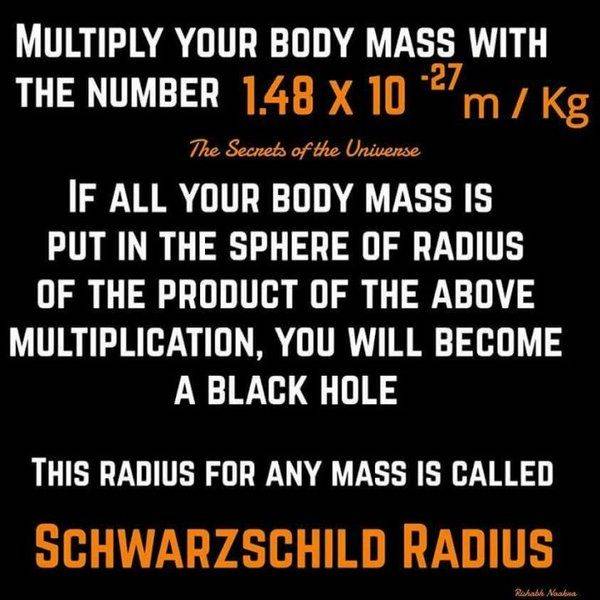
1485846985846.jpg
V(esc.)=(2GM/R)^1/2 that is equal to R=2GM/V^2 putting v=c,we get R=2GM/c^2 by putting the value of G,M,C we get schwarzschild radius=1.46*10^-27 m/kg
 
Physics news on Phys.org
Yes, you will get the Schwarzschild radius if you start with the classical formula for escape velocity as a function of mass and radius, set the escape velocity to ##c##, and solve for ##r##. However, a black hole is nothing like a classical body whose escape velocity is ##c##, so it is not clear that this result is telling us anything important.

To properly understand black holes and why the Schwarzschild radius is what is, you have to start with the Schwarzschild solution to the Einstein field equations. You'll find many threads here if you search for "black hole escape velocity".
 
I've found hundreds of posts on PF about the Schwarzschild radius, which you might look for as well. Simply use the search functionality at the top right in the frame of this side. Especially a couple of recently written Insight articles might be of your interest: https://www.physicsforums.com/insights/schwarzschild-geometry-part-1/#toggle-id-1

I've also found a funny calculation of the corresponding radii for objects the mass of our sun and a proton which you can compare your result to:
https://books.google.de/books?id=5d...ge&q=schwarzschild radius of a proton&f=false

Unfortunately the book quotation doesn't show how to assess these results, as it's not for free.