Realism of Seaquest DSV Submarine Design: Fact or Fiction?

  • Thread starter Thread starter Whitestar
  • Start date Start date
  • Tags Tags
    Design Submarine
Click For Summary
SUMMARY

The Seaquest DSV submarine design is primarily a work of fiction rather than a realistic engineering model. Key concerns include the structural weaknesses posed by windows and the overall flatness of the design, which complicates storage capacity. Real submarines, such as the USS Albacore, utilize streamlined shapes like teardrops or cylinders to minimize drag and withstand high-pressure environments. The discussion highlights that deviations from these shapes, including the Seaquest's design, would likely lead to increased drag and structural challenges.

PREREQUISITES
  • Understanding of submarine design principles
  • Knowledge of fluid dynamics and drag forces
  • Familiarity with pressure hull construction
  • Awareness of materials used in deep-sea submersibles
NEXT STEPS
  • Research the design principles of real submarines, focusing on the USS Albacore's features
  • Study fluid dynamics to understand drag and turbulence in various shapes
  • Explore materials used in submarine construction, particularly for pressure resistance
  • Investigate the engineering challenges of creating windows in deep-sea vehicles
USEFUL FOR

Marine engineers, submarine designers, students of naval architecture, and enthusiasts of underwater exploration will benefit from this discussion.

Whitestar
Messages
90
Reaction score
4
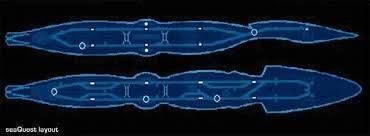
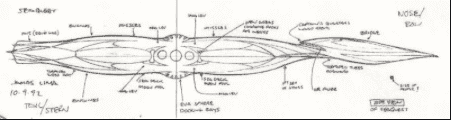
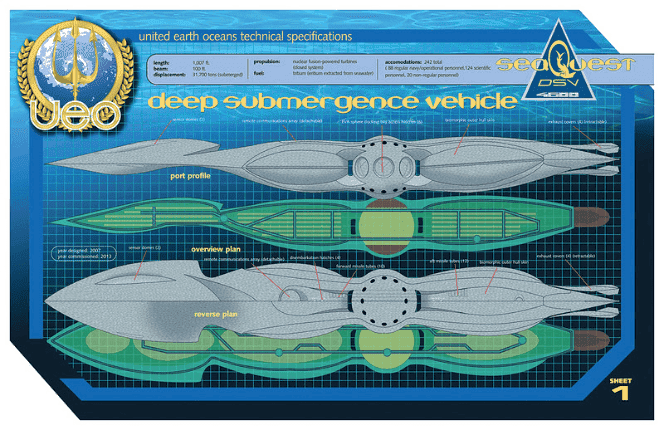
I've often wondered how realistic the Seaquest DSV submarine design was.

Here are some attachments I've included:
Seaquest schematics 1.png
Seaquest schematics 3.jpg
Seaquest schematics 2.png


https://www.pinterest.fr/pin/326651779206382460/

I would imagine that having windows on the sub would represent structural weakness and it's overall flatness design would make any kind of storage capacity to be a nightmare.

How realistic is the Seaquest DSV submarine design compared to it's real-life counterparts?
 
Last edited by a moderator:
Physics news on Phys.org
Whitestar said:
I would imagine that having windows on the sub would represent structural weakness and it's overall flatness design would make any kind of storage capacity to be a nightmare.
No more so than any other deviation from the basic best shape of a sphere( difficult to propel ) or a cylinder, such as where one would find things such as hatches. Maybe the glass for the window is of a different chemical composition from what we consider as glass.
Any flat surface would need beefy interior structural re-enforcement.
 
  • Like
Likes   Reactions: russ_watters and Whitestar
The shape looks like it would induce a lot of drag from turbulent flow, while the nose would generate lift.
I suppose windows are not a showstopper - the submersibles descending into the Mariana Trench had windows after all.
 
  • Like
Likes   Reactions: russ_watters, Whitestar and BvU
Bandersnatch said:
The shape looks like it would induce a lot of drag from turbulent flow, while the nose would generate lift.
I suppose windows are not a showstopper - the submersibles descending into the Mariana Trench had windows after all.

Really? How does the shape would induce tremendous drag from turbulent flow, considering it's sleek design?
 
I don't know about tremendous, but in general every shape deviation from the teardrop-shaped tube, i.e. every hole in the hull, every sharp corner or protrusion, will entrap the flow. That central bulb with its separation from the rest of the hull looks like the main offender here.
 
  • Like
Likes   Reactions: Whitestar and berkeman
Seaquest DSV
3D models are better to explain the origin of the shape - it is not that bad.

856fdf_99094fedd64c4be7a2e9620ad364a897.webp

From here

But:
..the ship has a crush depth of more than 9 km of water...

Sorry, but that makes it a big NO.
At that depth anything else but strictly circular cross sections for the pressure hull - no.
 
Some of these deep ocean vehicles have a spherical pressure hull buried in an outer hull that could be designed to let it slip through the water with less turbulence.
 
  • Like
  • Informative
Likes   Reactions: Whitestar and berkeman
Bandersnatch said:
I don't know about tremendous, but in general every shape deviation from the teardrop-shaped tube, i.e. every hole in the hull, every sharp corner or protrusion, will entrap the flow. That central bulb with its separation from the rest of the hull looks like the main offender here.

Interesting! :cool: So, there is a logical reason as to why real-life submarines are designed as cigar-like or teardrop-shape tubes, eh?
 
Whitestar said:
Really? How does the shape would induce tremendous drag from turbulent flow, considering it's sleek design?
Whitestar said:
Interesting! :cool: So, there is a logical reason as to why real-life submarines are designed as cigar-like or teardrop-shape tubes, eh?
It isn't sleek at all! Teardrop = sleek. Complicated shapes = not sleek.
Whitestar said:
I've often wondered how realistic the Seaquest DSV submarine design was.

How realistic is the Seaquest DSV submarine design compared to it's real-life counterparts?
The Seaquest DSV wasn't a "design" (as a submarine). It is, and should only be thought of as a piece of art.
 
  • Like
Likes   Reactions: Whitestar
  • #10
Whitestar said:
So, there is a logical reason as to why real-life submarines are designed as cigar-like or teardrop-shape tubes, eh?

https://en.wikipedia.org/wiki/USS_Albacore_(AGSS-569)

But I think your question is "why doesn't the fictional submarine look like real ones" rather than the reverse.
 
  • Like
Likes   Reactions: Whitestar and russ_watters

Similar threads

  • Poll Poll
  • · Replies 12 ·
Replies
12
Views
3K
  • · Replies 52 ·
2
Replies
52
Views
7K
  • · Replies 2 ·
Replies
2
Views
2K
  • · Replies 21 ·
Replies
21
Views
5K
Replies
29
Views
5K
  • · Replies 22 ·
Replies
22
Views
5K
  • · Replies 26 ·
Replies
26
Views
7K
  • · Replies 9 ·
Replies
9
Views
3K
  • · Replies 64 ·
3
Replies
64
Views
10K
  • · Replies 15 ·
Replies
15
Views
2K