Does adding an extra bolt distribute seat belt forces evenly?

Click For Summary

Discussion Overview

The discussion revolves around the forces experienced by a 3-point seat belt in a car, particularly focusing on the implications of adding an extra bolt for force distribution. Participants explore the mechanics of seat belt tension, anchor points, and the effects of different configurations on force distribution during a sudden stop.

Discussion Character

  • Technical explanation
  • Debate/contested
  • Mathematical reasoning

Main Points Raised

  • One participant suggests that using a factory bolt hole would distribute forces across four anchor points instead of three, implying a potential benefit in safety.
  • Another participant counters that the force is not divided among four points, arguing that only three points are effectively bearing the load, with specific percentages assigned to each anchor point.
  • There is a discussion about the tension in the seat belt, with one participant proposing that the tension is one-fourth of the stopping force due to the configuration of the belt.
  • Questions arise regarding the concept of extension in the belt and whether the belt stretches proportionally to the distance traveled by the person in restraint.
  • Participants explore the relationship between the number of anchor points and the forces experienced at each, with some suggesting that the D-ring experiences a different force compared to other anchors.

Areas of Agreement / Disagreement

Participants express differing views on how forces are distributed among the anchor points and whether adding an extra bolt changes this distribution. The discussion remains unresolved, with multiple competing perspectives on the mechanics involved.

Contextual Notes

There are limitations in the assumptions made about the geometry of the seat belt system and the specific conditions under which the forces are calculated. The discussion includes unresolved mathematical steps and varying interpretations of how force is distributed based on different configurations.

StephenSLR
Messages
2
Reaction score
0
Hi all,

I'm having an online discussion and curious to know about the forces a 3-point seat belt has on a car.

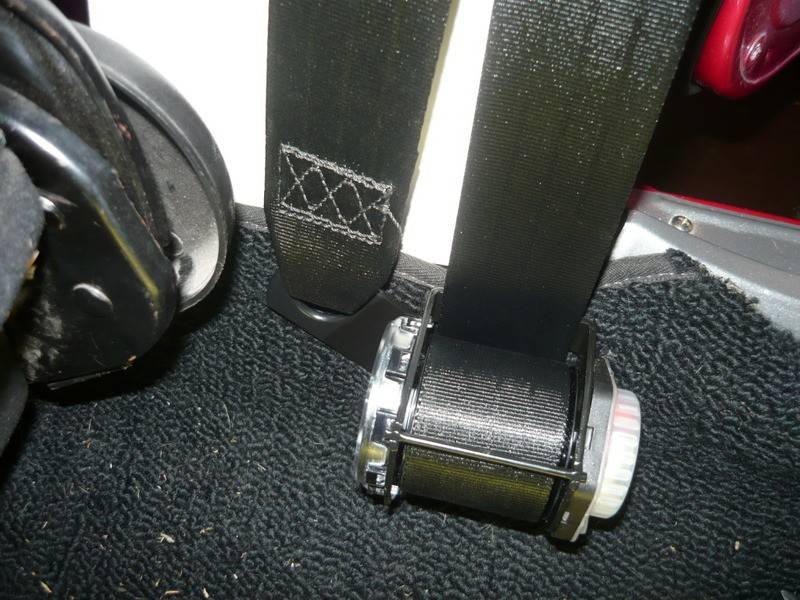
One guy is fitting this retractable belt to his car.
P1000672.jpg


The retractor and anchor mount at one bolt hole, the anchor is off centre, it attaches via a steel extension piece, the section of extension piece you can't see is behind the retractor and bolted to the same hole the retractor is.

His car has two 'factory installed' lower mounting holes on one side, a separate hole each for the retractor and anchor and I advised him to mount the belt as it is here.
asa%20seat%20belt%20load%20chart%20-%20colored%20wording_thumb.jpg


Saying 'Personally I'd use the factory bolt hole, in an accident you have the force distributed between four anchor points not three'

I received a reply from someone saying

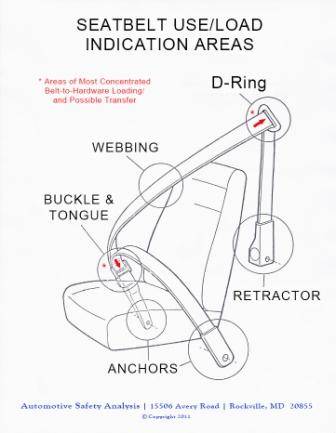
the force isn't divided up between four anchor points, it's really only three, the two floor ones on the side of the car and the one on the trans tunnel side.
The tunnel side gets 50% and the side ones 25% each


The top mount at the D-ring definitely experiences force so let's say you remove it.

Wouldn't the bottom anchor bolts feel an increase in force? When the person in the car experiences a sudden stop, doesn't the resultant force that the car experiences from the seat belt remain the same in both lap belt and lap-sash belt applications?

My opponent says adding an extra bolt will not distribute the forces evenly but I think he is assuming the tension T will be the same in both seat belt applications.

s
 
Last edited:
Physics news on Phys.org
To calculate tension in the belt, consider the required extension when the person moves a distance l: In the conventional setup, this is about 4l. Therefore, tension in the belt (integrated over the belt cross-section) is 1/4 of its stopping force F.
This is true for all belts which cross the body twice in some way.

To calculate forces on the anchors, simply count the number of belt parts connected to them: The outer anchor (same side as retractor) and the retractor will get F/4, the inner anchor and the D-ring get F/2.
 
do it by parts mate, that should help
 
mfb said:
consider the required extension when the person moves a distance l: In the conventional setup, this is about 4l.

Sorry but what do you mean by extension? The person in restraint has traveled distance L, does the belt stretch by 4 times the travel distance?

mfb said:
tension in the belt (integrated over the belt cross-section) is 1/4 of its stopping force F.

How did you work it out to be 1/4?

Is it because the person is held back at 4 points (shoulder, belt shoulder side hip, upper right hip, lower right hip) and at each point the force F= m/4 x a

Yes, Tension T = F/A (Cross sectional area)

mfb said:
This is true for all belts which cross the body twice in some way.

So the force in a lap belt (2-point belt) is twice at F = m/2 x a?

Or is there an elongation component to the equation and is the elongation more due to the restraining mass at only 2 points?

mfb said:
To calculate forces on the anchors, simply count the number of belt parts connected to them: The outer anchor (same side as retractor) and the retractor will get F/4, the inner anchor and the D-ring get F/2.

Wouldn't the force at the D-ring be 2FCos θ/2 ?

s
 
StephenSLR said:
Sorry but what do you mean by extension? The person in restraint has traveled distance L, does the belt stretch by 4 times the travel distance?
Approximately. Depends on the precise geometry of the system.
How did you work it out to be 1/4?
Inverse of the factor 4.
Is it because the person is held back at 4 points (shoulder, belt shoulder side hip, upper right hip, lower right hip) and at each point the force F= m/4 x a
Like that, yes.
So the force in a lap belt (2-point belt) is twice at F = m/2 x a?
If the belt just goes from one side to the other: Yes.
Wouldn't the force at the D-ring be 2FCos θ/2 ?
Ah, you are right. But the angle is small, so I don't expect a big difference.
 

Similar threads

  • · Replies 11 ·
Replies
11
Views
1K
  • · Replies 7 ·
Replies
7
Views
2K
  • · Replies 11 ·
Replies
11
Views
3K
  • · Replies 19 ·
Replies
19
Views
12K
  • · Replies 23 ·
Replies
23
Views
3K
  • · Replies 19 ·
Replies
19
Views
5K
  • · Replies 1 ·
Replies
1
Views
3K
  • · Replies 1 ·
Replies
1
Views
11K
  • · Replies 1 ·
Replies
1
Views
10K
  • · Replies 2 ·
Replies
2
Views
3K