Second highest frequency in a sound pipe

5 replies · 1K views · last reply
Bolter
Messages
262
Reaction score
31
Homework Statement
See below
Relevant Equations
Speed = frequency x wavelength
So here is my question

Printed problem text: A loudspeaker is placed near the open end of a pipe length 426 mm closed at its other end. The lowest frequency at which pipe resonates is 238 Hz. Calculate the speed of sound in the pipe.

Text problem: A loudspeaker is placed near the open end of a pipe length 95 cm closed at its other end. Calculate the second highest frequency (first overtone) of the pipe if the speed of sound is 340 m/s.

Have tried it and got these as my answers

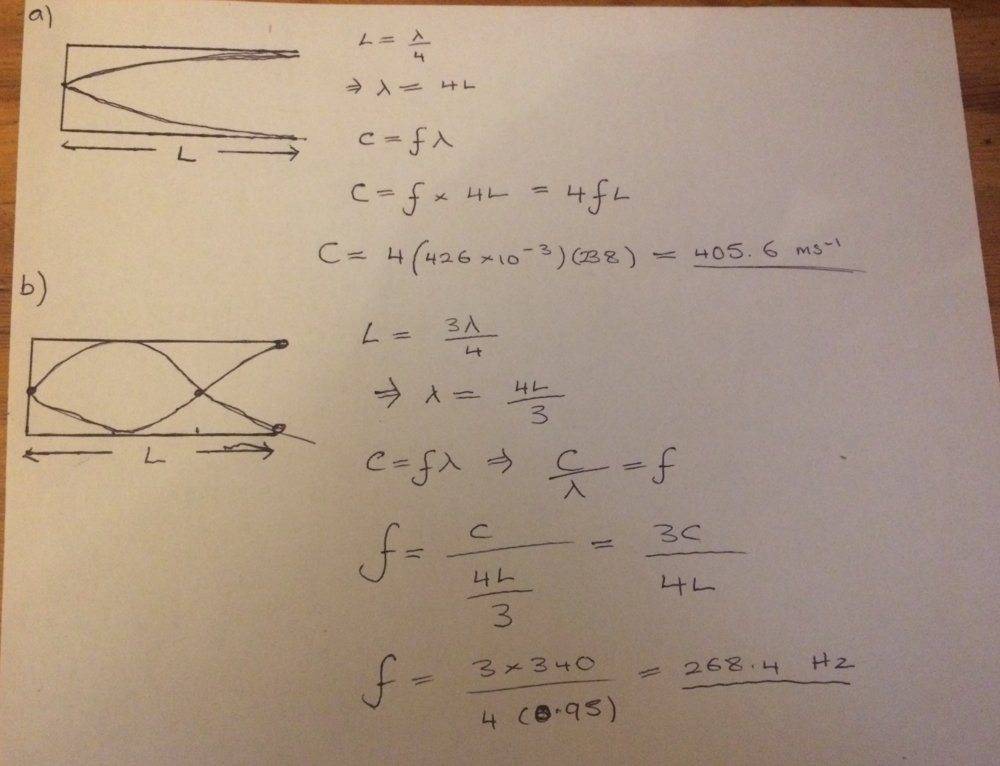
Handwritten working on paper: part a) shows a pipe closed at one end with a standing wave and L = λ/4, giving C = 4fL and C = 405.6 m/s; part b) shows a pipe with a standing wave of three half-wavelengths, L = 3λ/4, leading to f = 3C/4L = 268.4 Hz.


Have I done part b) correctly over here to find the 2nd highest frequency?

Any help would be much appreciated! Thanks
 
Bolter said:
Homework Statement:: See below
Relevant Equations:: Speed = frequency x wavelength

So here is my question

View attachment 258637
View attachment 258638
Have tried it and got these as my answers
View attachment 258639

Have I done part b) correctly over here to find the 2nd highest frequency?

Any help would be much appreciated! Thanks
You were doing fine as far as 3c/(4L), but I don't understand the numbers you plugged in for c and L.

By the way, what you have (almost) calculated is the second lowest frequency, which is what the question should have asked for. There is no highest frequency.
 
haruspex said:
You were doing fine as far as 3c/(4L), but I don't understand the numbers you plugged in for c and L.

By the way, what you have (almost) calculated is the second lowest frequency, which is what the question should have asked for. There is no highest frequency.

Ah yes I see why the question should’ve meant second lowest frequency and not second highest

For the c and L values I have plugged in, these are just the speed of sound (which is 340 m/s) and length of the sound sound pipe in mm (I converted them back into meters to keep in SI units)
 
Bolter said:
For the c and L values I have plugged in, these are just the speed of sound (which is 340 m/s) and length of the sound sound pipe in mm (I converted them back into meters to keep in SI units)
Ah, sorry, I misread the question. I was looking at data in the first part.
Your answers are fine.
 
  • Like
Likes   Reactions: Bolter
Bolter said:
Ah yes I see why the question should’ve meant second lowest frequency and not second highest

I completely agree what second highest should mean, but I can’t help point out the screwy confusions of how people actually use language. In the common vernacular people will sometimes say “second highest” when they mean “second in height”, so the “third highest rung on the ladder” is understood to be counted from the bottom. Very poor choice for a physics problem, but not unusual for English.
 
  • Like
Likes   Reactions: Bolter
Cutter Ketch said:
“second highest” when they mean “second in height”
Hmm... I would use those interchangeably, both meaning second from the top.