Second Isomorphism Theorem for Rings .... Bland Theorem 3.3.1

Click For Summary

Discussion Overview

The discussion revolves around Bland's proof of the Second Isomorphism Theorem for rings, specifically focusing on the kernel of a ring homomorphism and the relationship between the ideals involved. Participants are seeking clarification on the proof's details and definitions.

Discussion Character

  • Technical explanation
  • Conceptual clarification
  • Debate/contested

Main Points Raised

  • Peter seeks help with proving that the kernel of the ring homomorphism is ##I_1/I_2##.
  • Andrew provides a method to show that ##I_1/I_2## is in the kernel by taking an arbitrary element and demonstrating it belongs to the kernel.
  • Andrew also suggests proving that the kernel is contained in ##I_1/I_2## by showing that if an element is in the kernel, it must also be in ##I_1/I_2##.
  • Peter asks for clarification on why ##x+I_2\in I_1/I_2## implies that ##x\in I_1##.
  • Another participant explains that this implication is true by definition of the cosets in ##I_1/I_2##.

Areas of Agreement / Disagreement

Participants generally agree on the definitions and steps involved in the proof, but there is a request for clarification on specific implications, indicating that some aspects of the discussion remain contested or require further explanation.

Contextual Notes

The discussion includes assumptions about the definitions of ideals and cosets, which may not be universally understood by all participants. The proof relies on these definitions, and any missing context could affect understanding.

Math Amateur
Gold Member
MHB
Messages
3,920
Reaction score
48
I am reading "The Basics of Abstract Algebra" by Paul E. Bland ... ...

I am currently focused on Chapter 3: Sets with Two Binary Operations: Rings ... ...

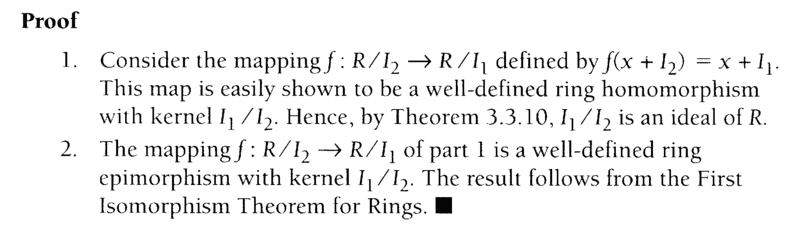
I need help with Bland's proof of the Second Isomorphism Theorem for rings ...

Bland's Second Isomorphism Theorem for rings and its proof read as follows:
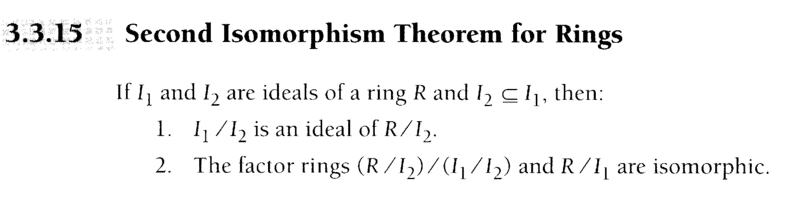
Bland - 1 - Theorem 3.3.15 ... PART 1 ... .png

Bland - 2 - Theorem 3.3.15 ... PART 2 ... .png

In the above proof by Bland we read the following:

" ... ... This map is easily shown to be a well defined ring homomorphism with kernel ##I_1/I_2##. ... ... "I can see that ##f## is a ring homomorphism ... but how do we prove that the kernel is ##I_1/I_2## ... ... ?Hope someone can help ...

Peter
 

Attachments

  • Bland - 1 - Theorem 3.3.15 ... PART 1 ... .png
    Bland - 1 - Theorem 3.3.15 ... PART 1 ... .png
    10.1 KB · Views: 932
  • Bland - 2 - Theorem 3.3.15 ... PART 2 ... .png
    Bland - 2 - Theorem 3.3.15 ... PART 2 ... .png
    18.3 KB · Views: 780
Physics news on Phys.org
Math Amateur said:
I can see that ##f## is a ring homomorphism ... but how do we prove that the kernel is ##I_1/I_2## ... ... ?
First prove ##I_1/I_2## is in the kernel. Take an arbitrary ##x+I_2\in I_1/I_2##. That means that ##x\in I_1##. Then

##f(x+I_2)\triangleq x+I_1=I_1## (since ##x\in I_1)\ =0_{R/I_1}##.

So ##x+I_2## is in the kernel.

Now prove that the kernel is in ##I_1/I_2##. Take an arbitrary element ##x+I_2## of the kernel. Then we have ##f(x+I_2)\triangleq x+I_1=0_{R/I_1}=I_1##. Hence ##x\in I_1##. Hence ##x+I_1\in I_1/I_2##.
 
  • Like
Likes   Reactions: Math Amateur
andrewkirk said:
First prove ##I_1/I_2## is in the kernel. Take an arbitrary ##x+I_2\in I_1/I_2##. That means that ##x\in I_1##. Then

##f(x+I_2)\triangleq x+I_1=I_1## (since ##x\in I_1)\ =0_{R/I_1}##.

So ##x+I_2## is in the kernel.

Now prove that the kernel is in ##I_1/I_2##. Take an arbitrary element ##x+I_2## of the kernel. Then we have ##f(x+I_2)\triangleq x+I_1=0_{R/I_1}=I_1##. Hence ##x\in I_1##. Hence ##x+I_1\in I_1/I_2##.
Thanks for the help, Andrew ...

But ... just a minor point of clarification ...

You write ... " ... ... Take an arbitrary ##x+I_2\in I_1/I_2##. That means that ##x\in I_1## ... ... "

Can you explain why ##x+I_2\in I_1/I_2## implies that ##x\in I_1## ... ... ?

Peter
 
Math Amateur said:
You write ... " ... ... Take an arbitrary ##x+I_2\in I_1/I_2##. That means that ##x\in I_1## ... ... "

Can you explain why ##x+I_2\in I_1/I_2## implies that ##x\in I_1## ... ... ?

Peter
It is true by definition.

##I_1/I_2## is defined to be the following collection of cosets of ##I_2##
$$I_1/I_2 \triangleq \{x+I_2\ :\ x\in I_1\}$$
 
  • Like
Likes   Reactions: Math Amateur
Hi Andrew ...

Hmmm ... yes ... of course ... you're right ...

Thanks again for your help ...

Peter
 

Similar threads

Replies
6
Views
2K
  • · Replies 2 ·
Replies
2
Views
3K
Replies
3
Views
2K
  • · Replies 4 ·
Replies
4
Views
2K
  • · Replies 2 ·
Replies
2
Views
2K
  • · Replies 2 ·
Replies
2
Views
1K
  • · Replies 2 ·
Replies
2
Views
2K
  • · Replies 6 ·
Replies
6
Views
2K
Replies
2
Views
2K
  • · Replies 21 ·
Replies
21
Views
2K