Seeking formal derivation for common thermo equation

  • Context: Graduate 
  • Thread starter Thread starter saybrook1
  • Start date Start date
  • Tags Tags
    Derivation Thermo
Click For Summary
SUMMARY

The discussion centers on deriving the change in entropy during an isothermal process in thermodynamics. The user seeks a formal derivation of a specific equation, referencing the first law of thermodynamics and the relationship between heat and entropy. Key resources mentioned include F. Reif's book on Statistical Physics/Thermodynamics and the texts by Pathria and Schroeder. The user successfully identifies a method to derive the equation by taking the difference between two states, while also questioning the necessity of the isothermal condition for general entropy change equations.

PREREQUISITES
  • Understanding of the first law of thermodynamics
  • Familiarity with entropy concepts in thermodynamics
  • Knowledge of partition functions in statistical mechanics
  • Basic principles of Maxwell-Boltzmann statistics
NEXT STEPS
  • Study the derivation of the partition function from statistical mechanics
  • Learn about the relationship between heat and entropy in isothermal processes
  • Explore the derivation of entropy change equations for adiabatic processes
  • Review F. Reif's Statistical Physics for deeper insights into thermodynamic equations
USEFUL FOR

Students and professionals in physics, particularly those focusing on thermodynamics and statistical mechanics, as well as educators seeking to clarify entropy concepts in isothermal and adiabatic processes.

saybrook1
Messages
101
Reaction score
4
Hi guys,

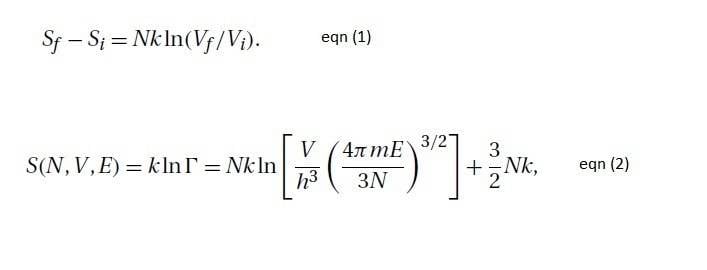
I was hoping that someone might be able to help me out with a formal derivation of this common thermodynamic equation regarding the change in entropy during an isothermal change of state.

The first equation is what I would like to derive, and the second is where the book tells me to derive it from once we acknowledge that there is no energy change in an isothermal process. I've tried a few different ways but haven't had success yet. I'm thinking it has to do with the first law and then somehow relating heat to entropy.
entropy change.jpg


Anyway, thanks for any help. Even a link would rock!

Best regards

Here's a link to the image in case it won't load for you here:
http://imgur.com/a/s9qoP
 
Science news on Phys.org
Hello again. The best book I know of for Statistical Physics/Thermodynamics is F.Reif's book. He derives the case ## F=-kT ln Z ## and gives an extensive treatment of ## Z ## for ## N ## atoms using the Maxwell-Boltzmann Statistics with the ## N! ## Boltzmann factor in the denominator. ## Z=\zeta^N/N! ## where ## \zeta ## is the partition function for a single atom (of the gas). The derivation of ## \zeta ## is somewhat lengthy but not difficult. Once you get Z and F, the minus partial of F w.r.t. T at constant V I think is the entropy ## S ##.
 
  • Like
Likes   Reactions: saybrook1
Hello my friend! I've just returned from getting some late night tacos; I appreciate you responding to my post again. So, the text that I'm going through is Pathria and I also have the Schroeder undergrad text "Thermal Physics". The problem is that I think Pathria implies that you can derive eqn (1) without use of the partition function. This is at the end of chapter 1 of his book and the partition function has not been introduced in any form yet. I'm just banging my head on a way to derive eqn (1) from eqn (2) under an isothermal change of state(fixed N,T). I will however attempt your method. Thanks again!
 
  • Like
Likes   Reactions: Charles Link
Wooo I think I figured it out. I think you need to take eqn (2) and just take the difference like so: $$S_2(N,V_2,E) - S_1(N,V_1,E)$$
I'll report back and let you know how it goes!
 
Alright, so here it is. I actually found this solution while looking through the publicly available lectures notes of Alejandro L. Garcia of San Jose State University.
If anyone has anything to add, please do. A question that I still have about this, is that it doesn't seem like we needed to invoke an isothermal condition, so is this a general entropy change equation for adiabatic processes?
Entropy change solution.jpg
 

Similar threads

  • · Replies 1 ·
Replies
1
Views
2K
Replies
5
Views
718
  • · Replies 1 ·
Replies
1
Views
2K
  • · Replies 11 ·
Replies
11
Views
9K
  • · Replies 6 ·
Replies
6
Views
2K
  • · Replies 4 ·
Replies
4
Views
1K
  • · Replies 15 ·
Replies
15
Views
2K
  • · Replies 1 ·
Replies
1
Views
1K
  • · Replies 2 ·
Replies
2
Views
2K
  • · Replies 4 ·
Replies
4
Views
6K