Self-adjoint matrix, general form

  • Context: Graduate 
  • Thread starter Thread starter Jakub Tesar
  • Start date Start date
  • Tags Tags
    Form General Matrix
Join the discussion
Registration is free. Ask a follow-up in this thread, or start your own.
4 replies · 3K views
Jakub Tesar
Messages
2
Reaction score
0
Hi,
I am looking for the general form of 2x2 complex transformation matrix.

I have the article, that says "the relative position of a self-adjoint 2x2 matrix B with respect to A as a reference (corresponding to the transformation from the eigenspaces of A to the eigenspaces of B) is determined by two real-valued parameters."

But the general form of self-adjoint matrix is determined by four real-valued parameters (or three if I limit the matrix by the detU=1), isn't it?

I tried to start with the matrix derived from the Bloch vector, but I doubt, that it's the most general case:
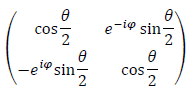
upload_2016-1-29_14-44-33.png


I expect I just made a mistake somewhere, but I can't find the right place.
Thank you,
Jakub
 
Physics news on Phys.org
They're probably talking self-adjoint unitary matrices, which do have just two real degrees of freedom.

Your formula misses the Pauli Z matrix.
 
  • Like
Likes   Reactions: Jakub Tesar
Self-adjoint is a mathematical description. A general description is as follows:

From Wikipedia, the free encyclopedia
In mathematics, a Hermitian matrix (or self-adjoint matrix) is a square matrix with complex entries that is equal to its own conjugate transpose—that is, the element in the i-th row and j-th column is equal to the complex conjugate of the element in the j-th row and i-th column, for all indices i and j:

047bf7f688e415bf724ddd891712758c.png
or
eaf2c338093020405a336a2ed8ffaf63.png
, in matrix form.
 
  • Like
Likes   Reactions: Jakub Tesar
Sorry, I do not look for self-adjoint matrix, just unitary (wrong title) -- for the general form of transformation between two different bases in the 2x2 Hilbert space.

I was thinking in the same direction Stirlanc, but I wonder how I can add Pauli Z matrix and still have unitary matrix with only 2 real parameters.
 
Let's see. A general ##\mathbb{C}^{2 \times 2}## matrix,
$$M=\begin{pmatrix} a & b \\ c & d \end{pmatrix}$$
has 4 independent complex, i.e., 8 independent real parameters. Now for the matrix to be unitary you must have
$$M^{\dagger} M=\mathbb{1},$$
which implies that both the columns and the rows are two orthonormal vectors. Thus you have the constraints
$$|a|^2+|b|^2=|c|^2+|d|^2=|a|^2+|b|^2=|c|^2+|d|^2=1,$$
i.e., of the 4 moduli of the numbers only 2 are indpendent.
Then you have
$$a^* c + b^* d=a^* b+c^* d=0,$$
which are two more constraints, i.e., of the 8 real parameters only 4 are independent.

Depending on your problem different parametrizations are more or less convenient. One is to use the Lie algebra of the unitary group U(2), leading to
$$M=\exp(\mathrm{i} \varphi) \exp(\mathrm{i} \vec{\alpha} \cdot \vec{\sigma}/2),$$
where ##\vec{\sigma}## are the three Pauli matrices, and ##\vec{\alpha} \in B_{2\pi}(0)##, ##\varphi \in [0,2 \pi[##.
 
  • Like
Likes   Reactions: Jakub Tesar