Math Amateur
Gold Member
MHB
- 3,920
- 48
Dummit and Foote in Section 13.5 on separable extensions make some remarks about separable polynomials that I do not quite follow. The remarks follow Corollary 34 and its proof ...
Corollary 34, its proof and the remarks read as follows:
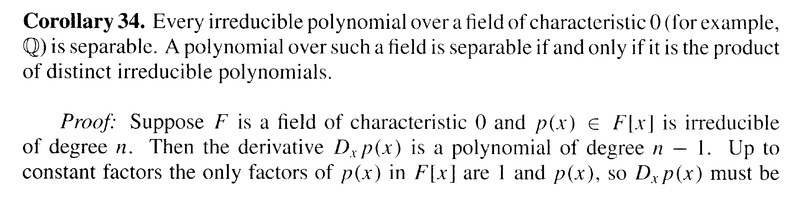
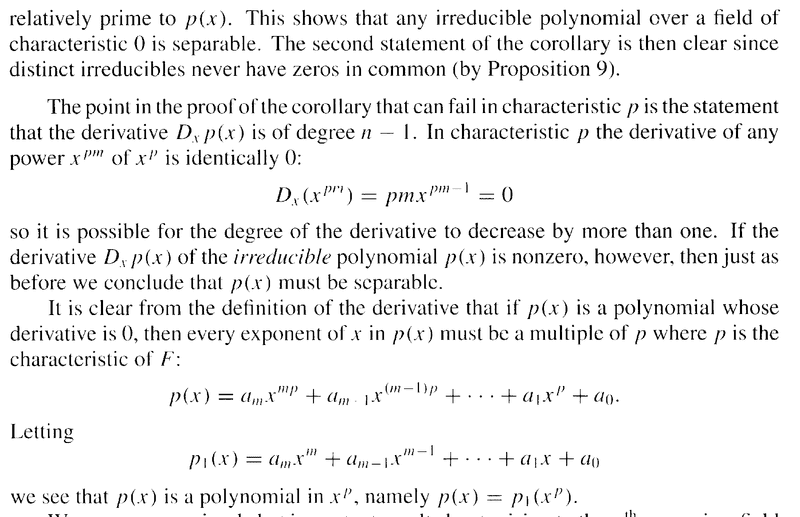
In the above text by D&F, in the remarks after the proof we read:
" ... in characteristic ##p## the derivative of any power ##x^{pm}## of ##x^p## is identically ##0##:
##D_x( x^{pm} ) = pm x^{pm - 1 } = 0##
so it is possible for the degree of the derivative to decrease by more than ##1##.
If the derivative ##D_x p(x)## of the irreducible polynomial ##p(x)## is non-zero, however, , then just as before we conclude that ##p(x)## must be separable. ... ... "My questions are as follows:Question 1
I am assuming that when the degree of the derivative decreases by more than ##1, p(x)## is still relatively prime to ##D_x p(x)## and so ##p(x)## is separable ... is that the correct reasoning here ...Question 2
In stating that "if the derivative ##D_x p(x)## of the irreducible polynomial ##p(x)## is non-zero, however, , then just as before we conclude that ##p(x)## must be separable". D&F are implying that if ##D_x p(x) = 0## then ##p(x)## is not separable (or not necessarily separable) ... is this the case ... if it is the case, why/how is this true ...
Hope that someone can help ...
Peter
Corollary 34, its proof and the remarks read as follows:
In the above text by D&F, in the remarks after the proof we read:
" ... in characteristic ##p## the derivative of any power ##x^{pm}## of ##x^p## is identically ##0##:
##D_x( x^{pm} ) = pm x^{pm - 1 } = 0##
so it is possible for the degree of the derivative to decrease by more than ##1##.
If the derivative ##D_x p(x)## of the irreducible polynomial ##p(x)## is non-zero, however, , then just as before we conclude that ##p(x)## must be separable. ... ... "My questions are as follows:Question 1
I am assuming that when the degree of the derivative decreases by more than ##1, p(x)## is still relatively prime to ##D_x p(x)## and so ##p(x)## is separable ... is that the correct reasoning here ...Question 2
In stating that "if the derivative ##D_x p(x)## of the irreducible polynomial ##p(x)## is non-zero, however, , then just as before we conclude that ##p(x)## must be separable". D&F are implying that if ##D_x p(x) = 0## then ##p(x)## is not separable (or not necessarily separable) ... is this the case ... if it is the case, why/how is this true ...
Hope that someone can help ...
Peter

