Serge Lang: Inequality Problem

Click For Summary
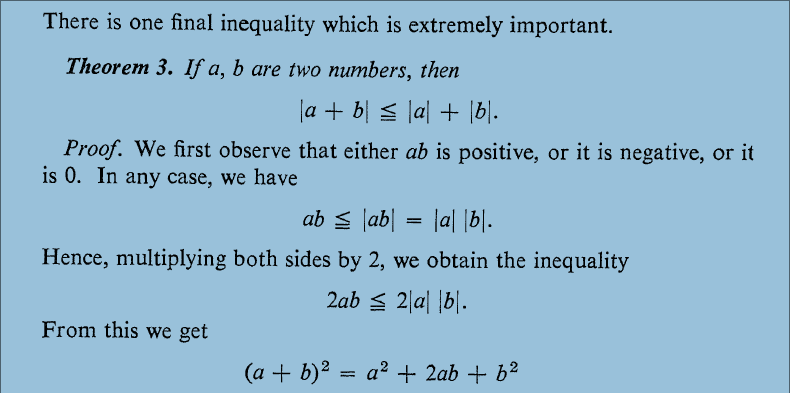
The discussion revolves around a confusion regarding the inequality 2ab ≤ 2|a||b| and its relationship to the equation (a+b)² = a² + 2ab + b². It is clarified that the second equation is always true and does not derive from the first inequality. The user initially misinterpreted the connection between the two, believing they could be manipulated into one another. Upon reflection, they realized that the first inequality serves a different purpose in proving |a+b| ≤ |a| + |b|. The conversation highlights the importance of understanding the context in which mathematical statements are used.
Cosmophile
Messages
111
Reaction score
2
Hello, all. I am reading Serge Lang's "A First Course in Calculus" in order to get a better understanding of the topic. I thought I would read his review of fundamental concepts, and, naturally, it has been a breeze so far. However, I am stumped when trying to work out this problem:
8aab10f09c.png


I do not see how 2ab \leq 2|a||b|
turns into (a+b)^2 = a^2 +2ab + b^2

Any help in resolving this is greatly appreciated. I don't want to move on without understanding this bit. It's really bothering me.

Also, I apologize for not adhering to the established template. I didn't see a way to formulate this question in a way that fit the template.
 
Physics news on Phys.org
Cosmophile said:
I do not see how 2ab \leq 2|a||b|
turns into (a+b)^2 = a^2 +2ab + b^2
It doesn't turn into that. The second equation is always true. I would have to guess that the use of the first equation comes a bit further on. If that doesn't explain it, please post a longer extract.
 
I stepped away from it for a while (since I posted this) and when I sat down, I realized that it was just a poor execution (in my opinion) on Lang's part. The "from this we get..." confused me into thinking the first could be manipulated into becoming the second. The first was stated because I can use that to say:

(a+b)^2 \leq a^2 +2|a||b| + b^2 <br /> = (|a|^2 + |b|^2)
Square root both sides and voila, you get |a+b| \leq |a| + |b|
which is what we wanted to prove. All I had to do was step away for a bit.
 
Question: A clock's minute hand has length 4 and its hour hand has length 3. What is the distance between the tips at the moment when it is increasing most rapidly?(Putnam Exam Question) Answer: Making assumption that both the hands moves at constant angular velocities, the answer is ## \sqrt{7} .## But don't you think this assumption is somewhat doubtful and wrong?

Similar threads

  • · Replies 9 ·
Replies
9
Views
2K
  • · Replies 9 ·
Replies
9
Views
2K
  • · Replies 19 ·
Replies
19
Views
3K
  • · Replies 9 ·
Replies
9
Views
2K
  • · Replies 3 ·
Replies
3
Views
2K
  • · Replies 3 ·
Replies
3
Views
2K
  • · Replies 8 ·
Replies
8
Views
2K
  • · Replies 6 ·
Replies
6
Views
3K
  • · Replies 2 ·
Replies
2
Views
2K
Replies
7
Views
1K