Show that a particle moves over a circumference

Click For Summary

Discussion Overview

The discussion revolves around demonstrating that a particle moves along a circumference centered at the origin. Participants explore the mathematical representation of the particle's position vector and its implications for motion along a circular path, including directionality and the occupancy of points on the circumference as a parameter varies.

Discussion Character

  • Technical explanation
  • Mathematical reasoning
  • Debate/contested

Main Points Raised

  • One participant presents the position vector and attempts to use the equation x² + y² = r² to show the particle's motion along a circumference.
  • Another participant provides algebraic manipulations to confirm that the expression simplifies to 1, indicating the particle's path is indeed circular.
  • Some participants note potential typos in the expressions used, particularly regarding the coefficients in the y-coordinate, which could affect the conclusions drawn.
  • There is a discussion about determining the direction of the particle's motion as the parameter t increases, with suggestions to analyze the behavior of the functions or relate them to trigonometric identities.
  • Participants question whether all points on the circumference are occupied by the particle as t varies from negative to positive infinity, leading to a debate about the implications of the parameterization and the nature of real numbers.
  • One participant suggests that certain points, such as (-1, 0), are not occupied by the particle, prompting further exploration of the mathematical conditions that lead to this conclusion.

Areas of Agreement / Disagreement

Participants express differing views on the occupancy of points on the circumference, particularly regarding the point (-1, 0). While some agree that not all points are occupied, others question the reasoning behind this conclusion, indicating that the discussion remains unresolved.

Contextual Notes

Participants highlight limitations in the mathematical expressions used, such as the dependence on the parameter t being real and the implications of approaching infinity. There is also a recognition that certain points cannot be attained based on the parameterization provided.

Thales Costa
Messages
12
Reaction score
0
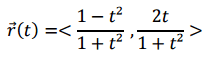
The problem asks me to show that a particle moves over a circumference with its center at the origin.

The position vector of a moving particle is:
ljiZbVp.png


I've tried using the x2+y2=r2 formula of the circumference, squaring both components of the vector function but I couldn't figure out what to do with the result.

How should I go in order to show this?
 
Physics news on Phys.org
Simple algebra: x^{2}+y^{2}=(\frac{1-t^{2}}{1+t^{2}})^{2}+(\frac{2t}{1+t^{2}})^{2}=\frac{1-2t^{2}+t^{4}+4t^{4}}{(1+t^{2})^{2}}=\frac{1+2t^{2}+t^{4}}{1+2t^{2}+t^{4}}=1.
 
Those formulas are from the http://www.qc.edu.hk/math/Certificate%20Level/t%20method.htm that is sometimes useful in trigonometry. If you read the first part of the link, you'll see why the particle travels around a circle.
 
Svein said:
Simple algebra: x^{2}+y^{2}=(\frac{1-t^{2}}{1+t^{2}})^{2}+(\frac{2t}{1+t^{2}})^{2}=\frac{1-2t^{2}+t^{4}+4t^{4}}{(1+t^{2})^{2}}=\frac{1+2t^{2}+t^{4}}{1+2t^{2}+t^{4}}=1.
Oh my god, that's it. I did the math but for some reason I had 4t2 instead of 2t2. I should double check my math more often. Thanks for the reply.

The problem also asks about the direction the particle moves as t increases, if it's counter or clockwise, and if there are points in the circumference that are not occupied by the particle when t goes from negative infinity to infinity.

Do I just plug in t values and see how the function behaves to find out the direction?
 
Svein said:
Simple algebra: x^{2}+y^{2}=(\frac{1-t^{2}}{1+t^{2}})^{2}+(\frac{2t}{1+t^{2}})^{2}=\frac{1-2t^{2}+t^{4}+4t^{4}}{(1+t^{2})^{2}}=\frac{1+2t^{2}+t^{4}}{1+2t^{2}+t^{4}}=1.
There's a typo in one of the expressions - ##\frac{1-2t^{2}+t^{4}+4t^{4}}{(1+t^{2})^{2}}## should be ##\frac{1-2t^{2}+t^{4}+4t^{2}}{(1+t^{2})^{2}}##
 
Looks to me that the original formula has a typo: The numerator of the y-coordinate should be 2t2, not 2t.

Then you actually get

x(t)2 + y(t)2 = 1​

for all t.

Hint: You might notice that

y(t) / x(t) = tan(θ),​

so

θ(t) = arctan(y(t) / x(t))​

will tell you the angle θ(t) (or θ(t) ± π) around the circumference. In either case dθ/dt is the rate the angle is increasing.
 
zinq said:
Looks to me that the original formula has a typo: The numerator of the y-coordinate should be 2t2, not 2t.

Then you actually get

x(t)2 + y(t)2 = 1​

for all t.
How so?
Looking only at the numerators:
##(1-t²)²+(2t)²=1-2t²+t^4+4t²=1+2t²+t^4=(1+t²)²##, and that is equal to the denominator squared.
 
Last edited:
Thales Costa said:
Do I just plug in t values and see how the function behaves to find out the direction?
If you use the 't formula' link from post 3, you'll see that the formulas for x and y can be expressed as sin and cos of an angle (which in the link they call ##x## but for this purpose would be better thought of as ##\theta##), which is the angle traveled around the circle in the conventional direction for polar coordinates.
 
Samy, thanks again for the correction. It seems I ought to join up so I have more time to delete my stupid posts.
 
  • #10
These are indeed the t-formulas: Let tan(x/2) = t
=>
(1-t^2)/(1+t^2) = cos x
2t/(1+t^2) = sin x
 
  • #11
andrewkirk said:
If you use the 't formula' link from post 3, you'll see that the formulas for x and y can be expressed as sin and cos of an angle (which in the link they call ##x## but for this purpose would be better thought of as ##\theta##), which is the angle traveled around the circle in the conventional direction for polar coordinates.
I see that now. Thank you for your help!

The problem also asks if there are points that are not occupied by the particle as t goes from negative infinity to positive infinity.
Since the vector function (cosθ, sinθ) is defined at every t from -infinity to +infinity, is it safe to say that all the points are occupied by the particle as t changes?

The answer says that the point (-1,0) is not occupied, by I couldn't figure out why. I think it has something to do with the r2 x2+y2=r2 being ±1
 
  • #12
Thales Costa said:
Since the vector function (cosθ, sinθ) is defined at every t from -infinity to +infinity, is it safe to say that all the points are occupied by the particle as t changes?
The function is defined for every ##t\in(-\infty,\infty)##. But ##t## must be real, so cannot take on a value of ##\pm\infty## as that is not a real number. Hence points on the circle that would require an infinite ##t## are never attained - only asymptotically approached.
 
  • #13
andrewkirk said:
The function is defined for every ##t\in(-\infty,\infty)##. But ##t## must be real, so cannot take on a value of ##\pm\infty## as that is not a real number. Hence points on the circle that would require an infinite ##t## are never attained - only asymptotically approached.
And why is the point (-1,0) not occupied by the particle if the circle is always defined for all real numbers?

Is it because making x = (1-t^2)/(1+t^2) = -1 would give me 2 = 0, therefore not possible.
And plugging x= -1 in x2+y2 = -1 would give me y = 0?

Sorry if it's confusing, my english is a bit bad
 
  • #14
Thales Costa said:
Is it because making x = (1-t^2)/(1+t^2) = -1 would give me 2 = 0, therefore not possible.
Yes
 
  • #15
andrewkirk said:
Yes
Got it. Thank you so much for your help!
 

Similar threads

  • · Replies 6 ·
Replies
6
Views
5K
  • · Replies 40 ·
2
Replies
40
Views
5K
  • · Replies 1 ·
Replies
1
Views
2K
Replies
2
Views
2K
  • · Replies 12 ·
Replies
12
Views
3K
  • · Replies 3 ·
Replies
3
Views
1K
  • · Replies 50 ·
2
Replies
50
Views
4K
  • · Replies 5 ·
Replies
5
Views
13K
  • · Replies 36 ·
2
Replies
36
Views
8K
  • · Replies 1 ·
Replies
1
Views
2K