Show the envelope of circles around a circle is a cardioid

  • Context: Undergrad 
  • Thread starter Thread starter Happiness
  • Start date Start date
  • Tags Tags
    Circle Circles
Click For Summary

Discussion Overview

The discussion revolves around deriving the polar equation of a cardioid as the envelope of circles surrounding a central circle. Participants explore various mathematical approaches and techniques involved in this derivation, including the use of derivatives and transformations between coordinate systems.

Discussion Character

  • Technical explanation
  • Mathematical reasoning
  • Debate/contested

Main Points Raised

  • One participant questions if there is a shorter method to derive the polar equation of the cardioid directly from the equations of the circles.
  • Another participant asks for clarification on the variables u and v used in the initial function, indicating a need for clearer definitions.
  • Several participants discuss the complexity of converting the derived equations into the polar form, with one noting the tedious nature of the manipulations required.
  • There is a suggestion to unroll variables to avoid potential errors with derivatives and to clarify whether the optimization is constrained or involves multiple variables.
  • One participant highlights the challenges of changing coordinate systems and suggests looking into tensor analysis and differential geometry for further insights.

Areas of Agreement / Disagreement

Participants express varying opinions on the methods and challenges involved in deriving the polar equation, indicating that there is no consensus on a singular approach or solution.

Contextual Notes

Participants mention the difficulty of manipulating trigonometric functions and the potential for missing critical points due to the complexity of the equations involved. There is also a recognition that existing mathematical methods may require "tricks" and "guesses" for successful transformations.

Happiness
Messages
686
Reaction score
30
Is there a shorter way to get the answer, the polar equation of a cardioid, directly?
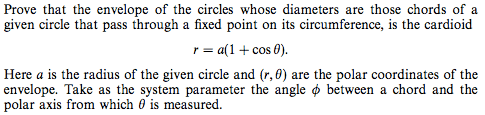
Screen Shot 2016-06-25 at 3.06.50 am.png


My solution involves some tedious work and doesn't give the polar equation directly:

The equation of the member curves (circles) is

##f(x, y, \phi)=(x-a\cos^2\phi)^2+(y-a\cos\phi\sin\phi)^2-a^2\cos^2\phi=0##. --- (1)

To find the envelope curve, we impose ##\frac{\partial f}{\partial\phi}=0##. Thus, we have

##2\sin\phi\cos\phi u-(cos^2\phi-sin^2\phi)v+\sin\phi\cos\phi a=0\,\,\,##, where ##u=x-a\cos^2\phi\,\,\,##and ##\,\,\,v=y-a\cos\phi\sin\phi##.

Making ##v## the subject and then substituting into equation (1), we have (after some tedious work)

##x=2a\cos^2\phi\cos2\phi##.

Making ##u## the subject and then substituting into equation (1), we have (after some tedious work)

##y=2a\cos^2\phi\sin2\phi##.
 
Last edited:
Physics news on Phys.org
Hey Happiness.

Where are the "variables" u and v in your initial function?
 
chiro said:
Hey Happiness.

Where are the "variables" u and v in your initial function?

Hey chiro

##u=x-a\cos^2\phi\,\,\,##and ##\,\,\,v=y-a\cos\phi\sin\phi##

The two equations are

$$(x-a\cos^2\phi)^2+(y-a\cos\phi\sin\phi)^2-a^2\cos^2\phi=0$$

$$2\sin\phi\cos\phi(x-a\cos^2\phi)-(\cos^2\phi-\sin^2\phi)(y-a\cos\phi\sin\phi)+\sin\phi\cos\phi a=0$$

Is there a shorter way to convert this pair of equation into the polar equation ##\rho=a(1+\cos\theta)##?I introduced ##u## and ##v## just to make them look shorter:

$$u^2+v^2-a^2\cos^2\phi=0$$

$$2\sin\phi\cos\phi u-(\cos^2\phi-\sin^2\phi)v+\sin\phi\cos\phi a=0$$
 
Last edited:
I'd recommend unrolling all of your variables so that you only get a function of independent ones since you can potentially miss things with the chain rule (of derivatives).

Since you have two relations (one is a function, the other possibly a relation) you will need to tell us if you are trying to optimize the function with regard to the constraint only (which seems to be the case but needs clarification) or whether you are trying to optimize a multi-variable function (which in this case would be using both functions and then trying to optimize a second one in terms of a derivative in conjunction with the first).

If it's the first then you will need to probably use a normal Jacobian and Hessian formulation to get the critical points as well as something like Lagrange multipliers.

If it is the second then you either have to do a bi-variate optimization problem or find a way to translate one to the other (like with your u and v analogy) and do the first.
 
chiro said:
I'd recommend unrolling all of your variables so that you only get a function of independent ones since you can potentially miss things with the chain rule (of derivatives).

Since you have two relations (one is a function, the other possibly a relation) you will need to tell us if you are trying to optimize the function with regard to the constraint only (which seems to be the case but needs clarification) or whether you are trying to optimize a multi-variable function (which in this case would be using both functions and then trying to optimize a second one in terms of a derivative in conjunction with the first).

If it's the first then you will need to probably use a normal Jacobian and Hessian formulation to get the critical points as well as something like Lagrange multipliers.

If it is the second then you either have to do a bi-variate optimization problem or find a way to translate one to the other (like with your u and v analogy) and do the first.

The two equations are

$$(x-a\cos^2\phi)^2+(y-a\cos\phi\sin\phi)^2-a^2\cos^2\phi=0 -(1)$$

$$2\sin\phi\cos\phi(x-a\cos^2\phi)-(\cos^2\phi-\sin^2\phi)(y-a\cos\phi\sin\phi)+\sin\phi\cos\phi a=0 -(2)$$

Equation (2) is obtained from equation (1) by differentiating wrt ##\phi##. This part is easy.

The troublesome part is to show that these two equations together is equivalent to the polar equation ##r=a(1+\cos\theta)##. I get the answer in the end but my method involves laborious work of completing the square and scarily arduous work of converting the trigonometric functions raised to different powers into various forms using several identities in the hope that they will all simplify into a perfect square. The manipulation of the trigonometric functions is the difficult part because I do not know which form they should be converted to.
 
That's mainly a conversion of basis problem and that is known (given existing mathematical methods) to be difficult in general and it's the reason why differential geometry is not only hard but not that developed yet (it's a big generalization in comparison to the well developed framework of linear algebra).

What you are looking to do if I read your reply correctly is find some kind of technique to do an arbitrary change of basis.

Unfortunately the way current mathematics is setup, most of these results require "tricks" and "guesses" (like the one you use) and the typical co-ordinate systems/bases are often very restrictive.

The only thing I would recommend is taking a look at tensor analysis and differential geometry and go from spherical polar to another system and show the inverse relation holds with respect to the two bases. I'm pretty sure you did something similar but in applied mathematics and engineering, going from one space to another using matrix techniques is something these practitioners have to do and there are techniques to "invert" the basis given how the space "curves" as a function of variables.

The linear case is special in that it's derivatives are always zero meaning the vectors stay the same direction and span a normal linear plane.

If the above sounds like "gobbledy-gook" then pick up a book on tensor analysis (preferably an engineering related one since it will be more applied) and look at how to change the basis of the space with derivatives and tensor objects.
 

Similar threads

  • · Replies 2 ·
Replies
2
Views
2K
  • · Replies 0 ·
Replies
0
Views
2K
  • · Replies 2 ·
Replies
2
Views
2K
  • · Replies 12 ·
Replies
12
Views
5K
  • · Replies 36 ·
2
Replies
36
Views
6K
  • · Replies 3 ·
Replies
3
Views
3K
  • · Replies 7 ·
Replies
7
Views
4K
  • · Replies 33 ·
2
Replies
33
Views
5K
  • · Replies 4 ·
Replies
4
Views
5K