Simple Circuit Analysis - 2 Questions

Click For Summary

Homework Help Overview

The discussion revolves around circuit analysis involving operational amplifiers and resistive networks. Participants are tasked with designing an op-amp circuit for a specified output and calculating input voltages across various resistors in the circuit.

Discussion Character

  • Exploratory, Assumption checking, Problem interpretation

Approaches and Questions Raised

  • Participants discuss their calculations regarding equivalent resistances and voltage dividers, questioning the accuracy of their results and the assumptions made about the circuit configuration.

Discussion Status

Some participants have provided calculations and expressed confusion about their results, while others have offered insights into the equivalent resistance and current through specific branches of the circuit. There is an ongoing exploration of the relationships between the components and their effects on the circuit's behavior.

Contextual Notes

Participants are working under the constraints of homework rules, which may limit the information they can share or the methods they can use. There is a noted discrepancy between calculated and expected values, prompting further inquiry into the circuit's setup.

Gorz
Messages
29
Reaction score
0
Appologies for the amazing circuit diagrams in MS Word

Homework Statement


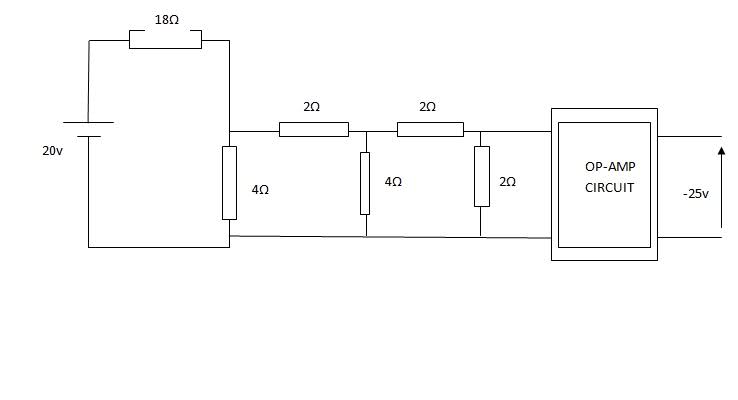
For the Circuit shown below, design the opamp circuit which will give an output of -25V
123bghk.jpg


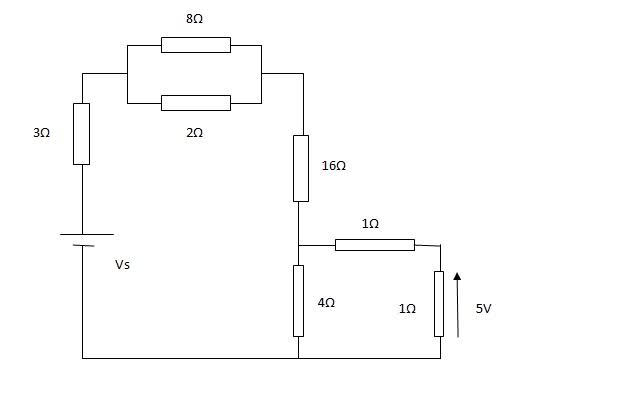
For the cicruit shown, calculate Vs

24v00ew.jpg


The Attempt at a Solution


Ok, for the first one, I summed the resistances in parallel and found that the the voltage 4 ohm resitor that's that would act as the voltage divider would have a value of 2 ohm, which means the volatge input using the voltage divider rule would be 2v, however the answers states that it is 0.5V

For the second question, , the 5V across the 1 ohm resistor, being in series with the other 1 ohm resistor, suggests that the sum of the voltages in that mini circuit is 10V. Resistors in parallel have the same voltage across, therefore, 10V across the 4ohm resistor. By the voltage divider rule, there should be 50V across the 16ohm resistor. Not sure how to go from here, I've tried playing around with figures for the other 2 in parallel and the 3ohm, and get nowhere near the answer of 164.48ohms

HELP!
 
Physics news on Phys.org
Sunday Afternoon Bump.
 
Gorz said:

The Attempt at a Solution


Ok, for the first one, I summed the resistances in parallel and found that the the voltage 4 ohm resitor that's that would act as the voltage divider would have a value of 2 ohm, which means the volatge input using the voltage divider rule would be 2v, however the answers states that it is 0.5V

Hmmm, I get 0.5V as well.

What equivalent resistance do you get when you combine all but the 18-ohm resistance? You can ignore the op-amp, since it behaves close to an open circuit as far as the resistor network is concerned.
 
Redbelly98 said:
Hmmm, I get 0.5V as well.

What equivalent resistance do you get when you combine all but the 18-ohm resistance? You can ignore the op-amp, since it behaves close to an open circuit as far as the resistor network is concerned.

I get an equivalent resistance of 2ohms. Working from the Resistor closest to the Op-amp.

2+2 = 4 Ohms in series, 1/4 +1/4 = 0.5 = 2ohms.

2+2 = 4 Ohms in series, 1/4 +1/4 = 0.5 = 2ohms.

So the total resistance in the circuit is 20ohm. 20v source, therefore the input is 2v.

Where am I going wrong.

:(
 
By the voltage divider rule, there should be 50V across the 16ohm resistor.
This is wrong. Find the current through 1 ohm and 4 ohm branch. That current flows through 16 ohm. I got that current 7.5 A. Now proceed.
So the total resistance in the circuit is 20ohm. 20v source, therefore the input is 2v
How did you get 2 V?
First of all find the current through each branch.
 
Last edited:
rl.bhat said:
By the voltage divider rule, there should be 50V across the 16ohm resistor.
This is wrong. Find the current through 1 ohm and 4 ohm branch. That current flows through 16 ohm. I got that current 7.5 A. Now proceed.

I assume you are talking about the 2nd question yes?
 
Yes.
 
(1st question here)

Gorz said:
I get an equivalent resistance of 2ohms. Working from the Resistor closest to the Op-amp.

2+2 = 4 Ohms in series, 1/4 +1/4 = 0.5 = 2ohms.

2+2 = 4 Ohms in series, 1/4 +1/4 = 0.5 = 2ohms.

So the total resistance in the circuit is 20ohm. 20v source, therefore the input is 2v.

Where am I going wrong.

:(

2 Ω (and 20 Ω if you add the 18 Ω resistor) is correct.

It's 2V across the network of 4Ω & 2Ω resistors, which means 2V across the left-most 4Ω resistor. But the voltage at the op-amp input (across the right-most 2Ω resistor) will be different.
 

Similar threads

  • · Replies 3 ·
Replies
3
Views
2K
Replies
9
Views
3K
Replies
11
Views
2K
  • · Replies 3 ·
Replies
3
Views
2K
Replies
23
Views
6K
Replies
15
Views
3K
  • · Replies 2 ·
Replies
2
Views
2K
  • · Replies 7 ·
Replies
7
Views
3K
  • · Replies 3 ·
Replies
3
Views
4K
Replies
2
Views
2K