Simple Circuit Question (KVL/KCL)

  • Thread starter Thread starter Novark
  • Start date Start date
  • Tags Tags
    Circuit
Click For Summary
SUMMARY

The discussion focuses on solving a circuit problem using Kirchhoff's Current Law (KCL) and Kirchhoff's Voltage Law (KVL). The user initially struggles to relate voltage (v) and current (i) in the circuit but ultimately derives the correct current value of i = 4 A through proper application of KCL and Ohm's Law. The user also clarifies the equivalent resistance of the circuit branches, confirming that the voltage drop across the 2-ohm resistor is equal to v. The final solution is reached by correcting arithmetic errors in the calculations.

PREREQUISITES
  • Understanding of Kirchhoff's Current Law (KCL)
  • Understanding of Kirchhoff's Voltage Law (KVL)
  • Familiarity with Ohm's Law
  • Basic circuit analysis techniques
NEXT STEPS
  • Study advanced circuit analysis techniques using Thevenin's and Norton's theorems
  • Learn about mesh and nodal analysis for circuit simplification
  • Explore practical applications of KCL and KVL in real-world circuits
  • Review common mistakes in circuit calculations to improve accuracy
USEFUL FOR

Electrical engineering students, circuit designers, and anyone looking to improve their understanding of circuit analysis using KCL and KVL.
Novark
Messages
14
Reaction score
0
[Solved]

Homework Statement


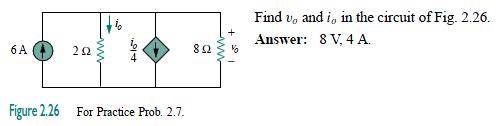
4017773043_4297587691_o.jpg


Homework Equations


KCL, KVL, Ohms Law

The Attempt at a Solution


6 = i + (i/4) + (v/8)

I just can't get another equation that relates v & i.

Any suggestions? Am I going about this the right way?
 
Last edited:
Physics news on Phys.org
The branch with the 2 ohm resistor tells you that the voltage drop across it is given by i*(2 ohms), which, from the way the circuit is laid out, must also be equal to v.
 
we know that the equivalent resistance of the io/4 branch is 4 times that in the 2 ohm resistor, because 1/4 the current flows. So it's easy to redraw the circuit using an 8 ohm resistor in place of that branch, and that makes it all nice and easy.
 
cepheid said:
The branch with the 2 ohm resistor tells you that the voltage drop across it is given by i*(2 ohms), which, from the way the circuit is laid out, must also be equal to v.

If that's the case, then won't I get:

6 = i + (i/4) + (2i/8) = (5i/2)
Which would give: i = 12/5.

Am I missing something?
 
Bad arithmetic:

i = 4i/4

i/4 = i/4

2i/8 = i/4

so the sum is:

4i/4 + i/4 + i/4 = 6i/4 = 3i/2

if 3i/2 = 6, then 3i = 12, and i = 4.
 
cepheid said:
Bad arithmetic:

i = 4i/4

i/4 = i/4

2i/8 = i/4

so the sum is:

4i/4 + i/4 + i/4 = 6i/4 = 3i/2

if 3i/2 = 6, then 3i = 12, and i = 4.

Ah, that's right. Not sure how I made such a silly mistake.
Thank you.
 

Similar threads

  • · Replies 3 ·
Replies
3
Views
2K
  • · Replies 12 ·
Replies
12
Views
2K
  • · Replies 6 ·
Replies
6
Views
3K
  • · Replies 3 ·
Replies
3
Views
5K
  • · Replies 14 ·
Replies
14
Views
574
  • · Replies 2 ·
Replies
2
Views
1K
Replies
16
Views
2K
  • · Replies 13 ·
Replies
13
Views
2K
  • · Replies 5 ·
Replies
5
Views
3K
  • · Replies 14 ·
Replies
14
Views
3K