Simple harmonic motion of a bar pivoted at one end

Join the discussion
Registration is free. Start your own thread to ask a follow-up.
6 replies · 2K views
Martin89
Messages
25
Reaction score
1
Homework Statement
See below...
Relevant Equations
Equations of torque and simple harmonic motion
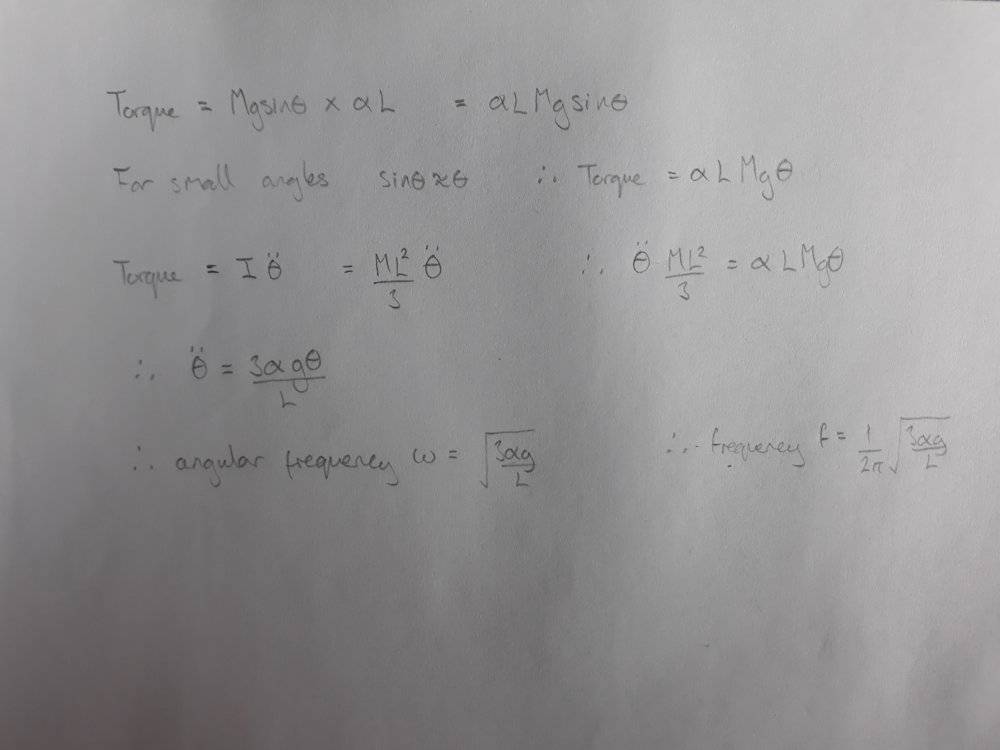
Hi, I am unsure how to proceed with this problem. I believe that I can correctly calculate the frequency of the oscillations for a bar that is not suspended from a spring but I do not know how to take the effect of the spring into account. The answer given by my professor is $$
f=\frac{1}{2\pi}\sqrt{\frac{3\alpha^2k}{M}}$$
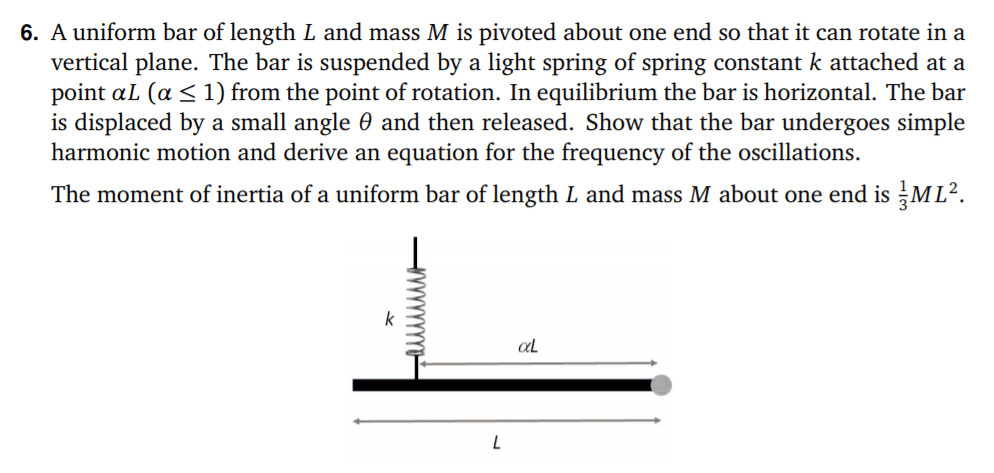
Problem.png
20190417_142546.jpg
 
Physics news on Phys.org
Hello Martin,

That's funny: your derivation has no ##k## and profs' has no ##g##

What do you mean when you say torque is ##\alpha l Mg\sin\theta## ?
 
##Mgsin\theta## is the force on the bar and the length of the bar is ##\alpha L##, although for a uniform bar the force should act through the centre of mass I believe?
 
Martin89 said:
##Mgsin\theta## is the force on the bar and the length of the bar is ##\alpha L##, although for a uniform bar the force should act through the centre of mass I believe?

The force on the bar when displaced must depend on ##k##.
 
Martin89 said:
##Mgsin\theta## is the force on the bar and the length of the bar is ##\alpha L##, although for a uniform bar the force should act through the centre of mass I believe?
Yes. So at equilibrium the spring is extended to compensate ##{1\over 2} Mg##.

But what is the restoring torque if the spring is extended a little further ? Express the extension in ##\theta## too and bingo !
 
PeroK said:
The force on the bar when displaced must depend on ##k##.

This is the part I'm having difficulty with. I know that the force on the bar must depend on ##k## but I don'nt know how to express it.

Working backwards from my professor's answer I believe that the torque on the rod is given by ##Torque=\alpha^2KL^2\sin\theta##. However, I don't understand why there is no dependence on ##Mg##?
 
Martin89 said:
This is the part I'm having difficulty with. I know that the force on the bar must depend on ##k## but I don'nt know how to express it.

Working backwards from my professor's answer I believe that the torque on the rod is given by ##Torque=\alpha^2KL^2\sin\theta##. However, I don't understand why there is no dependence on ##Mg##?

First, write down the equation for the initial equilibrium of the bar. You have a torque from ##Mg## but you must also have an upward torque from the spring. Note that the spring itself, therefore, must initially be stretched.

Now, what happens when you pull the bar down and extend the spring a little further?

Hint: you could take the equilibrium position of the spring itself, hanging under its own weight as ##0##; the equilibrium position of the spring holding the bar as ##x_0## and take the displacement in addition to this, i,e, ##x_0 + x##.

I'm using ##x## here as the downward displacement of the spring.