Zero Amplitude Damped Simple Harmonic Motion with k=0.7s^-1 and f=3Hz

Click For Summary

Homework Help Overview

The discussion revolves around a problem related to damped simple harmonic motion, specifically focusing on determining the interval during which the amplitude of the motion is considered to be zero. The parameters given are a damping constant k of 0.7 s-1 and a frequency f of 3 Hz.

Discussion Character

  • Conceptual clarification, Assumption checking

Approaches and Questions Raised

  • Participants explore the interpretation of the question, with some suggesting that the focus should be on finding the times when the displacement x(t) is zero rather than when the amplitude is zero. There is confusion regarding the terminology used in the question.

Discussion Status

The discussion is ongoing, with participants seeking clarification on the original question and exploring different interpretations. Some guidance has been offered regarding the meaning of amplitude in the context of the provided equation, indicating that it may not be zero.

Contextual Notes

There is a noted ambiguity in the use of the term "amplitude," which some participants believe could lead to misunderstandings about the question's intent. The distinction between amplitude and displacement is under consideration.

Timburton91
Messages
3
Reaction score
0
Homework Statement
Damped Simple Harmonic Motion
Relevant Equations
x(t)=e^-kt cos(2πft)
Hi guys sorry if this is the wrong thread,
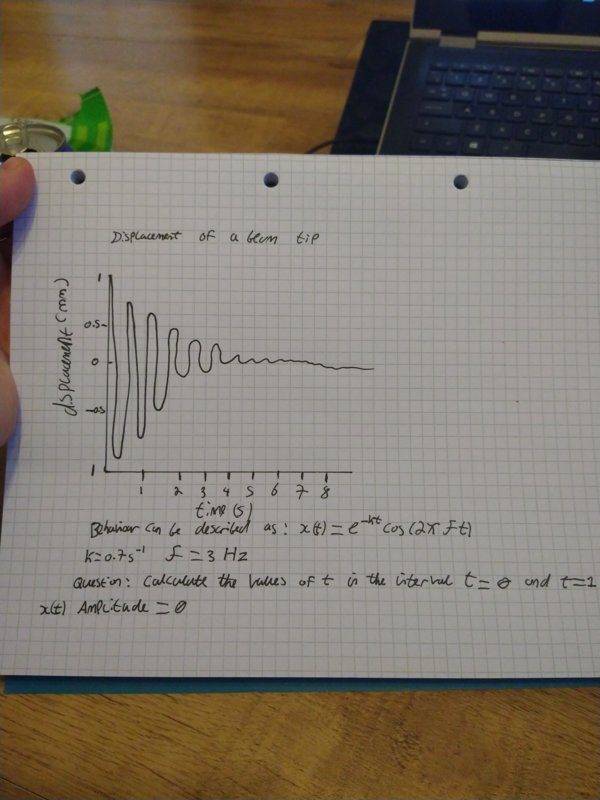
I have a damped simple harmonic motion pictured below, i have to find the inerval t=0 and t=1 for which the amplitude of x(t) is considered to be zero.

The behaviour of the graph below can be described as e^-kt cos(2πft)

k=0.7s^-1 and f= 3Hz
IMG_20200315_180120147.jpg
 
Last edited:
Physics news on Phys.org
I don't really understand the question, what makes more sense to me is to compute the values ##t_0## and ##t_1## that are the two smallest positive solutions to the equation $$x(t)=0$$ is this your question?
 
  • Like
Likes   Reactions: PeroK
Not really man, as, i guessed that would be zero.
Gaussian97 said:
I don't really understand the question, what makes more sense to me is to compute the values ##t_0## and ##t_1## that are the two smallest positive solutions to the equation $$x(t)=0$$ is this your question?
 
Timburton91 said:
Not really man, as, i guessed that would be zero.
What do you think the question is asking?
 
Timburton91 said:
Not really man, as, i guessed that would be zero.
Then, could you please explain to me what is exactly the question? I'm sorry, but I don't understand the question you post in #1.
 
The use of "amplitude " in the question may be misleading. In terms of the expression ##e^{-kt}\cos(2\pi ft)##, the amplitude is ##e^{-kt}##. This is never actually zero. I suggest the intended question is to find when the displacement x(t) is zero.
 
  • Like
Likes   Reactions: etotheipi

Similar threads

Replies
16
Views
2K
  • · Replies 13 ·
Replies
13
Views
2K
Replies
3
Views
953
  • · Replies 1 ·
Replies
1
Views
2K
  • · Replies 1 ·
Replies
1
Views
2K
  • · Replies 13 ·
Replies
13
Views
1K
Replies
7
Views
1K
Replies
9
Views
2K
  • · Replies 3 ·
Replies
3
Views
2K
  • · Replies 2 ·
Replies
2
Views
2K